The Great Himalayan National Park: The Struggle to Save the Western Himalayas:
Canadian Field-Naturalist (Malcolm Hunter)
Hindustan Times (Neha Sinha)
A book on The Great Himalayan National Park that focuses on an especially rich part of the Western Himalayas brings alive lesser known aspects of the magnificent mountains
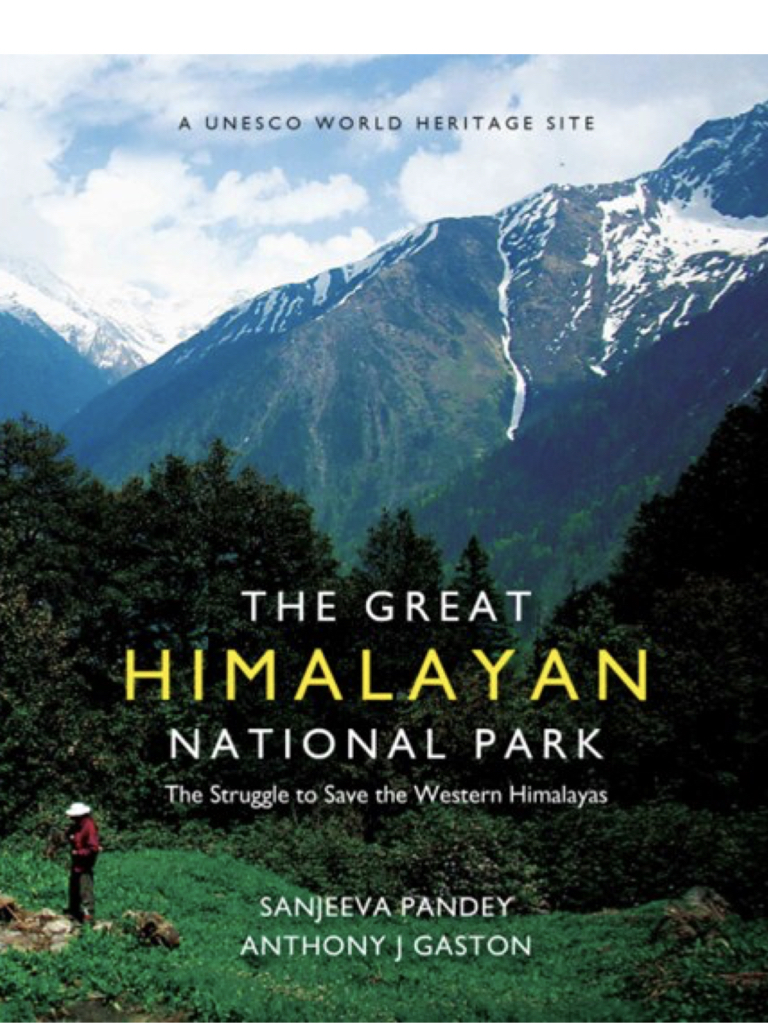
364 pp, Rs 1500; Niyogi books
“The comfortless snow-shires, the frozen rocks: this place was not hostile to my presence, far from it. Just entirely, gradelessly indifferent,” writes nature author Robert Macfarlane in his book, The Wild Places.
Many natural spaces can be intimidating, because they exist in an unapologetically wild state. But this certainly feels more true for the mountains. Mountain ranges, spread out like vast chain-links of meaning, can make you feel alive and set your skin tingling with a not-fully-understood spirituality. Or their vastness and lofty beauty can make you feel like the loneliest, most insignificant person on earth. Writing about mountains Macfarlane notes: “All travellers to wild places will have felt some version of this, a blazing perception of the world’s disinterest. In small measure, it exhilarates. But in full form it annihilates.”
Any book on mountains has to convey this duality: a sweep of beauty that can never be fully understood; a feeling of intimacy shrouded in mystery and remoteness.
The Great Himalayan National Park – The Struggle to Save the Western Himalayas focusses on an especially rich part of the Western Himalayas. Early on, the authors stress that they want to bring alive lesser known aspects of the Himalayas. “The general preoccupation with the zone of ice and snow is unfortunate because it diverts attention away from the truly extraordinary assemblages of plants and animals that live on the flanks of the mountains,” the authors write. Pandey, who was an Indian Forest Service officer, and Gaston, who did his PhD on Indian wildlife, cover ecology, culture and trekking trails of the GHNP in Himachal Pradesh. They stress on the details: the intermediate zones between altitudes that are endemic habitat; the time a particular flower will blossom; and how the bearded vulture with a one-metre wing span soars in a “slow, majestic fashion along the contours of the mountainside.” They are clearly in awe of the park. But they present why this awe — a product of the known and the unknown — should lead us to protect the diversity of the Himalayas.
Gaston and his team did wildlife surveys in GHNP, which led to the park being notified by the Government of India in the 1980s. Though decades have passed, you feel the area is still very much its own thing, threatened but willful. Four rivers, Tirthan, Sainj, JiwaNal and Parvati originate in the park, and Pandey and Gaston describe how goral (a kind of goat-antelope) clamber up the slopes and black bears come looking for fruit. They narrate how changing seasons and snow melt create a diversity of colour. Apricot (khumani in Hindi) trees have pale pink blossoms, elms put out purple leaves, and alder trees flower. As the months roll by, locals can tell the monsoon is coming because of the flowering of the whipcord cobra lily in rhododendron forests. The whipcord cobra lily looks like its name suggests: a cobra with its head up and hood spread out. Another local, unique flower with a literal name is the snowball flower — a blossom like a large, fluffy snowball.
Then there is the native Brahma kamal, a white and purple flower, which looks like it could be made of paper; a flower one wants to see, standing on a cool mountain slope. Local communities consider this to be Lord Brahma’s lotus. The authors tell us there are several Brahma kamals in Parvati Ka Bagicha (garden of goddess Parvati) at Srihand Mahadev, more than 5,000 metres above sea level.
A great deal of data is presented in this 364-page book, which makes it more a text book than a coffee table book. My favourite bits, though, were the unexpected flashes of material in between the straightforward text. For instance, we meet Shastriji, who ran a school in a cave for 13 years in Shakti village in Sainj Valley, simply because no other building was available. In pictures, we find a Gaddi shepherd carrying a new-born lamb, and other men carrying bunches of wild flowers — a kind of masculinity particular to the people of this ecosystem, that is to be cherished. A number of pictures accompany the text and data. This is a labour of love and a lifetime of work, a lifetime during which the park was also notified as a UNESCO World Heritage Site.
Information is the book’s primary aim, and it is full of government report-styled tables, flow charts and sections. I wish more insights accompanied the information. I wanted to know what the authors thought on the issues presented beyond these compilations. I would have liked more words on Shastriji, more field notes and raconteurship. The book could also have contained clearer portions on the political and climate challenges to the Himalayas now; faced as we are with climate change and a general apathy towards conservation. The writing varies between being descriptive and exceedingly formal. An effort to blend both styles would have appealed more to a lay audience.
Be that as it may, the book will be a rich source for researchers, scholars, and visitors, and should be sought out by those who enjoy history and not just the present. There is undeniably an old-fashioned, stoic quality about the book. Perhaps, it sought to mimic the mountains.
Neha Sinha is with the Bombay Natural History Society.
Birds of Nunavut:
Canadian Field-Naturalist (W.A. Montevecchi)
Canadian Wildlife, Nov-Dec 2018 (David Bird)
BIRDING Northern Flights A new two-volume atlas is a spectacular and
thorough catalogue of Canada’s northern birds
At the recent International Ornithological Congress in Vancouver, Tony Gaston, longtime seabird researcher, teared up in front of his spellbound audience while recalling the important contributions of his old friends, many since passed away. My mind wandered back to 1973 when I was a wet-behindthe-ears young ornithologist who had been fortunate enough to have been hired by the late Dalton Muir, then working for the Canadian Wildlife Service. He sent me to study the breeding ecology of a pair of white-morph gyrfalcons on a sandstone cliff not far from Eureka on the Fosheim Peninsula of Ellesmere Island. It was a dream job, and the gyrfalcon has been my favourite bird ever since. The occasion for Tony’s presentation was the introduction of a brand-new two-volume set entitled Birds of Nunavut that he co-edited with James Richards, for UBC Press. At press time I had not yet had time to read all 810 pages documenting every one of the 295 species of birds that have ever been recorded there (including even the now extinct passenger pigeon). The product of the combined efforts of 18 experts over no less than 300 seasons of fieldwork in Nunavut, the collection is breathtaking. I have seen thousands of bird books in my career, but Birds of Nunavut has to rank among the very top five in terms of presentation and content.
Because Nunavut is one of the most beautiful places on Earth, and because it is home to a wide array of exceptionally gorgeous birds, it made perfect sense to accompany articles on everything from identification to conservation with 800 stunning colour photographs taken by experts, as well as 145 range maps. The non-passerine birds — that is, waterfowl, raptors, seabirds, etc. — are covered in the first slightly thicker volume, and the songbirds are featured in the second volume, but the volumes are sold together as one book.
UBC Press and the 18 authors have thought of everything for these two volumes. The first begins with chapters on the ecology and geography of the territory, important and protected areas for birds, the history of ornithology and past, current and future monitoring of birds. There is also, of course, a huge chapter on climate change. A particularly nice touch is a page devoted to the people of Nunavut and the deceased pioneers who studied the birds there. You do not have to be an ornithologist, an Arctic biologist, a bird-lover at any level or a tourist to need to have these two volumes in your hands and on your library shelf. Anyone with a passing interest in any of the above will find them beautiful, informative and great value. And with climate change on many folks’ lips these days, the timing could not be better to catalogue and record the wide range of Nunavut’s current and historical bird populations. Copies are available in bookstores across Canada, online and directly from the publisher at ubcpress.ca. — DAVID BIRD
Nunatsiaq News: Nunavut November 08, 2018. New Birds of Nunavut book is a tell-all on the territory’s birds – two volumes contain info on 295 species, 800 photos
If you get excited when you spot a snowy owl, feel sad when the last snow buntings leave town, enjoy the taste of a fat Canada goose, or are simply an avid bird-watcher, ask Santa to put the tremendous Birds of Nunavut books on your Christmas gift list.
In its 820 pages, the two-volume set offers the first complete—and page-turning—survey of every species of birds known to occur in the territory. Birds of Nunavut documents 295 species, providing information on their identification, distribution, ecology, behaviour and conservation. That’s complemented by 800 colour photographs showing plumages, nests, eggs (such as a clutch of black eggs of a Pacific loon) and young for most breeding species.
Right now, of course, as winter sets in, you won’t see many birds in Nunavut, apart from ravens and the occasional small birds, such as redpolls, hardy stragglers that decide to tough out the winter. But, despite its short season of warmth, Nunavut overall remains “one of the world’s last great frontiers for the study of birds in pristine natural environments,” say the editors of Birds of Nunavut, bird experts James Richards and Anthony Gaston. Some 145 species, representing an Arctic population of millions of birds, come to breed in Nunavut and you can see them nesting on the land, cliffs and shorelines during the spring and early summer.
Right now, the biggest dangers to Nunavut’s birds come from outside the territory, and the books’ editors said for this reason that “the status of Nunavut birds therefore often has more to do with conditions outside than within the territory”—although pollution and tourism remain a worry.
In his foreword to Birds of Nunavut, Jason Akearok, executive director of the Nunavut Wildlife Management Board, said that in the coming years, climate change, which is expected to affect the Arctic in many ways, will also afffect birds. “We are already seeing its impact on birds, including changing prey species for southern Arctic seabirds; ‘shrubification’ of former tundra that affects nesting waterfowl and sea ducks; and increasing storm events that put migrating shorebirds at risk,” Akearok said.
Some of climate change’s impacts on birds have already made it into the news: diminishing numbers of red knots, the southern migration of snowy owls, a die-off of geese near Cambridge Bay and the late arrival of geese and other migratory birds during this cooler-than-usual past spring.
Outside of winter, without putting on binoculars, you can generally expect to see many shorebirds, ducks, geese, ptarmigans, snow buntings and the like in Nunavut. And, if you are lucky enough to visit Nunavut’s Akimiski Island in James Bay or live in the territory’s other hot-spots for birds, which include Kugluktuk, Bathurst Inlet, and communities along the coast of western Hudson Bay, Birds of Nunavut reveals that you are liable to see many more rarer visitors from the south.
These include the perky black-and-white, long-eared owl spotted by Gordy Kidlapik of Arviat in 2012, a sighting which is noted in Birds of Nunavut. In Arviat, house sparrows even maintain a small breeding population, the book notes. On that, Kidlapik told Nunatsiaq News that everyone was amazed at that this bird can go “upside down chasing flies.” Kidlapik also said he saw his first robin this year in Arviat, although these birds have been around this community for about 15 years.
Since the late 1990s, robins, which used to be unknown in Nunavut, have now become more common sights in Iqaluit, along with northern wheatears and American kestrels.
Other places in Nunavut also occasionally see surprising visitors, which are documented in Birds of Nunavut: A rufous hummingbird, which in 2009 showed up in Chesterfield Inlet and, before that, in Bathurst Inlet; an American coot that appeared last October in Igloolik; red-winged blackbirds in Pond inlet; blue and white kingfishers near Cambridge Bay; and mountain bluebirds, like the one earlier this year in Rankin Inlet.
Birds of Nunavut also provides information about birds from the pre-contact period in the Arctic, records from early European arrivals in the region, data from today’s wildlife surveys and updates on conservation measures and status. A European visitor in 1610 to Digges Island found thick-billed murres hanging in a stone structure: “I turned off the uppermost stone, and found them hollow within and full of fowles hanged by their neckes.”
Arctic birds remain a source of food for Inuit in Nunavut. But the hunting of geese, ducks and swans appears to have little impact on these bird populations, unless around communities, where, for example, ptarmigans may end up in short supply, said the Birds of Nunavut, which included input from 18 contributors.
Birds of Nunavut also comes in an e-book version, easier to tote around than the two weighty, if beautiful, volumes. But these would be good for all Nunavut schools, libraries and wildlife groups—or any bird-lovers—to own, read and re-read.
Although Birds of Nunavut is English-only, many Inuktut names are given with the species’ description. If there’s any shortcoming to be noted in Birds of Nunavut, it’s the lack of traditional Inuit knowledge about birds, but this could fill another book all on its own.
For more information on obtaining Birds of Nunavut you can go to the website of the University of British Columbia press, which published Birds of Nunavut earlier this year. All all revenue from sales will be donated to conservation projects and the education of youth throughout Nunavut.
 Being ourselves