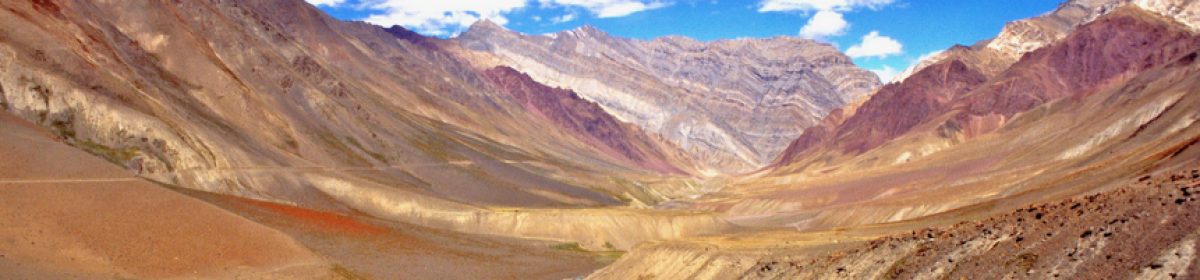
Three Canadians, an Indian and a Belgian (resident in India) took a trip to Spiti, in the Western Himalayas, in February 2026, in hopes of seeing a snow leopard in the wild and maybe getting some pictures and video. This blog was edited daily throughout the trip.
22 Jan: Anticipation
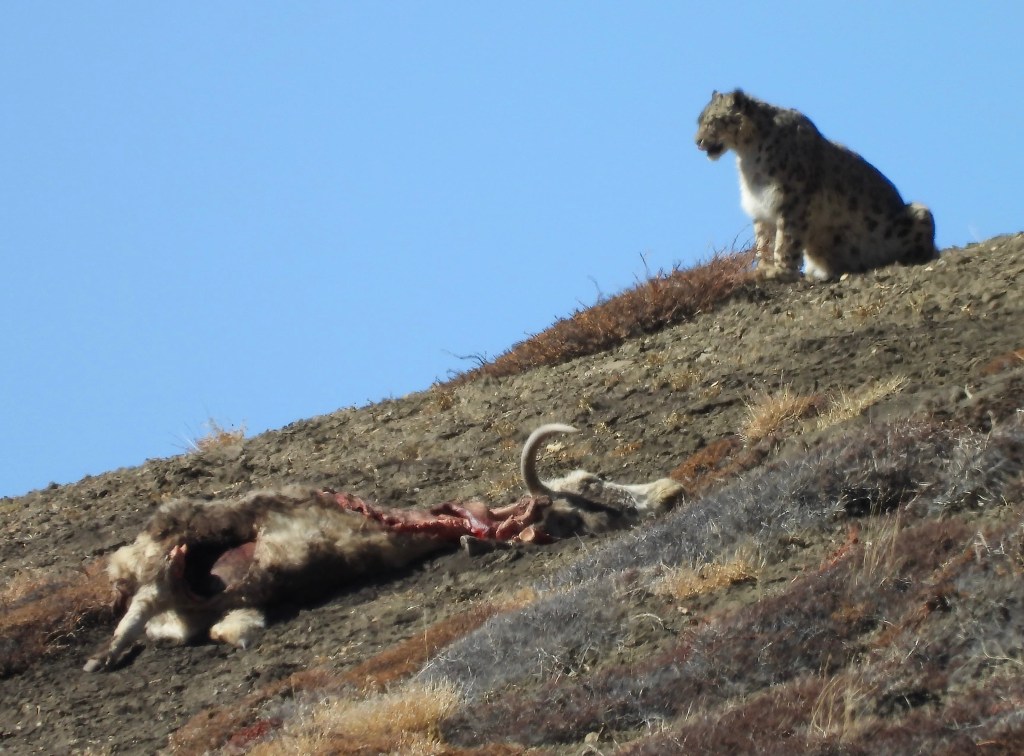
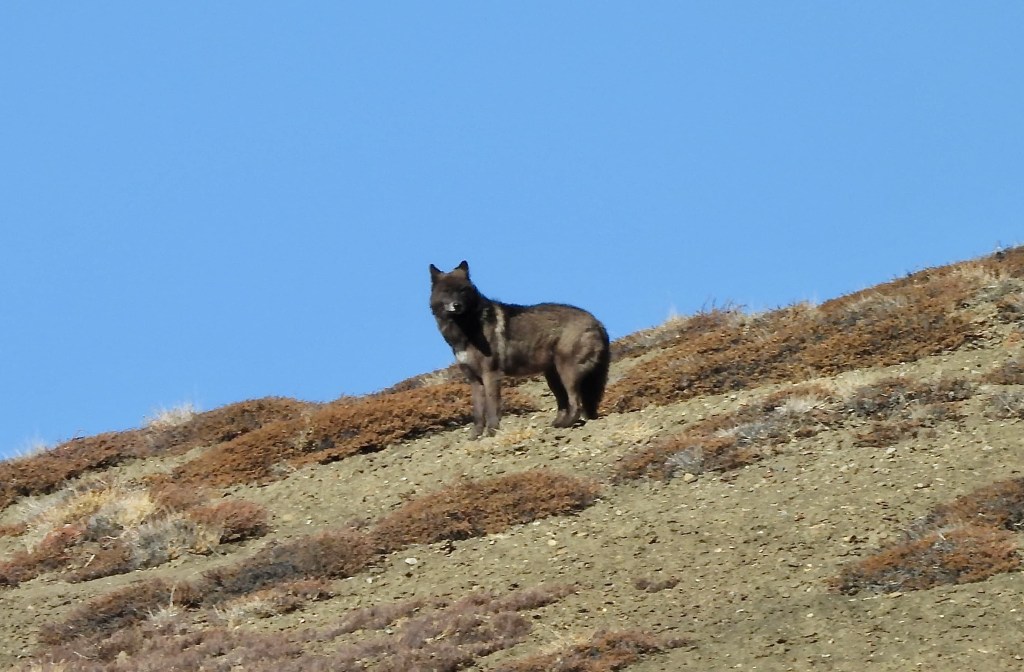
Lara, our guide, is feeding us pictures from Spiti. They are quite encouraging. Above, snow leopard beside kill; below, Tibetan Wolf, perhaps attracted by the kill. No snow yet (21 Jan) but apparently on its way today.
19 Jan: Last minute panic
Sunscreen, granola bars, toothpaste, spare glasses, TP, sunhat… There’s only going to be one bag so make sure everything goes in. Rope – might need to tie stuff on the roof of the jeep… does the altimeter work… hand warmers?
“Spectacles, testicles, wallet and watch”, as my friend Lindon used to catechize. Nowadays, “…wallet and ‘phone” probably.
30 January: Delhi
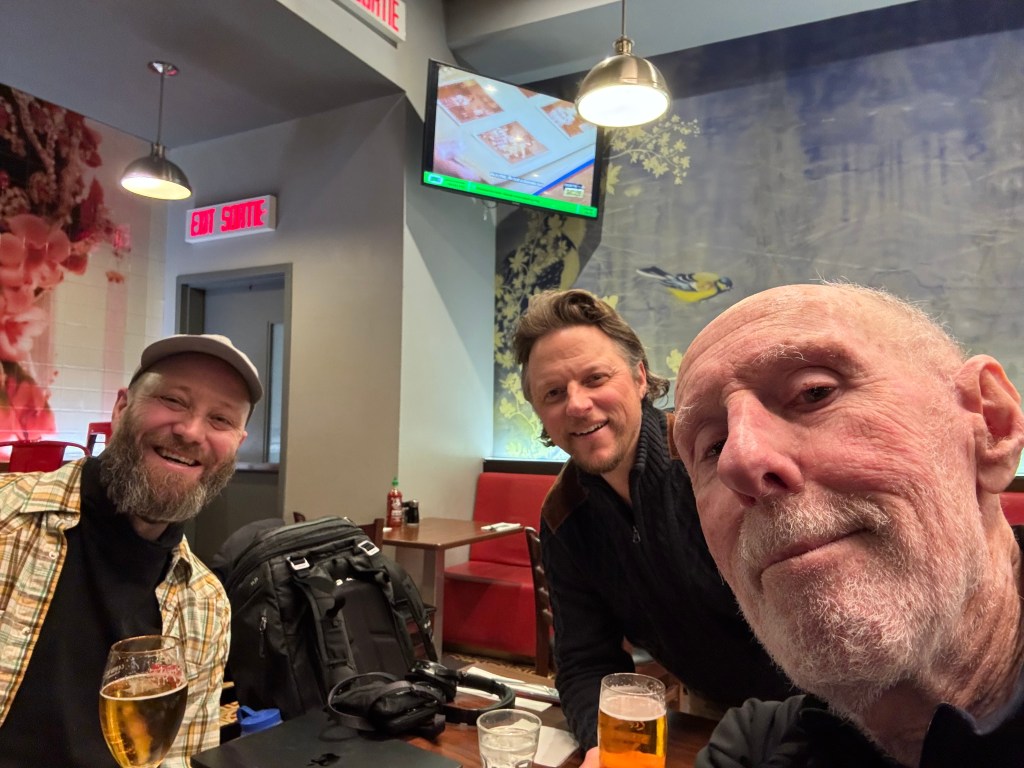
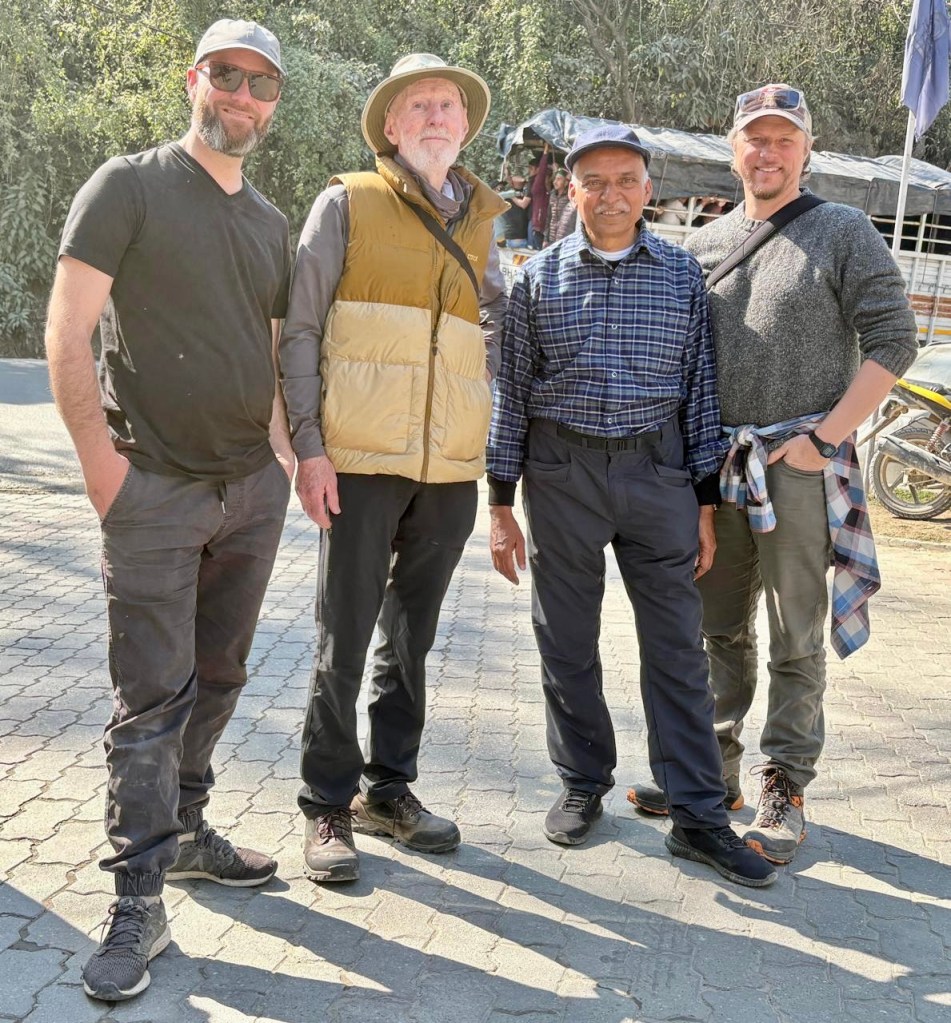
Arrived right on time at 10 pm after a tranquil direct flight from Toronto. The food, though, was abysmal and I say that as someone who has eaten some pretty bad stuff. Roger says the vegetarian offering was OK! We made it to the hotel round about 1 am, after both Roger and Kieran had some hiccups at immigration – nothing serious. Here we are just before departure: that’s Kieran the film-maker on the left and Roger, the diver, on the right.
31 January: Delhi smog
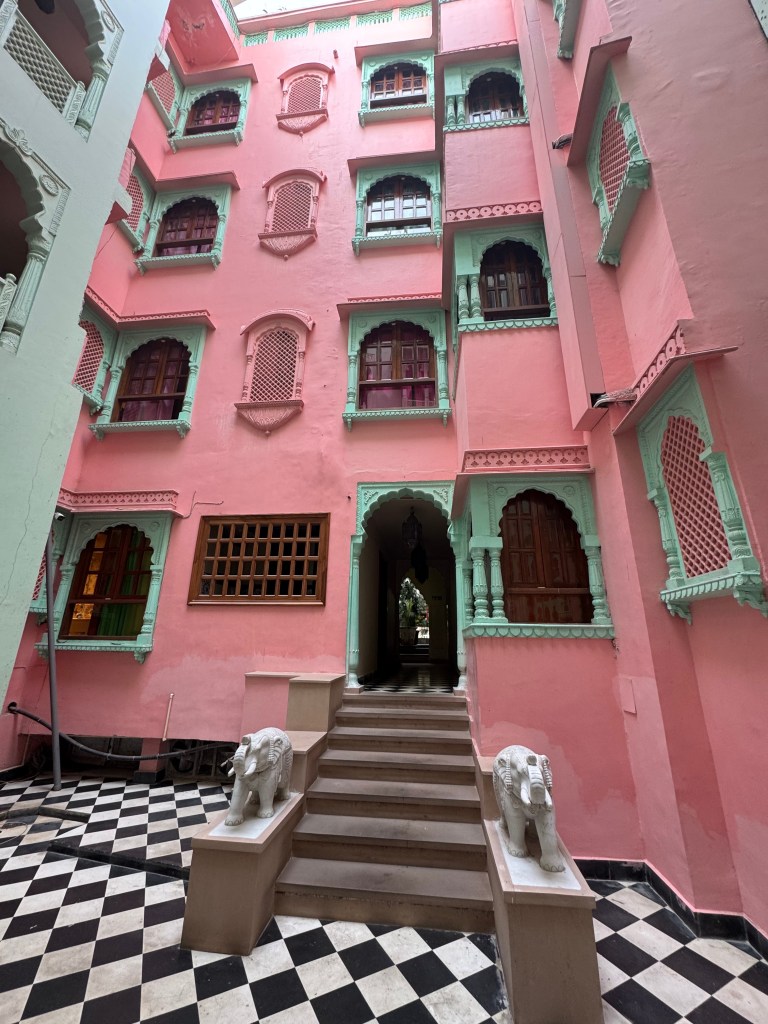
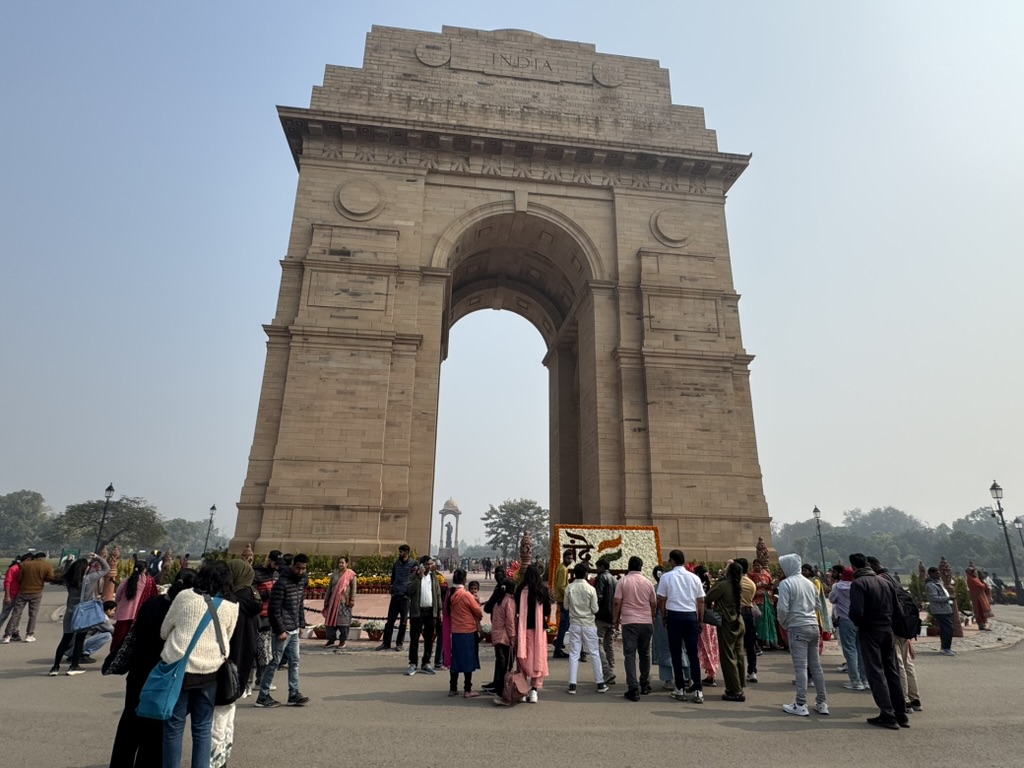
Breakfast at the hotel was better than anticipated. This is an old converted haveli (manor house) on the edge of Old Delhi and has a nice atmosphere, in contrast with the air outside which is so smoggy that visibility at ground level is about a half mile. Roger and I checked Connaught Place and India Gate while Kieran checked his gear.
February 1: Kalka to Rampur
The Kalka Mail (now the Netaji Express) left Delhi about two hours late and arrived in Kalka at 5:30 in the morning, 2 1/2 hours behind time. Sanjiva summoned our driver and we went to the hotel where we had been booked by Stephan. He appeared, somewhat sleepy and, after extended greetings, and being by then 6:00 AM, we decided against sleeping there and simply washed up and organized ourselves before driving up the road to find some breakfast and then departing for Rampur via Shimla.
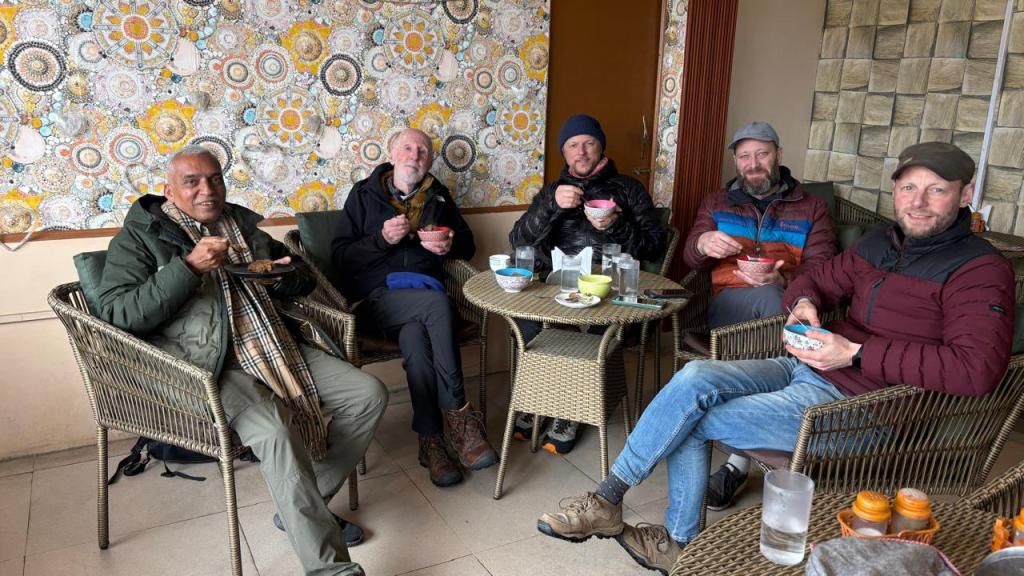
The excellent breakfast spot (parathas, puri, curds and tea) allowed everyone to get to know one another before we proceeded. Roger went with Stephan in his 4×4, while Sanjeeva, Kieran and I travelled in our spanking new Toyota SUV in which, by dint of great exertion by the driver (Pramod Thakur), we managed to get all the luggage inside, preventing the necessity of putting some on the roof. We expect rain.
The Rampur road goes via Shimla and Narkanda, whence it plunges off the pine and deodhar-clad Shimla ridge, and by means of uncountable zigzags, descends to the Sutlej River, nearly 2000 m down. The most striking aspect of the Shimla bypass was the enormous number of tourists all along the roadside, playing with the dirty snow left over from a fall a few days ago. Coming from Canada, land of vast pristine expanses of white stuff, we were somewhat surprised at their enthusiasm but the enjoyment of all the selfi-takers and snow sliders was unmistakable and not a little heartwarming, although the consequent traffic jams slowed us down quite a bit.
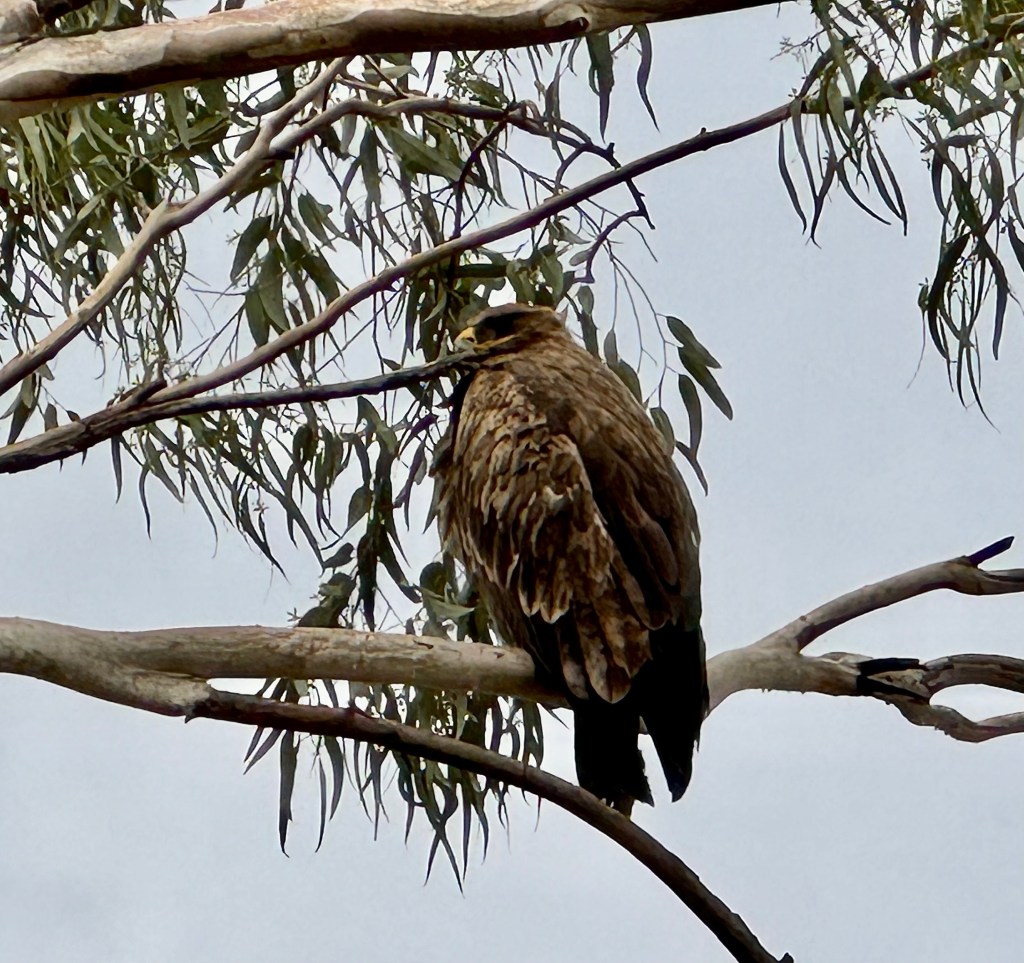
During the descent, our diver pulled up beside some large eucalypts and announced that there was an eagle perched above us. Sure enough, it turned out that 4 rather chilled-looking Steppe Eagles were perched beside the road. Pramod went up a lot in my estimation.
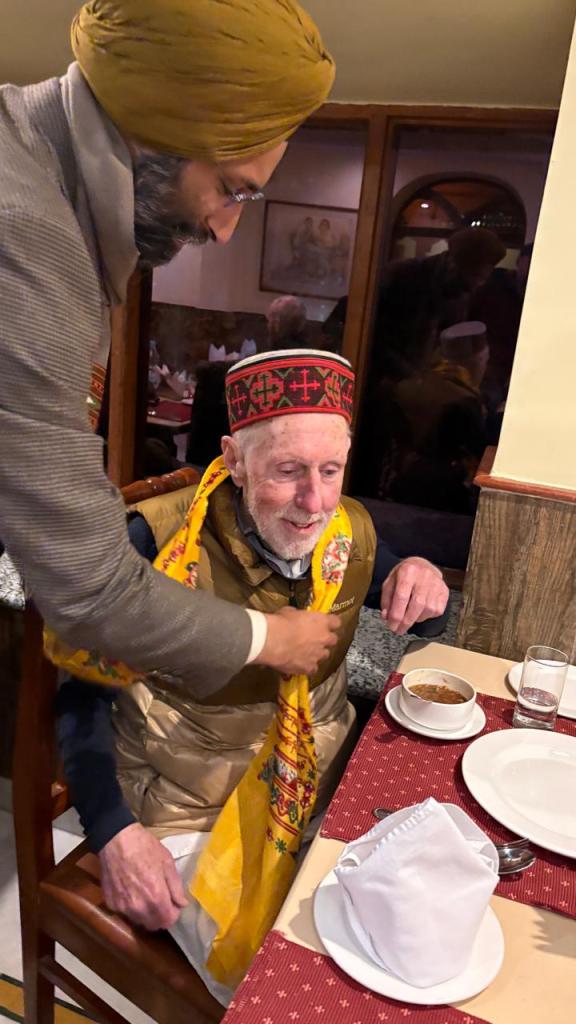
We arrived at the Nau Nabh hotel in Rampur about 6, just as it was getting dark. This is attached to the old winter palace of the Bushahr Raja and has quite a few local features, although I think the building itself is new. The wi-fi was good enough that I could video call Angela, which was a nice treat. Dinner was pretty good (B+, perhaps).. We were joined by Guru Harsh, the local DFO (Divisional Forest Officer), a young man who went to school with Sanjeeva’s sons. He was very effusive in greeting us and decked us all out with silk scarves, as is the local welcome custom, as well as presenting me (as the oldest) with a Kulu hat. After dinner everyone crashed early because, since getting off the plane on Friday night, our sleep thus far had been very irregular.
2 February: Rampur to Kalpa
Down for breakfast at 8 to find our organiser had laid on sandwiches, cutlets and french fries. We ordered puri and scrambled eggs. Sanjeeva, sadly, lost his voice overnight so the first order of business is some medications for him. This is a short day, maybe three hours, as far as Kalpa/Rekong Peo where we have to pick up a permit to go onward to Spiti which is inside the “inner line” – the Chinese border area, so a delayed start is not a problem.
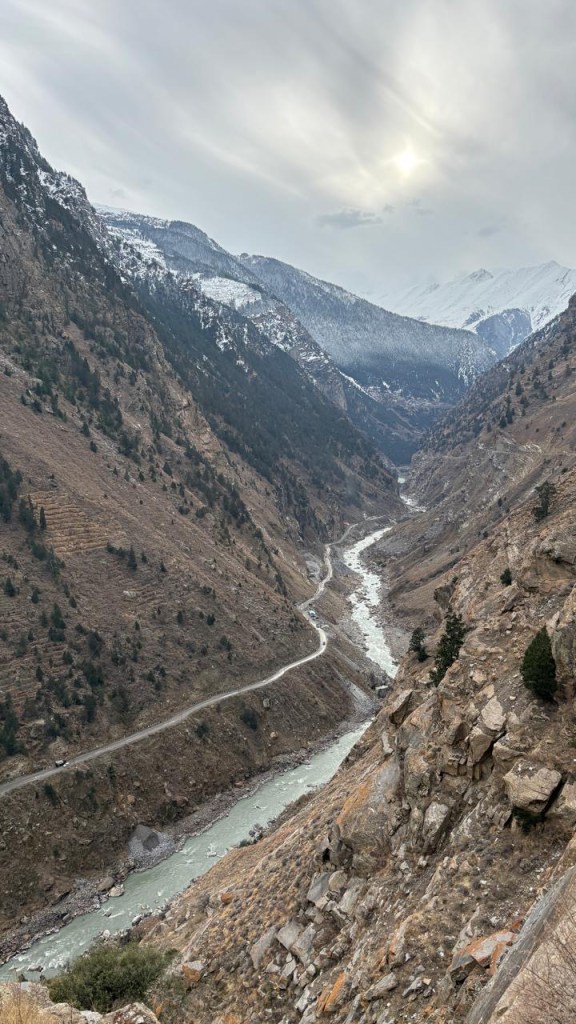
Today’s route lay entirely along the Sutlej Valley. It was only 100 km to Kalpa, so we took it easy. For the most part, the going was good and we sped along but some sections had been heavily damaged by landslides and it was slightly comical seeing tiny Tata cars, with wheels the size of small pizzas, sliding their way among the ruts. Fearless driving! Substantial portions of the road have been cut into sheer rock-faces, making a semi-tunnel. The whole valley has been converted to a giant hydro generating plant, with “run of the river” dams and powerhouses everywhere and hillsides festooned with high-tension cables. It looked chaotic, but presumably someone understands how it all works.
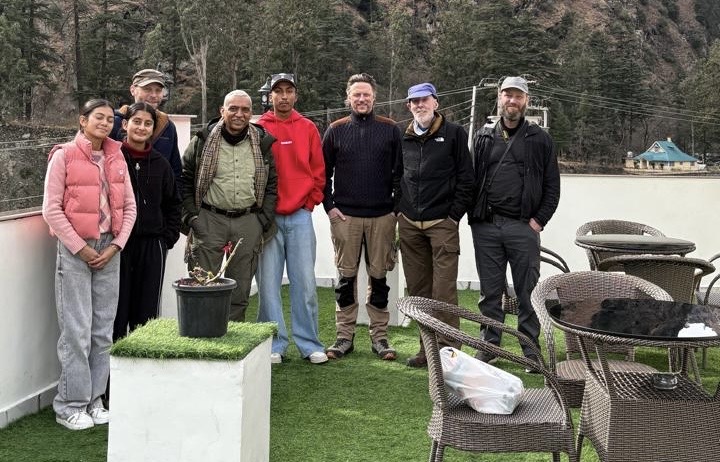
We had lunch at a rooftop restaurant in Tapri. Very nice chapattis, dahl and muttar paneer, with raita. We were accosted by a small covey of teenagers from a nearby town who requested a group photo. They get holiday for Jan and Feb, when snow makes school-going too difficult, so they were on a tour with big brother. Their English was pretty good, so school must teach something.
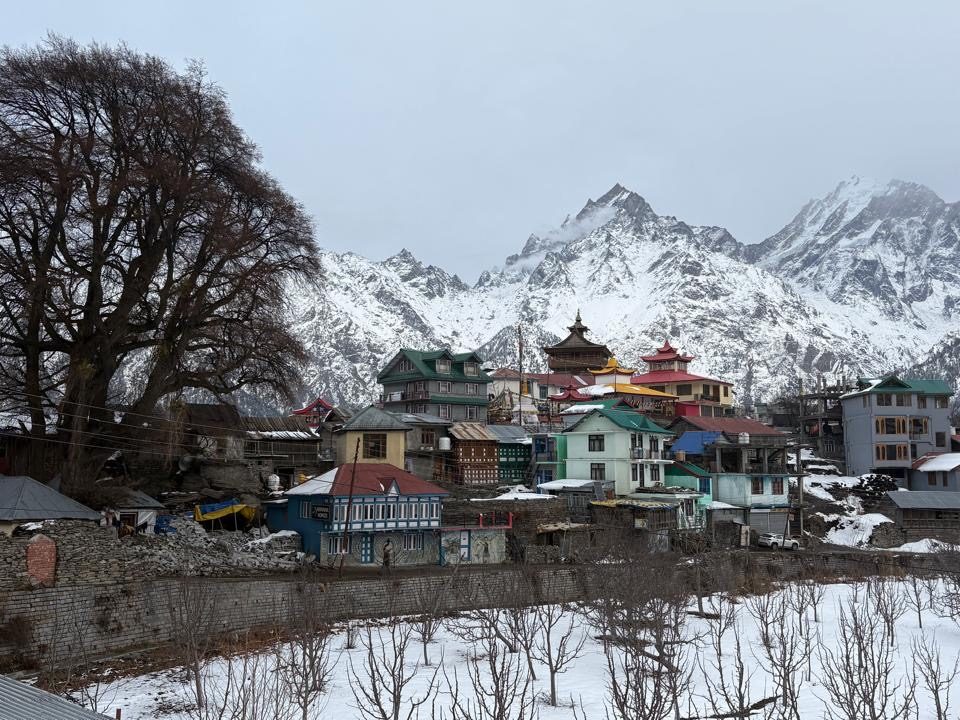
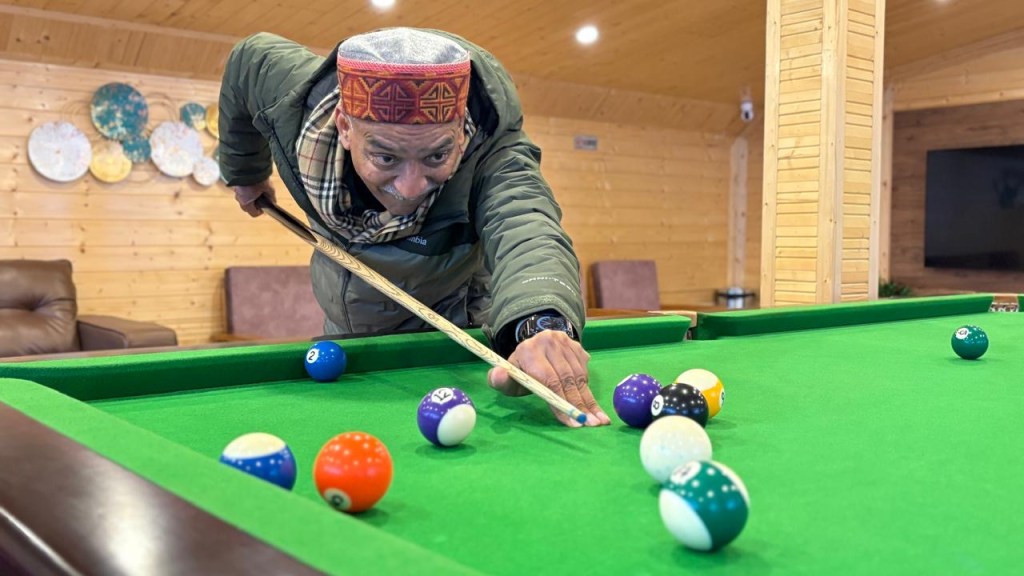
At Kalpa there was still quite a bit of snow. This town has the best mountain view of anywhere in Himachal, with a panorama of the Kinner Kailash range spread out on the far side of the valley. It also has a nice old temple complex. Our hotel has an especially good view and a nice games room with a large window. We played pool, some better then others. The meal was only a C (Sanjeeva: “greasiest food I ever ate”}, although the dining room got an A for having a heater. Indoor temperatures are around zero, so I slept in my sleeping bag.
3 February: Kalpa-Tabo
We awoke to a completely white landscape, with large, soft flakes of snow falling steadily. By the time we finished breakfast there was about 20 cm on the ground and we drove very cautiously down the hill to Rhekong Peo where we met up with Stephan, who had spent the night at the Forest Rest House. By the time we reached the main road towards Spiti, at about 10.30, the snow was gone although the road was wet. We proceeded to the inner line check point where our driver dealt with the formalities. Everything is now done via cellphone so we never received any actual paper work. The process included photographing me again because the permit-wallah said my picture in the permit application did not look like the one in my passport. We took the photo in the car, forwarded it to the office and received the permit as we travelled – a great improvement over earlier paper-based documents.
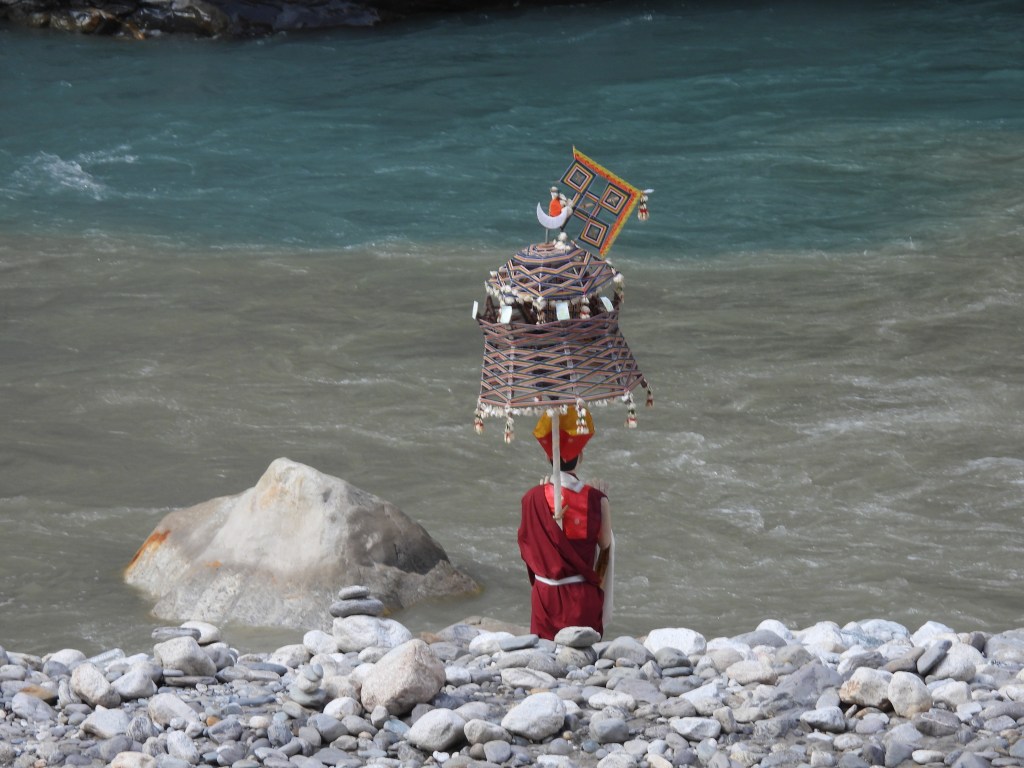
We paused at Khab, where the Spiti river enters the Sutlej, where the image of a solitary Buddhist monk stood beside the confluence holding a bamboo umbrella. I took this as an auspicious sign.
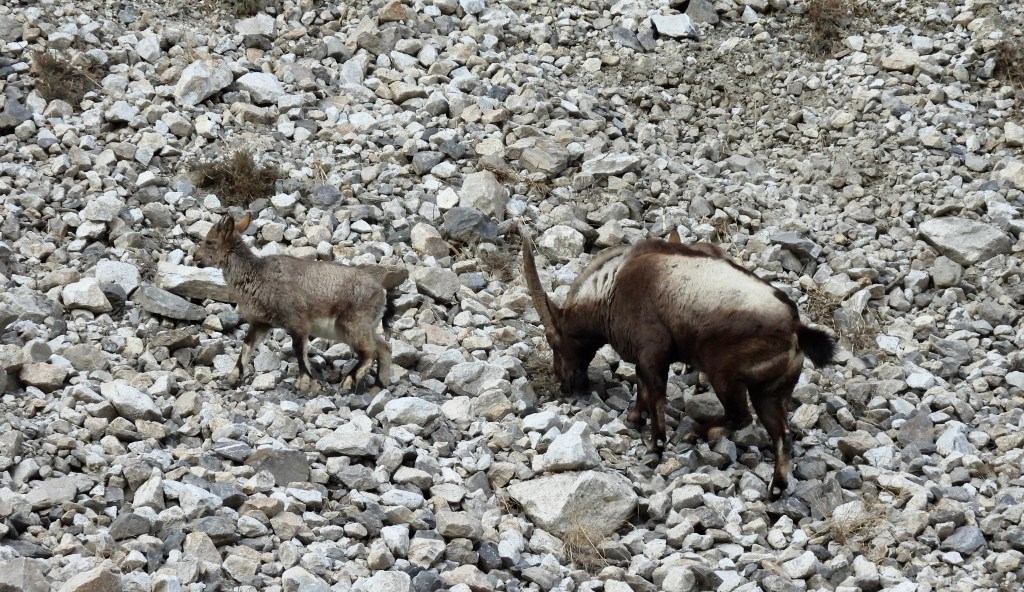
Moving on up the Spiti valley, our driver spotted a herd of Ibex on the opposite bank of the river and they were subject to intense scrutiny via a mass of expensive optics. Only one fine, mature male and ten females and kids. The hillside where they fed looked very barren, but they grazed contentedly, obviously accustomed to thin fare.
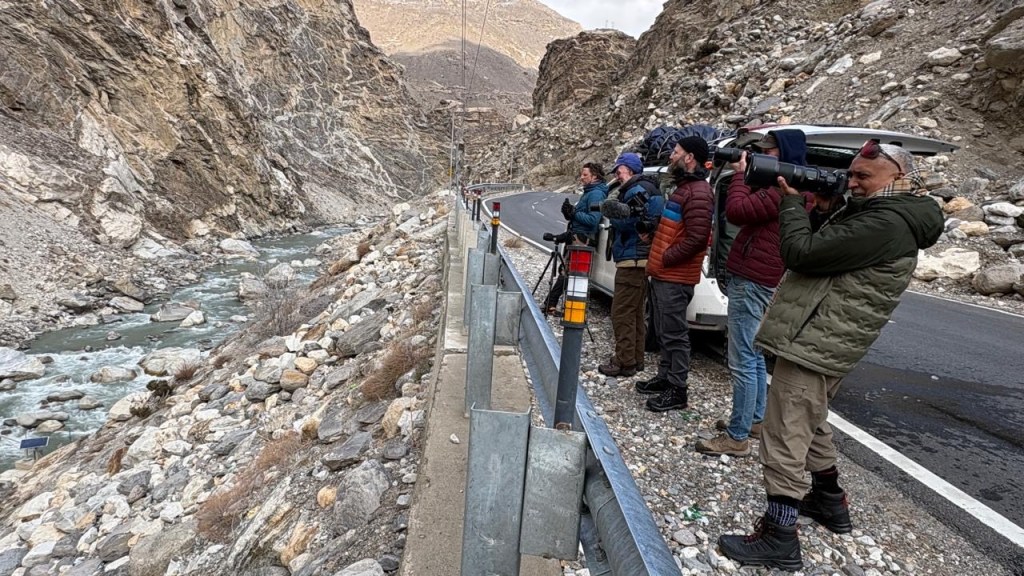
Soon after the ibex we took lunch at a roadside hostelry and only a few minutes beyond that we encountered a large rock slide across the road, with a backhoe working to clear it. I took one look and said, “That’s it. No Kaza today”, but the driver said it would take 15 minutes. In the event, we had to wait about an hour while the excavator tipped huge boulders off the edge of the road which bounced and spun at a great rate as they pounded down the almost vertical slope.
Given the delay, we decided to stop at Tabo, 2 hours short of our destination, where Lara, our outfitter, arranged for a very pleasant home-stay at Bridge View, which provided excellent breakfast (included pancakes w honey) and evening meal.
4 February – Tabo to Kibber and return to Kaza: first Snow Leopard sighting
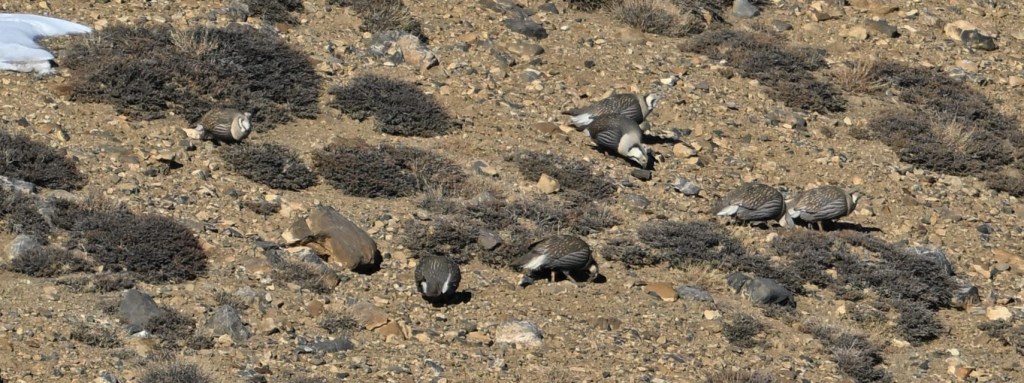
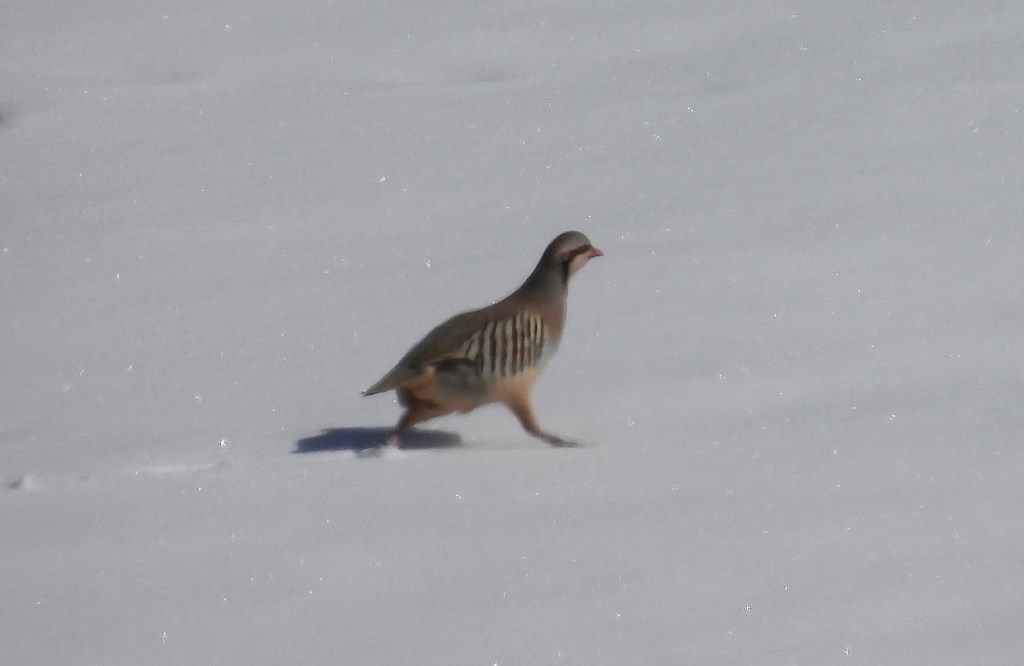
Stephan suffered an asthma attack in the morning and called in sick, but he revived in time to accompany us to Kaza and on to Kibber. From Tabo we are in the main Spiti Valley which opens out in places, the river running between broad gravel flats. Most of the scene is snow-clad but on some south faces the snow has cleared, revealing the rocky crags that embrace the valley. We see a few birds along the way, mostly choughs, redstarts and chukor partridges, the first in big, wheeling flocks, the last in coveys of 5-15. There are apple orchards and plantations of poplars and other broad-leaved trees along the road and thickets of Buckthorn.
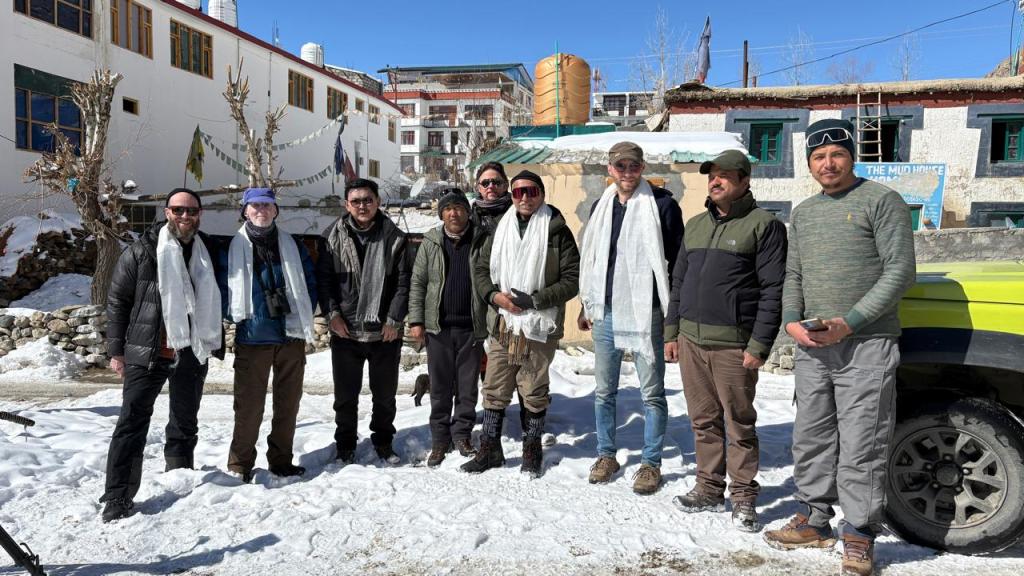
At Kaza, we are greeted with white silk scarves at the hotel and take lunch at a rather trendy restaurant in the main town. All meals are accompanied here by lemon-ginger tea. The soundtrack was Pink Floyd, Beatles and Bob Dylan. They must have known we were coming. As soon as we finished lunch (I had panir pizza – it was good!), we jumped in the car and sped up the road to Kee Monastery and on up a zigzag track made bumpy and slippery by frozen snow, towards Kibber and the “elusive” snow leopard.
It was at that point our driver revealed, what became rather obvious, that our vehicle was not, as I had supposed, 4-wheel drive, but rear-wheel only. He assured us that, in his hands, we were perfectly safe, and I admit that there were no really heart-stopping moments. However, the track ran, in places, along the brink of a precipice. I would have been a lot happier if all four wheels had been working at getting us up instead of the fronts slaloming uselessly on ice patches.
The viewing points were easily spotted by the rows of vehicles parked wherever the snow allowed and the amazing displays of high-powered optics deployed. We proceeded as far as the bridge that connects to the furthest village, Chicham, where many eager observers were lined along the railings peering down into the deep chasm below. We were met by guides from our outfitter, Spiti Valley Tours, who quickly pointed out the cause of the excitement: a snow leopard munching very energetically on the carcass of a bharal (blue sheep about 100 m below us in the gorge. The kill was made several days ago but the leopard, by dint of a lot of hauling and tearing, was still finding plenty of meat. Sadly, the leopard had chosen to drag its prey under a small bush, so although the long and gorgeously spotted tail was very visible, we could only see other parts of the animal briefly, as it wrestled the carcass, which appeared to be an animal substantially larger than itself.
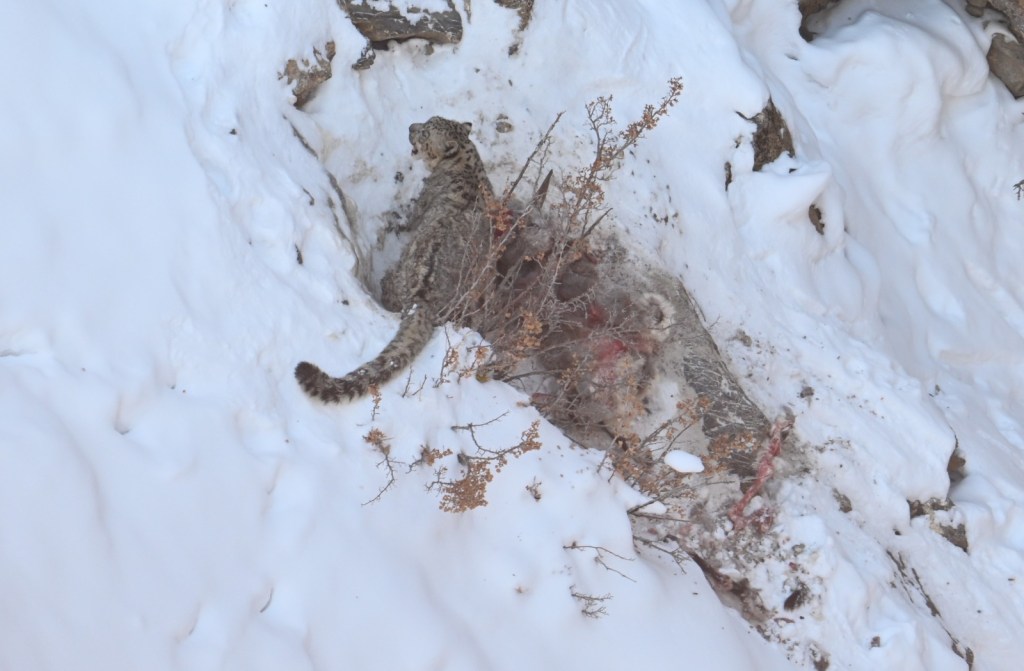
Trying to film, or even watch, from the bridge was slightly impaired by the passage of cars and trucks which caused the metal girders to bounce and vibrate. After a while, Kieran found a spot underneath the bridge that we could crawl down to and which afforded a firm base for his mega-tripod. It also got us away from the crowd, although subject to the rumbling of vehicles passing above us. Sadly, I took a whack from the bridge girders which left me somewhat out of sorts for the next section, after we moved back down the road to a spot looking across the valley to flocks of ibex (12 and 8, plus a few solitaries) and blue sheep (6). A very distant snow leopard in deep snow, was making it’s way towards the nearest ibex, but it was still far from its putative target when light faded and we decided to descend before wet patches on the road refroze.
Evening was enlivened, for the rest of the party, by Sanjeeva’s rum and Kieran’s purchase of several cans of 8% beer. We were joined in the lounge by a party of six middle-aged French photographers. Although most of the tourists here are Indian, we are by no means the only foreigners. My idea that Spiti would be less-travelled than Ladakh by wildlife tourists turns out to have been mistaken. I had ignored the fact that Spiti is a much easier drive than Ladakh from the big population centres of North India. But as Kieran remarked, social media has killed the idea of the unknown paradise. Everyone knows everything instantly nowadays.
5 February – Kaza to Kibber
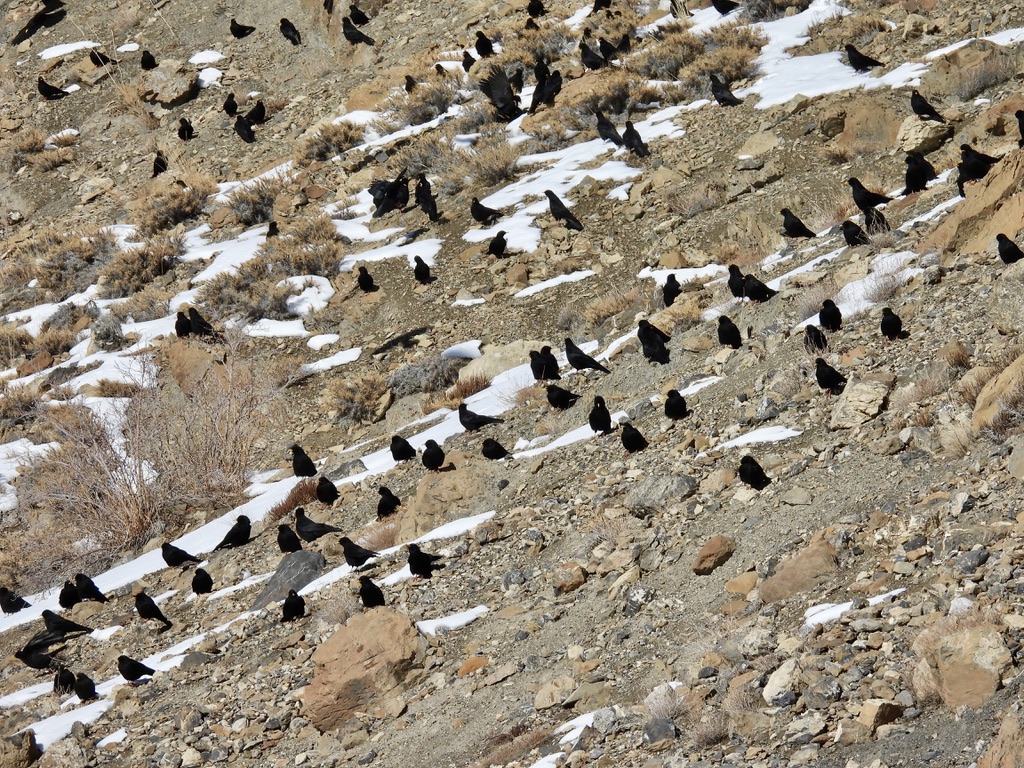
Accounts of the overnight temperature ranged from -27 to -37 C. After a nice breakfast, we proceed towards Kibber, pausing on the way near Kee to view an immense gathering of Yellow-billed Choughs.
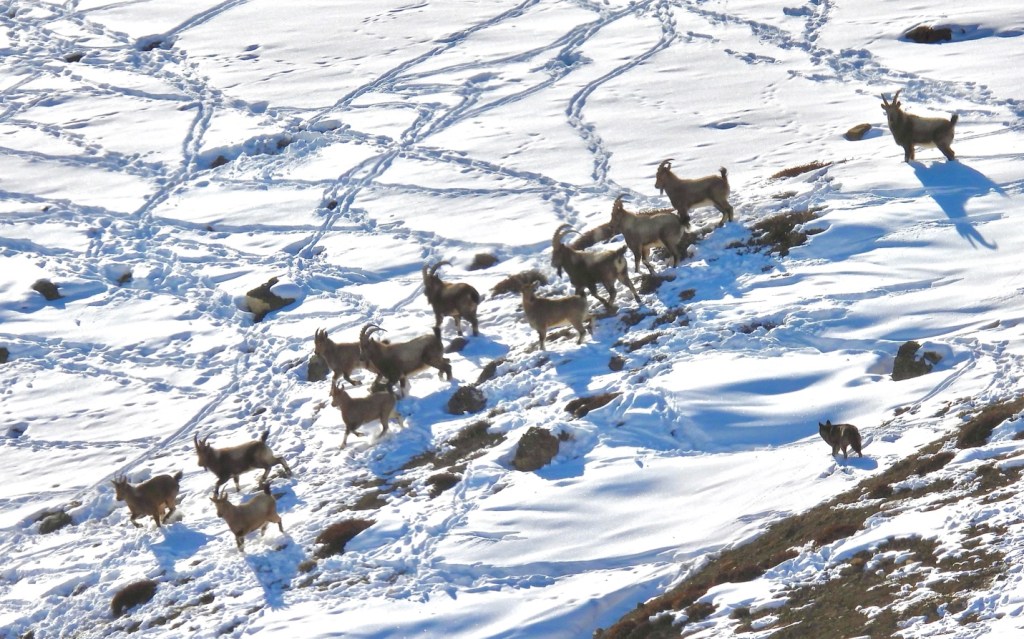
The original plan was to have a rest once we got to Kibber and to begin serious snow leopard viewing tomorrow, but when we arrived, we were told that a wolf was hunting ibex nearby, so we took off after a quick lunch to try to see the action. The temperature was some -10 deg, but there was no wind and in the sun it felt quite pleasant. As expected, there was a large crowd of photographers, but the filming site was 200 m from the road, so we were not bugged by the traffic. As we arrived, a solitary wolf could be seen trekking across a snow field about half a kilometre from two herds of ibex comprising about 30 animals. Although the wolf seemed to no more than trudge, we found that by the time tripods, cameras and spotting scopes had been set up the wolf had almost reached the ibex. There followed an amazing 25 minutes of intense interaction between wolf and ibex, with the wolf managing to get among the herd on several occasions, but never getting close enough to any one individual to make the killer leap that might bring it down.
The wolf, which we estimated at about 35 Kg, was dwarfed by the large male ibex, which apparently weigh up to 130 Kg and are equipped with fearsome-looking horns. Some of the males stood their ground while the smaller females and young sprinted about according to the movements of their putative killer. With about 30 cm of snow on the open hillside, the sprightly ibex seemed to have an advantage over the wolf. When the chase reached bare rock outcrops the pace seemed more even. However, in the end, the wolf broke off, looking rather fatigued, and the ibex went back to pawing at the snow to find buried vegetation. The whole encounter was very gripping.
After the wolf show, we proceeded down the valley to a spot where a snow leopard was visible, resting on a gravel ridge. Being more than a half kilometre from us, and pretty much inactive apart from occasionally poking its head up and looking around, this event was much less entertaining than the wolf viewing. It was, however, enlivened by the arrival of several mini-buses of Indian tourists who were without any kind of optical equipment. When I offered to allow one grinning Odishan a look through my spotting scope he went wild with excitement, “Yes! I saw a snow leopard!” This would obviously be a great story from the trip.
As a result of his enthusiasm, a dense crowd of Mumbayites and others formed to take turns at the scope and Roger, drawing on his museum experience, acted as master of ceremonies, pointing out where to look within the field (even at 25X the leopard was hard to make out) and resetting the telescope whenever an overenthusiastic looker nudged it out of its setting. It was heartwarming to see how much enthusiasm could be generated by the sight of a cat’s backside half a kilometre away!
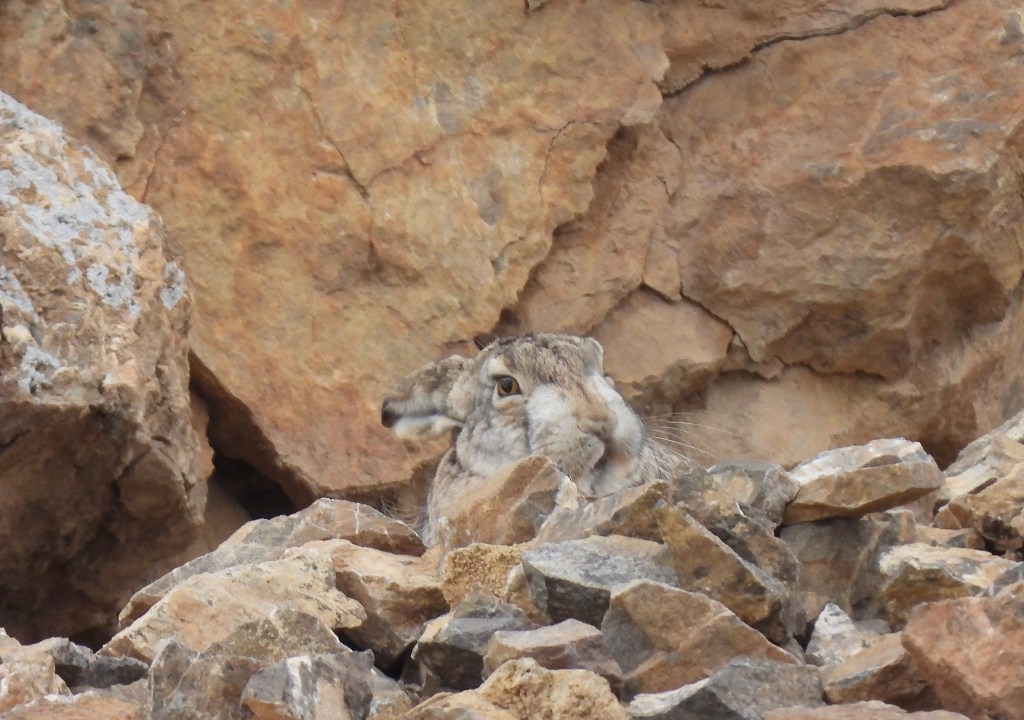
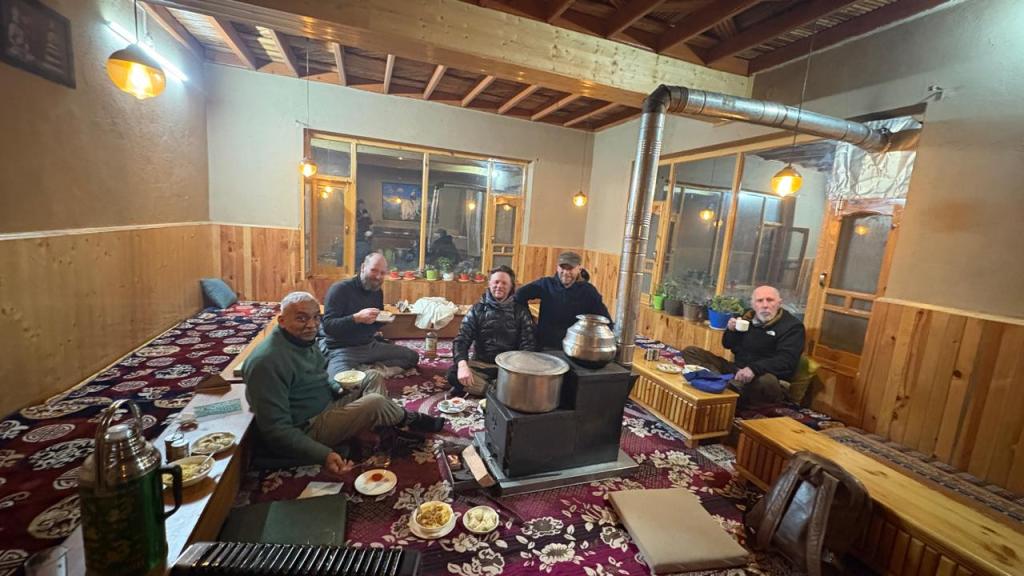
We returned to our homestay in Kibber soon after the sun went down behind the mountains, at which point the thermometer went into free fall. We paused only to spot a woolly hare squatting behind some rocks. The homestay was somewhat better equipped for the cold than our earlier lodgings, with small wood-stoves in each room, as well as a pleasant living/dining room equipped with carpeted raised sitting areas and small wooden tables. Sadly, the day’s exertions had completely worn me out and I lay down and slept for two hours in the saloon, feeling rather shivery.
6 February – Kibber: Tony takes time out
Almost certainly as a result of being at 4200 m, I slept rather badly, waking up at 2.30 to find that my autonomic breathing system had packed up and I spent the following 3 hours consciously having to keep myself breathing. As a result of this experience I decided to rest for the morning while the balance of the company walked a mile or so to see a ledge where two snow leopard cubs were sheltering while their mum was off hunting. Apparently the action was not very exciting, but the cubs were extremely cute. After lunch, I decided to look for birds around the village, where I had seen Mountain Finches and Accentors the previous day, but the terrain proved totally birdless in the afternoon, so I walked out of town as far as the bridge to Chichem, eventually finding a herd of 44 ibex. Faced with a long, uphill walk back, I summoned the car for the return journey.
In the evening, we were visited by Mr Lara, our outfitter, to discuss changes of plan and to pay him in full, because he is a cash-only operator. Roger did a fine job of clarifying what was owed, translating back and forth from US dollars, as necessary. We managed to reach a satisfactory agreement about additional charges to cover our changes of itinerary and, hopefully everyone left happy. Nice meal of veg soup, chicken curry, sabji and chapatti.
7 February – Kibber to Kaza via the highest Post office in the. world
Stephan left us this morning to investigate tour options in the Pin Valley, a left bank tributary of the Spiti River that joins down near Tabo. We changed our plans yesterday because I was suffering from difficulty in breathing, so we decided to quit Kibber today and work our way down to Kaza while trying to pick up wildlife on the way. In the event we ended up going even higher than Kibber, because we visited Komic, the highest village in India (occupied year-round) at 4500 m. We also passed the highest post office in India where we paused to buy cards and stamps. It will be interesting to see if they get to be delivered. Sixty cents seemed rather cheap for a card from India to Canada.
Today’s project was to find snowcock: a big, chicken-like bird that lives higher than any other bird in the Himalayas, inhabiting exclusively the zone of rock and scree above the level of the subalpine scrub. Because of its predilection for utter sterility, it is not a bird often encountered. We looked in several places where our guides said they were sometimes seen, but had no luck, although we saw several excellent herds of blue sheep and (very much appreciated) we found ourselves away from the snow leopard crowds, the only other outsiders we encountered being a brace of Austrian males and an American woman who were also searching for snowcocks.
Our watchers found a small party of snowcock near Komic, but only Roger managed to spot them before they scooted round a rocky bluff. In the end, it was sunset, about 5 pm, by the time we found our birds but, although they were rather distant, Sanjeeva managed to get some excellent shots of part of the flock, which numbered about 20. They were completely oblivious to us as they meandered across a barren hillside, about 400 m away on the other side of a valley: a very fine sight and all the more so because there were no crowds.
We descended to Kaza, arriving about 6 and staying at the same hotel as before. Today did not seem quite as cold as the last two days but maybe we are getting accustomed to it. Sadly, I have developed a very rough throat and have to cough a lot, although I managed to sleep well, perhaps because of the lower altitude.
8 February: Kaza to Tabo via Pin Valley
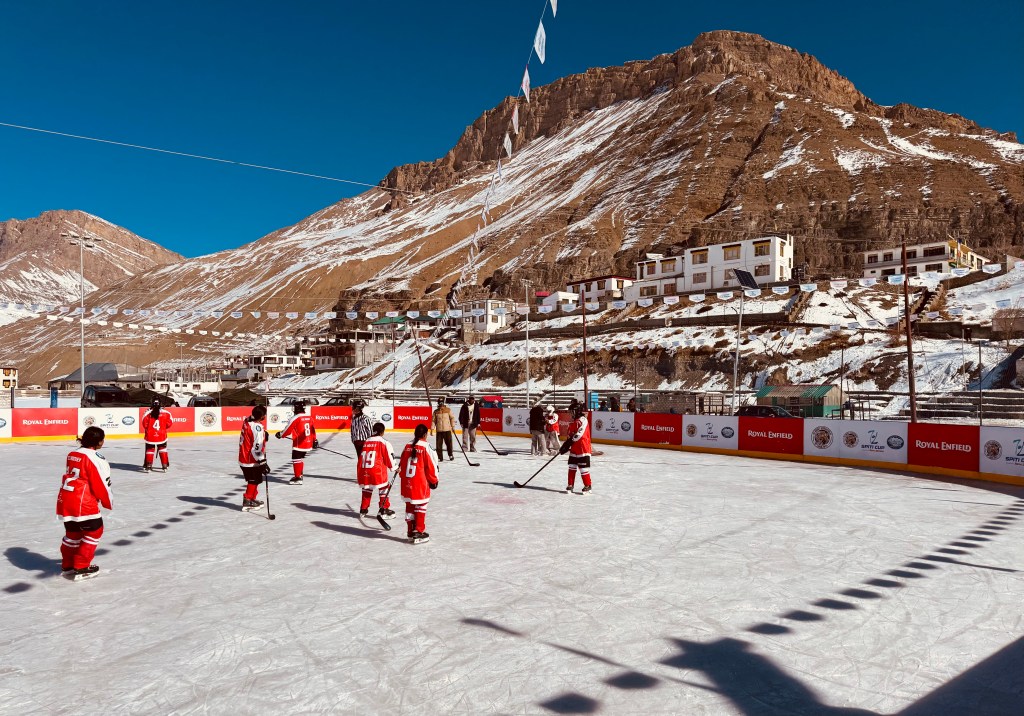
Before we leave Kaza we go to the local outdoor rink, where an ice hockey tournament has been organised, sponsored by Royal Enfield Motorbikes. When we arrive, about 9, a match is just starting between two girls teams, a local Kaza team and one from Pin Valley. Everyone was very smartly equipped with nice helmets and sticks. Unfortunately, judging purely on stature, the Kaza team looked to be about two years older than their opponent, on average. This reflected somewhat in the run of play, although the Pin side had one outstanding skater. The Pin goalie was possibly the smallest player on either side which meant she did not block much of the goal. On the other hand, the regulation-sized pads covered up almost her entire body, so she was well protected. The match was nicely officiated and, had it not been for the vast snowy mountains looming as backdrop, you might have thought yourself in Canada, at a village rink. We moved on after the first period with Kaza leading 2-0.
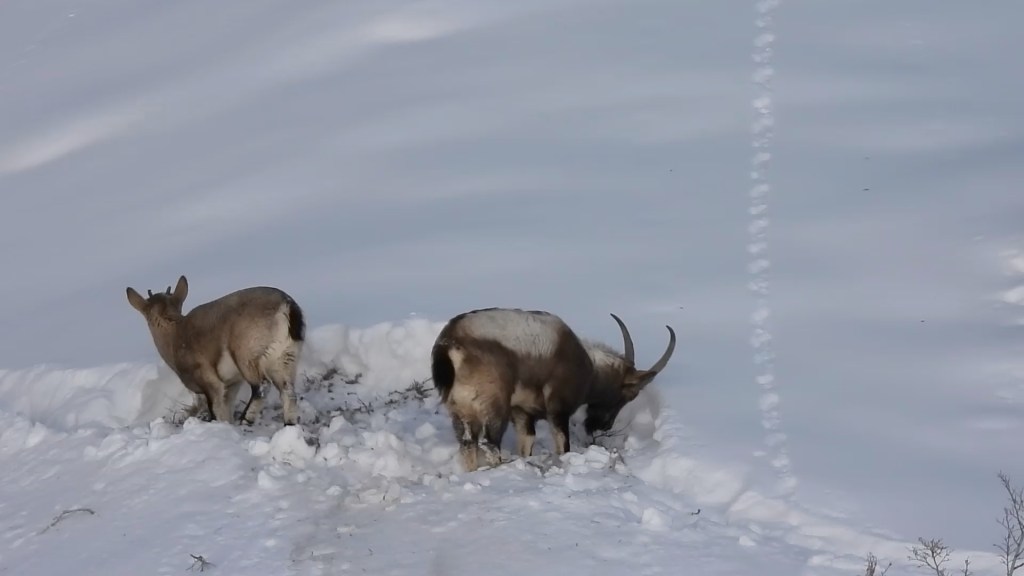
We drive south down to the bridge over the Spiti and then meet a couple forest guards who were supposed to locate wildlife for us. They have nothing to report, but soon afterwards, just as we enter the gorge of the Pin River, we spot ten Ibex on the far bank digging vigorously in the snow for edible vegetation. After watching for a half hour or so we proceed onwards towards the monastery at Kungri, meeting Stephan on his way down. The road is single-track all the way and very little tarmac is showing, but the plough that cleared it has left a fairly substantial wall of snow on the downhill side, so we feel somewhat protected from falling off the edge.
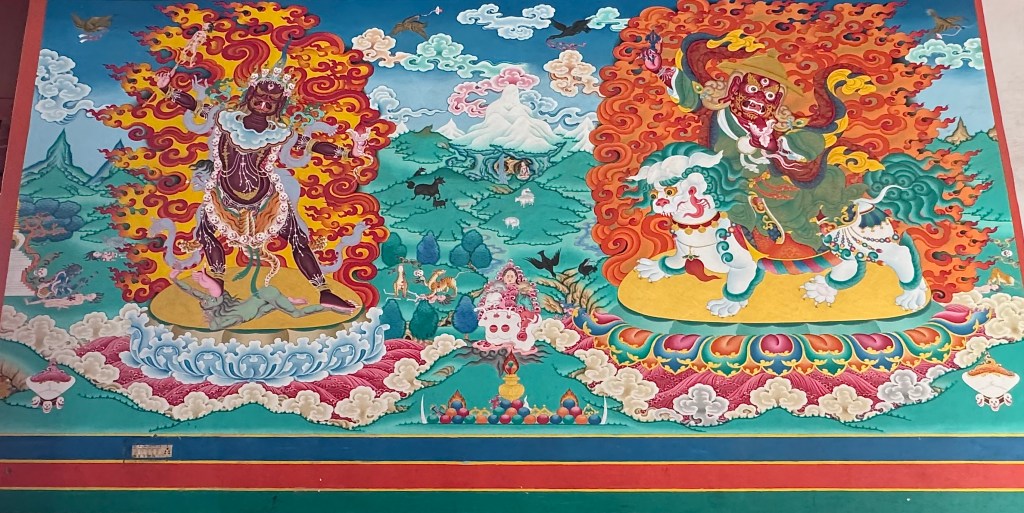
We drive on for several miles to the Kungri Monastery, where the few monks who have stayed on over the winter are intoning their rituals in the old monastery. We sit and listen for ten minutes before one of the monks walks out with a bowl of grains, apparently bound for feeding the choughs. We follow him outside but it turns out this is a mistake and the birds do not feed until late afternoon. Instead, we visit the new monastery building that I saw being decorated in 2019. Sadly, some of the fine paintings on the exterior walls have been damaged, presumably by weather. The giant images of Amitabha, Guru Rimpoche and White Tara have been mostly disassembled during the process of shifting backwards to enlarge the prayer hall. The only well-preserved art works were the painting on the inside walls, some of which looked very fine. The monastery follows the Nyingma sect.
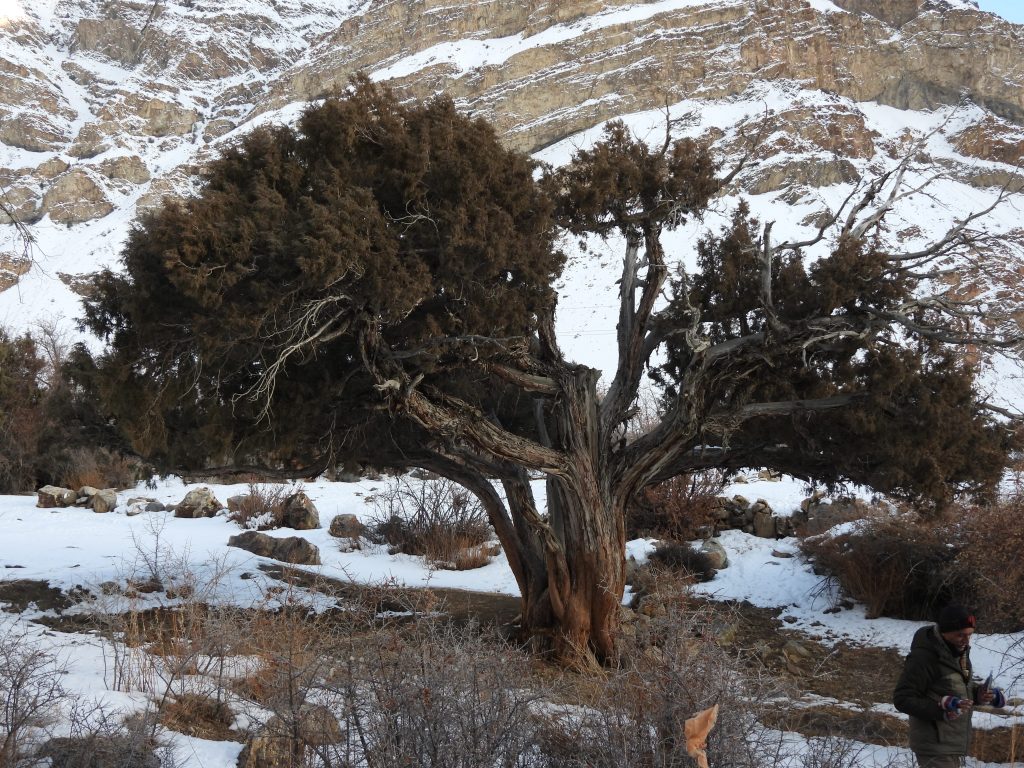
After viewing the monastery, we descended a little way to a Forest Rest House, where we ate our packed lunch on the verandah, in the sun. By the time we left it was nearly 3 pm, so we headed to Tabo. En route, we stopped at Poh to look at a group of a dozen half-dead Junipers growing on a level, boulder-strewn area close to the road. They must be several hundred years old, at minimum. It would be interesting to know their history.
At Tabo we arrived about 5 pm and are booked at the same rooms where we had stayed on 3rd February. Kieran and Roger bought some beer on the way to fortify their spirits. Tabo, 300 m lower than Kaza, feels distinctly less chilly.
9 February: Tabo – Sangla – Farewell to Stephan
After breakfast we visit the old Tabo Monastery, said to be 1000 years old and built out of timber and mud. The walls are lined with demonic sculptures, presumably wooden, very colourfully painted. Unfortunately, they keep the light very dim and do not allow flashlights, so it is rather hard to make them out. The area around the old building has been updated with new stupas (or newly painted) and a newish prayer hall. The general surroundings, though, are somewhat underwhelming for such a significant monastery.
After Tabo, we are heading for Sangla, in the Baspa Valley, which means retracing our route of 2 February as far as the Baspa-Sutlej confluence and then taking the giddyingly narrow and precipice-bordered road up the Baspa Valley, which is in dreadful shape because of the constant movement of heavy trucks associated with the various hydro projects in the valley. Sangla has expanded hugely since my last visit, in 2010, with large numbers of new hotels everywhere. We are staying at the rather grandiosely named, “Royal Castle” which lives up to its name somewhat by supplying 24-hour hot water in the room. As the outside temperature has risen to about zero, bathing is not the ordeal it was higher up. Nice evening meal.
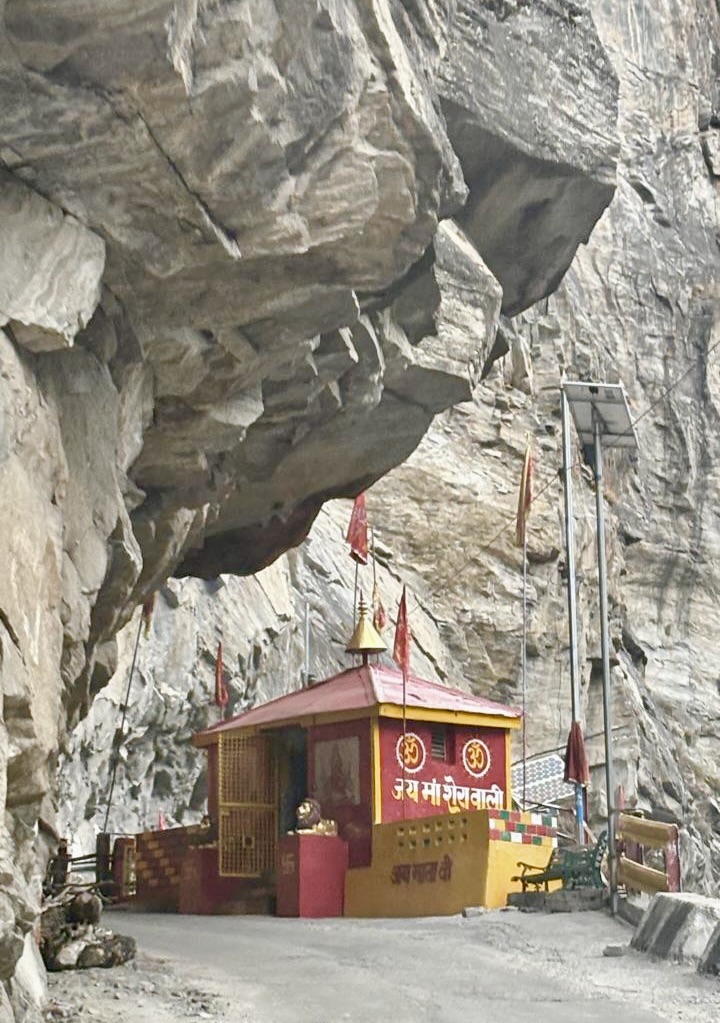
10 February: Sangla – I seek medical help
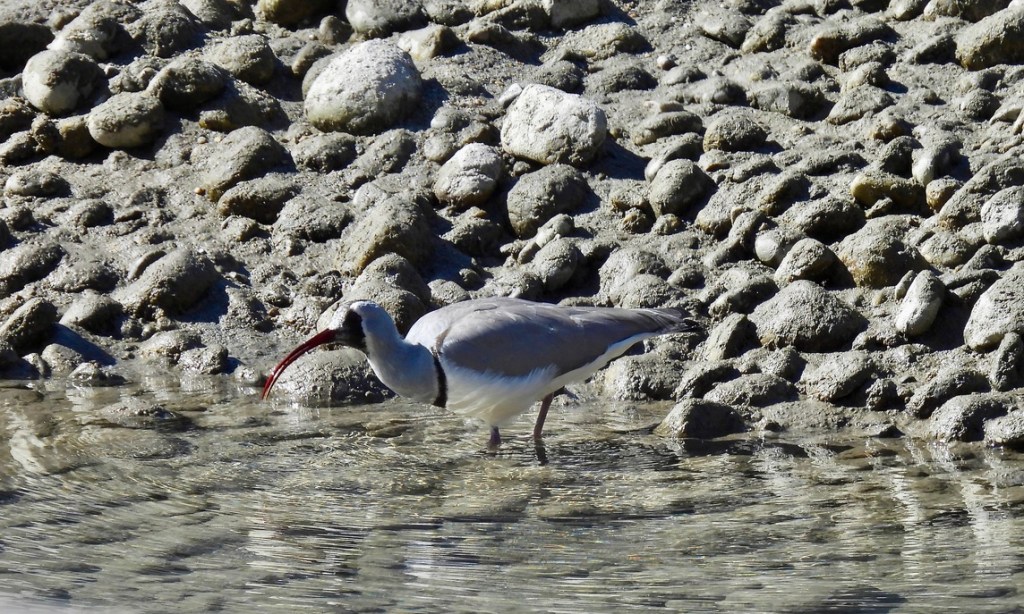
The cough that has dogged me for 5 days is no better and perhaps trending worse. As we are resting here in Sangla today, I decide to go to the local clinic to get help. This turns out to involve a cast of thousands. Sanjeeva contacts people from everywhere to get me the necessary paperwork and find me the right doctor. Eventually, we walk to the clinic, only a few hundred metres away, and after a ten minute wait are issued in to see the doctor, who gives me a general check-up and recommends antibiotic injections for my cough. From his office we move to the nursing section a few feet away where a smiling, middle-aged nurse gives me a quick shot to test for reaction and, after ten minutes, gives me the full shot and we are out of the door, about a half hour after we arrived. Total cost is 20 cents for the piece of paper on which the doctor writes his prescription! After that I retire to bed for the rest of the day, while the others go birding with a local birder, Mahesh Negi, and see… my most wanted bird, an Ibisbill, a bird so odd that the single species constitutes the entirety of Family Ibidorhynchidae. When they return with the news, I contemplate suicide before realising that we have a good chance to see one tomorrow. Nice dinner at the hotel.
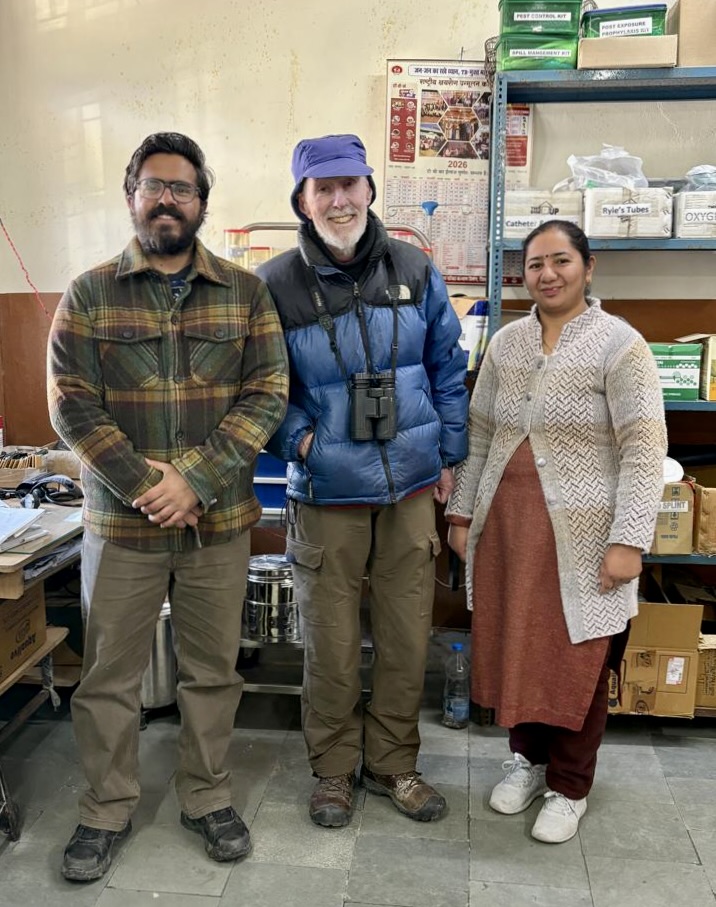
11 February: Sangla – Sarahan: things are definitely warming up
The plan today was to return to the clinic for my second injection, then proceed to Sarahan, but because of the unexpected discovery of the Ibisbills yesterday, we decided that, after I had been jabbed, we would go searching to the elusive birds again in case I could add it my list. In the event, we had no difficulty at all in finding them. They are actually on a property of the hydro company, in an area where sand is being trucked away to use for concrete elsewhere. Kieran spotted one as soon as we arrived, stalking beside a backwater of the dam impoundment. It was only about 30 m from where trucks were loading sand and making quite a bit of noise, so the birds seem relatively unmoved by human disturbance.
12 February: Sarahan-Banjar/Bihar village
Several forest staff come to breakfast at the hotel, then we all go together to the Sarahan Pheasantry and inspect the pheasants. The enclosures are situated inside the forest and just as we reach them a covey of four Kaleej fly off.
The Western Tragopans, which are the stars of the collection, seem to be in fine shape. One of the birds, 18 years old, and apparently a female, has now begun to produce male plumage, despite having produced several clutches of eggs. It is permanently banded and there is a comprehensive stud book, so misidentification is very unlikely.
After an hour at the pheasantry, I leave to get my injection, which goes very smoothly, with the assistance of our driver. After that, I check us all out of the hotel and then sit in the sun until the rest of the party, which visited other parts of the extensive pheasantry grounds, turned up, after which we departed towards Rampur, where we met up again with Guru Harsh, the DFO at Rampur, who was having a lunch party to celebrate his boss’s wife’s birthday, along with his own parents, at the hotel where we stayed on 1 February. We ate in the garden and it was so warm that we had to shift the tables into the shade! Something of a change from -25 at Kibber! Food was great!
Our schedule was by now somewhat behind, so we roared off leaving our guests in the middle of their meal – very rude of us, but we did not know what the conditions might be at the Jalori Pass: the pass we had to cross from the Sutlej to the Beas valleys.. However, in the event, it turned out to be no problem: the snow had mainly been cleared and, although a little icy, the descent on the north side was negotiated without peril: Shabash, driver!
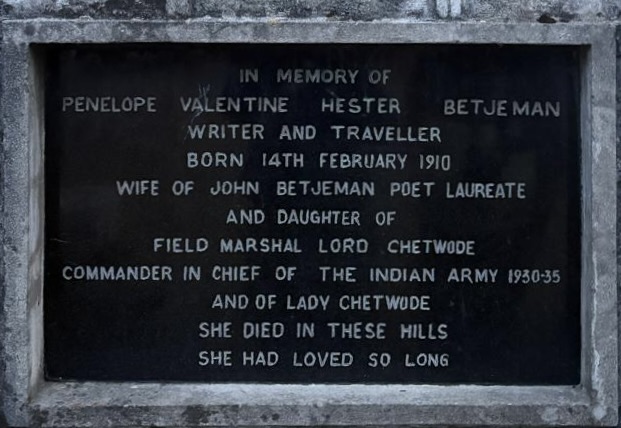
Just before reaching the pass, we met up with a couple of forest staff who were waiting on the road at the turn for the Khanag Rest House. This is where Lady Penelope Betjeman, a good friend of Anne-Marie’s, died in the middle of leading a cultural tour through the district. It is a splendid old raj-era rest house, tucked away in the forest. I append her memorial plaque. And for those who know John Betjeman’s poems, yes, she was the Joan Hunter-Dunn.
It was pitch dark by the time we reached Eagle Nest, the Marchal Homestay, but Hema met us on the road and guided us with a flashlight. The house is built on a spur, facing more or less southwest. To reach the front door it necessary to climb 3 stories of exterior steps, then you enter a mud room on “almost” the top floor and descend to the dining area and the guest bedrooms: a rather unique arrangement. It has amazing views in 3 out of 4 cardinal directions, though. Dinner and bed!
13 February: Rest day at Eagle’s Nest:
We have coffee at 7:30, then spend an hour birding nearby, coming up with a typical list of hill birds. After breakfast, I descend to Banjar, the bazar about 3 km and 500 m below Eagle Nest. Hema takes me into the hsopital and it is a good job she does because this is a much more hectic scene than Sarahan, with crowds milling outside the office of the duty doctor being severely managed by several orderlies. “Chaotic” was Roger’s description, although actually it was slightly more ordered than it appeared. After about 20 minutes we managed to gain entry to the doctor’s room, which was about 3 m square. The doctor, a magnificently-bosomed woman in a yellow sweater, with luxuriant long, black hair, sitting very close to an electric bar fire, never looked up once. Nor did she say anything in English, addressing only Hema. She made uncomplimentary remarks about the original prescription, saying that the dose should have been twice as much. However, she made the necessary marks on a piece of paper and we proceeded upstairs to the nursing room.
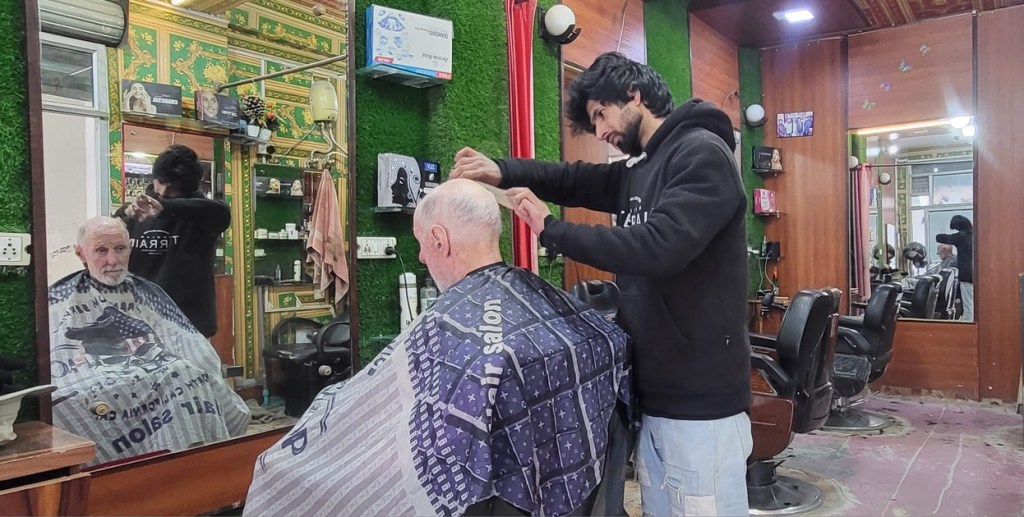
There, far from the jostling crowd, four nurses were seated around another of the ubiquitous bar fires. They announced that I should have a canula inserted, but I demurred on the grounds that the previous three injections had gone fine and had only two more to go. One nurse gripped my arm, while the other slid the needle in: We were gone. I went to get a haircut while Roger shopped for shawls.
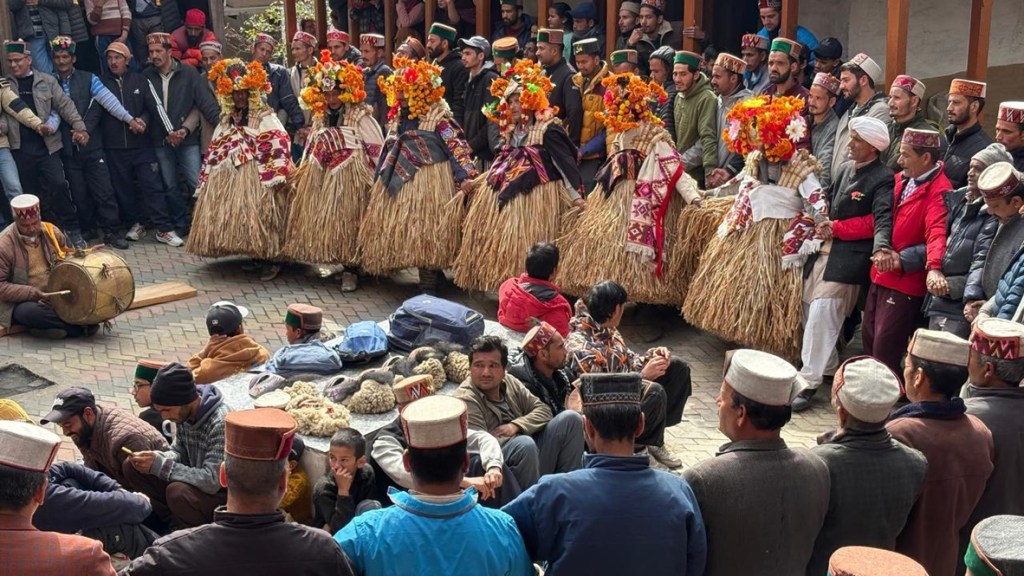
While we had been gone, Sanjeeva and Kieran had attended a festival gathering at Bihar village, just above our homestay. The occasion is the festival of Faguli, which is dedicated to Krishna, and is a kind of “first spring”, with another spring festival coming later. In two days, when we reach Mandi, the town will be celebrating Shivratri, a birthday for Shiva, the fact that Shiva is eternal notwithstanding.
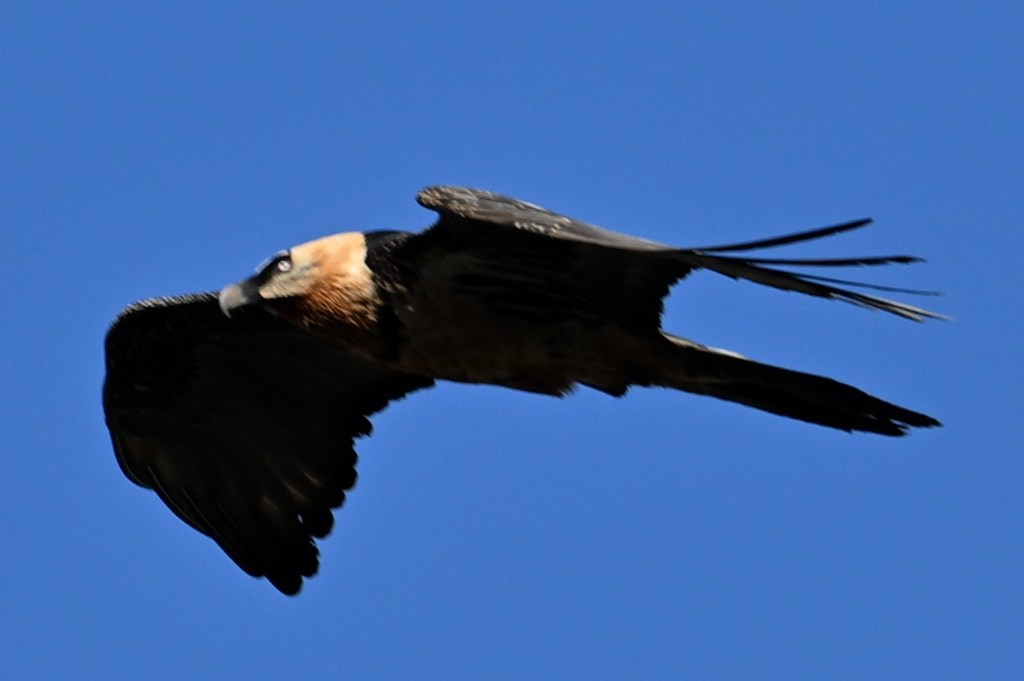
14 February: Another day at Eagle Nest and celebrating the last injection
Up at 7:30 for coffee, then we walk eastwards, below Bihar village and through the forest to some orchards half a kilometre beyond, where we can get an excellent view across the Tirthan valley to Great Himalayan National Park. Back for breakfast at 9:30, then Pramod takes Kieran and me down to Banjar where I get my last injection. As before, the mainstreet is a horrendous traffic jam, with a solitary policewoman trying womanfully to sort it out. She looked, as we might say, “brassed off”. Eventually, we negotiated the choked and choking street and my injection was done and dusted in 5 minutes, following which Pramod and I joined Kieran in the shawl store, then waited while he had a hair+beard trim at the same place I patronised yesterday. I hung about doing less than nothing, as one does in a small Indian town where most shops sell detergent, steel buckets, biscuits or packets of chips. There was no Starbucks.
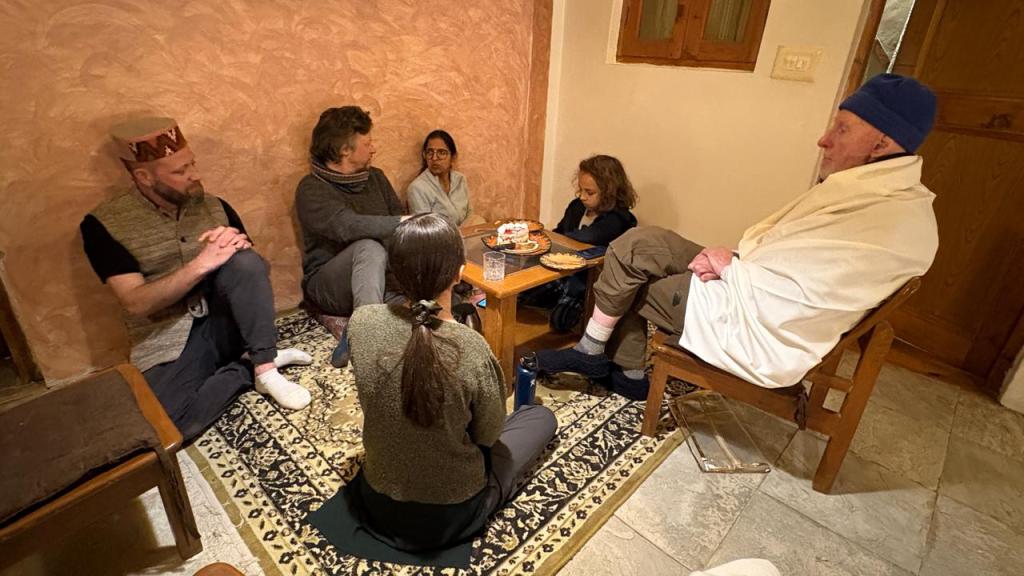
We arrived back at Eagle Nest in time for lunch. Then, exhausted by all that less than nothing, I took a nap. After that, Kieran shot some video of interviews with Janisha and myself. We did it on the balcony with the snowy mountains of the Great Himalayan National Park in the background: quite inspiring. It is cooler tonight so we all gather round the wood stove in the evening and Hema produces pakoras. She will depart early tomorrow, so I have settled our bill.
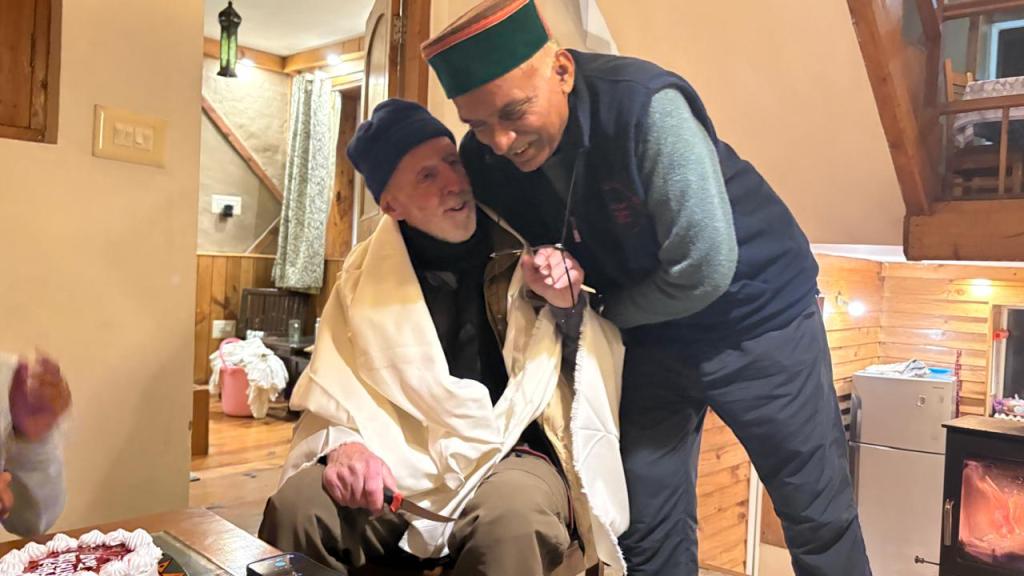
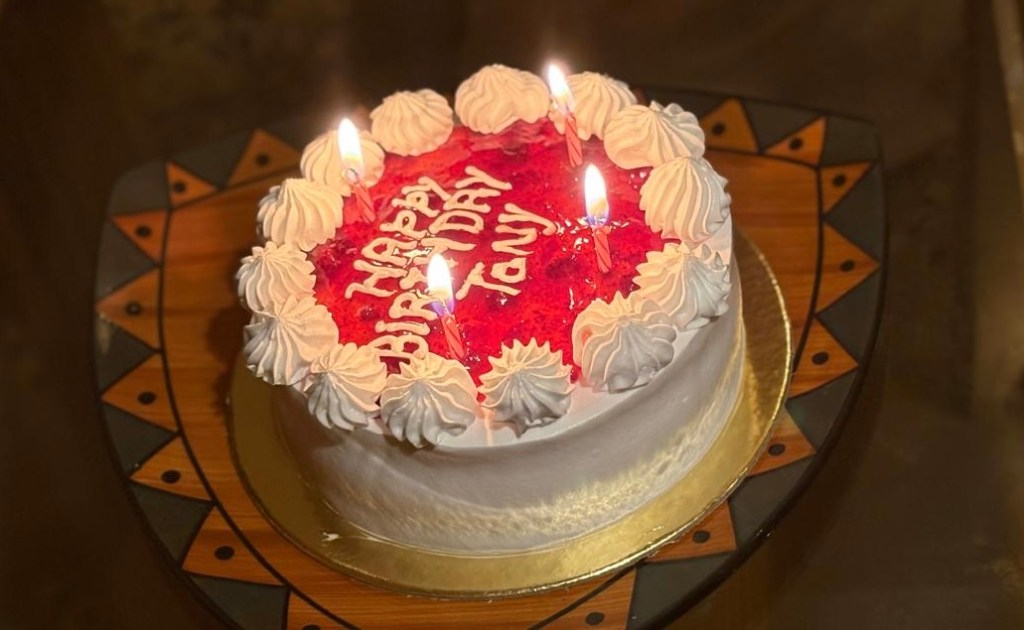
The evening was full of surprises. A splendid birthday cake, surmounted with four candles: one for each of my virtues, I assume, arrived about 7 pm, and my “primary chela” (Sanjeeva) presented me with a splendid woollen shawl. Once a suitable amount of cake had been consumed, we moved on to an excellent dinner of spagetti bolognese, produced by Hema and verified by all as “authentico”. A very satisfactory birthday, held two days early because Sanjeeva has to leave us tomorrow to travel to Kangra for a family event. After all that, everyone scattered to organise their gear for an early departure tomorrow: Hema is going to Mumbai, the kids to their grandmother’s and we to the old princely seat of Mandi.
15 February: Departure from Eagle Nest and farewell to Sanjeeva
We were all up fairly early, because we had expected to leave by 8:30 but, as usual, things got delayed and we only managed to depart an hour later after an excellent farewell breakfast of puris and potato curry. Pramode tried to bypass the dreaded Banjar high street, but discovered that the bypass road was under construction, leaving us with no alternative to Banjar. After an hour of bucking and rolling on the “partially made” highway, we suddenly found ourselves, below Larji, on a smooth divided highway allowing us to exceed 30 km/h for the first time since we were on the Sutlej highway. Naturally, it was only temporary, but below Thalaut the road entered a tunnel with perfectly smooth walls and pavement which took us almost to Pandoh – a Swiss-style piece of engineering that greatly reduces the time and wear of the journey. By noon, we were on the outskirts of Mandi and we made rendezvous in a gas station with Sanjeeva’s taxi, that was to take him to “Dharamsala” (actually nearer to Kangra). Fond farewells and assurances that we would all meet again some day were exchanged. I certainly hope that happens: Sanjeeva is one of a kind. Once underway, we discovered that he had left his camera and long lens in our car. Luckily, he was close behind us: a call was made and the equipment handed over.
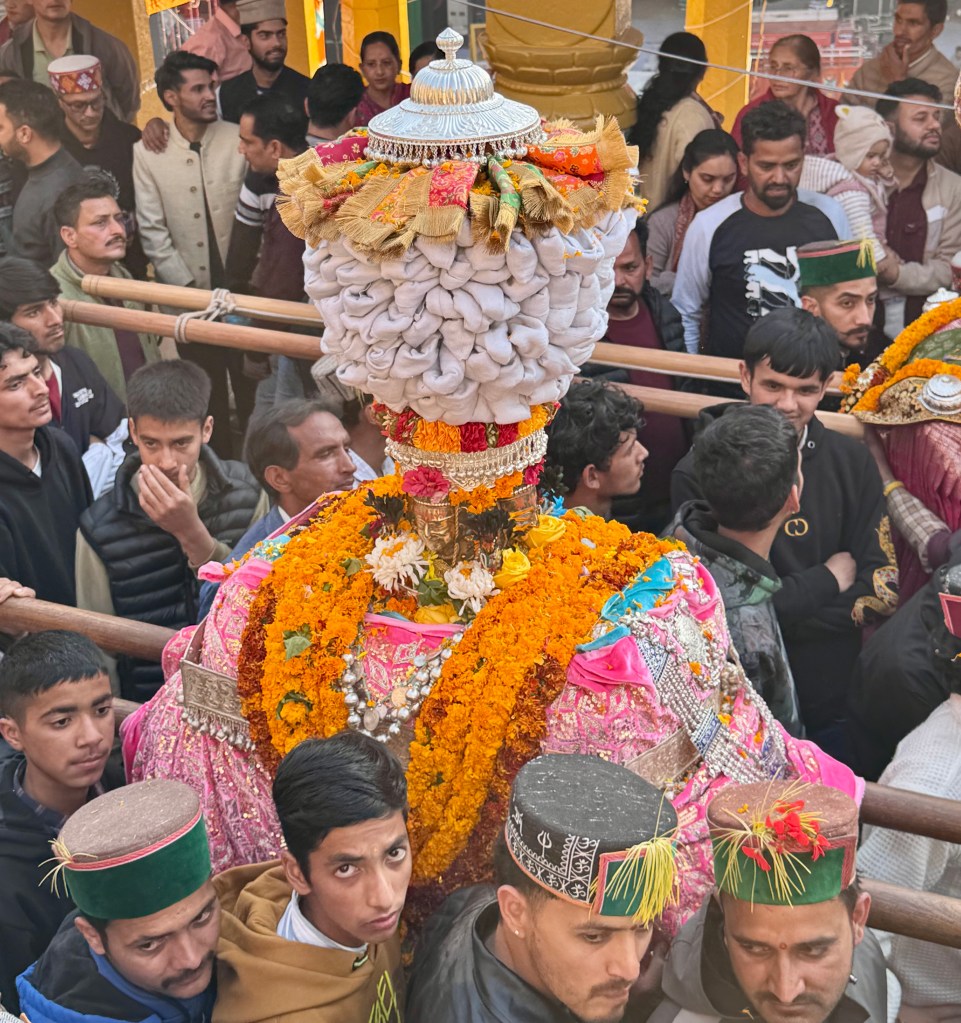
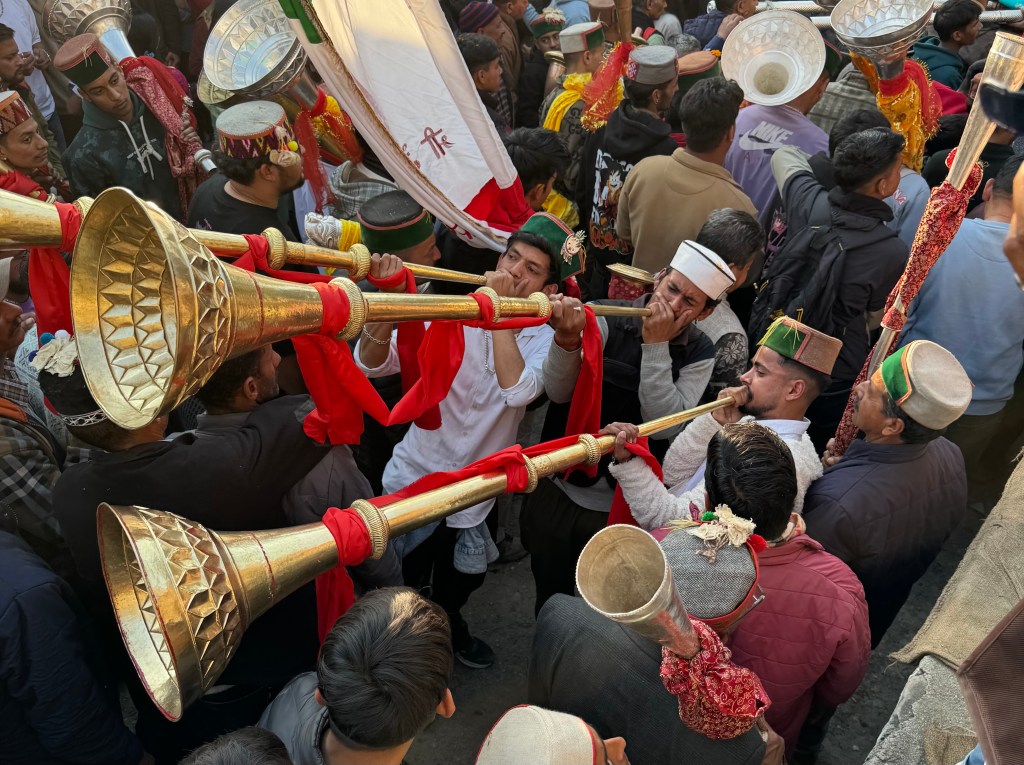
As we approached Mandi, we passed long lines of men (all men) carrying, and in some cases playing, drums and horns in accompaniment to devtas being carried on palanquins supported by two or more marchers: these devtas were village deities that were coming to Mandi, as the district HQ, for the festival of Shivratri (Shiva’s birthday). There must have been at least 20, perhaps 30, of these processions entering the town. One of their first acts, on reaching the city centre, was to make some sort of homage to the local administrator, whose office was right beside our hotel, the Raj Mahal Palace. Luckily we managed to get our car into the hotel parking lot before the mobs arrived, otherwise we would have been jammed up for hours.
These gatherings of village devtas occur several times each year. The idea, in at least some of the festivals, is for the village deities to pay homage to the deity of the local Raja, in this case the Raja of Mandi. In Kullu, the Raja’s deity is Krishna and the biggest gathering is at Dusshera, a Vaishnava festival. However, nearly all the old temples at Mandi are to Shiva so I suspect the Raja worships him: hence the big festival at Shivratri. Just an hypothesis!
The noise of the musical processions is absolutely mind-numbing, as it is extremely loud but no attempt is made to tune either horns or drums and there are periodic ear-splitting blasts of shennai (Indian reed instrument) that likewise are in no way attuned to the rest of the orchestra. Some of the devtas apparently become restless or playful and start jumping about, despite the best efforts of their bearers to control them. Given the close press of onlookers, this leads to substantial confusion. At one point I had to duck for cover as a frolicking devta bucked in my direction. However, you don’t see anyone getting upset or out-of-temper. The whole event proceeds with great good humour among the participants and great forbearance among the townsfolk attempting to go about their business.
16 February: Mandi to Shimla
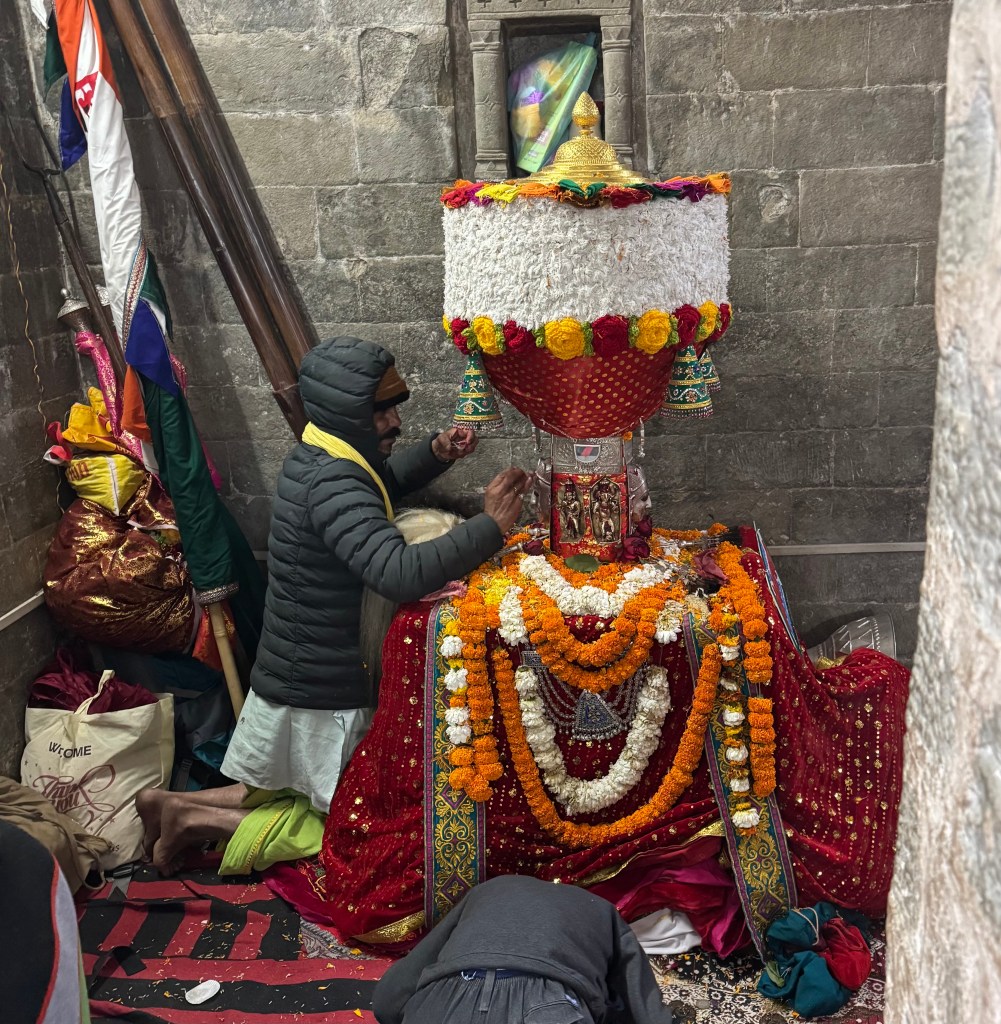
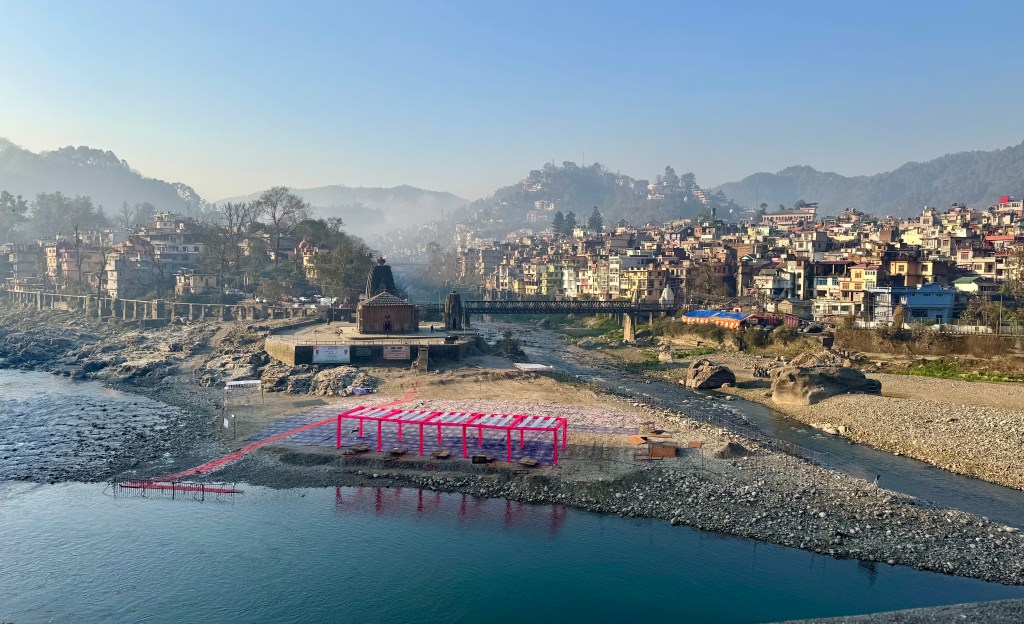
First thing, Roger and I walked through Mandi old town to the old road bridge, now kept for pedestrians, and crossed to the Triloknath Temple: the oldest and possibly the most famous in “Chhota Kashi“, as Mandi is sometimes known. It turned out that one of the devtas, with its entourage, had spent the night inside and everything was bustling with preparations for the big festival. Everyone was very friendly but we were surprised to see a policeman with an automatic weapon nearby – perhaps some disruption to the festival was considered possible.
After the excursion, we had breakfast at our hotel and loaded the car at 11 am for the journey to Shimla. There is now a fine, dual carriageway road about half the way, but after that the road is still in construction and there were literally hundreds of cement trucks grinding along slowly, so we made very slow work until we reached the Shimla outskirts where the road and traffic improved. Eventually, we made it to the lifts, which take pedestrians from the Shimla cart road to the pedestrian mall that runs along the summit of the Shimla Ridge.
The Combermere Hotel, where we were booked, has its own lift, but we were misdirected and took the public lift, resulting in lots of sweating and heaving until we managed to get our gear to the reception. In fact, we discovered that the entire hotel is very difficult to navigate, partly because the lift stops are offset by half a floor from the actual floors of the same number and partly because some parts of the hotel can only be accessed by going out onto one of several patios. There are eight floors, the upmost being accessed from The Mall. After a short walk, we had supper in the SOL brewery bar to the accompaniment of a live DJ spinning techno at high volume: a bit of a departure from the rest of the entertainment on the trip. I have started coughing again, so took an early night.
17 February: Shimla, summer capital of the Raj
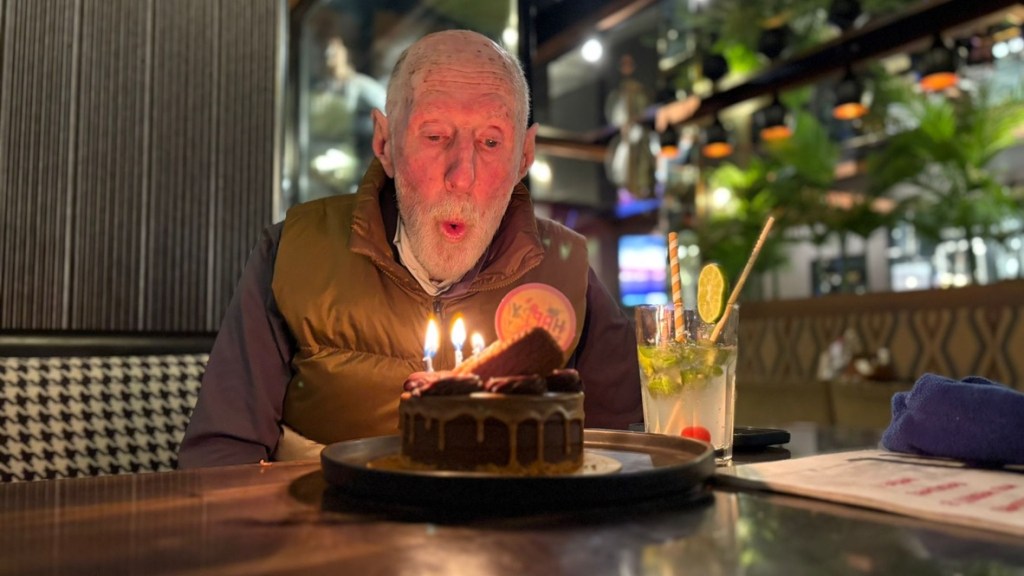
Today was my actual 80th birthday but I had a bad night, so went back to bed after breakfast for a couple of hours. Kieran and Roger check out the Himachal State Museum. We all took lunch at a nearby cafe where we could sit in the sun but out of the wind and protected by razor wire from the marauding rhesus macaques: very pleasant. The daytime high here is about 15 C. Later, we returned to the SOL brewpub and braved the techno music to indulge in my second birthday cake – chocolate this time. Sadly, I had no appetite and could only manage a single wedge.
18 February: Shimla to Delhi
Our driver, Pramod, arrived punctually at the foot of the lift at 7.30. It took us about eight hours to the hotel (J Residency, Jangpura Extension). Traffic was terrible because there is a big international meeting on AI going on in Delhi. We took a rather depressing walk though some slums to get supper at a very nice South Indian restaurant.
19 February: New Delhi, Kieran departs
We visited Humayun’s tomb (Humayun, second Mughal emperor) in the morning. The tomb is still magnificent and the surroundings calm and pleasant. A museum has been added last year which, today, housed an excellent Indo-Italian collaboration highlighting the commonalities among animal and other motifs from China to Europe. After that, we lunched near Lodhi Road, then Roger and I returned to the hotel while Kieran rambled some nearby bazaars. He returned by 4 and left for ther airport at 5.30 to connect via Singapore to Vancouver and thence to Yukon. We two got some sleep from 7 to midnight then followed Kieran in departing to the airport and thence to Heathrow and onward to Ottawa.
20 February: The end and thoughts on the journey
Roger and I arrived in Ottawa, via Air Canada, 25 minutes before time and Angela was waiting to pick us up. She managed to look a little like Penelope on the return of Ulysses. At least to me…
So was it worth the fairly substantial discomfort and wear? I think so… Looking back, I now realise, what I did not understand at the time, that in Spiti we were seeing an almost primeval contest between large ungulates (blue sheep, ibex) and their natural predators (wolf, snow leopard). Because of the openness of the terrain and the fact that most was covered in snow, we could observe every move of both predators and prey with exceptional clarity. Plus the landscape, riven with deep gorges, allowed many people to observe the interactions of the predators and their prey on distant hillsides without any danger of disturbing them. I suspect this is a very unusual situation.
The only downside was that the combination of low temperatures (below -10 all the time, below -20 at night) and the altitude (4000 m and above) restricted the amount of time that I personally could spend on the ground actually watching. However, the wolf attacking ibex on 5 February was undoubtedly one of the most exciting wildlife encounters I have seen and the total of five separate snow leopard encounters far exceeded my prior expectations. Added to the grace and bonhomie of the people of Spiti who provided us, everywhere, with friendly service and excellent food, the core of the trip — our time in Spiti — will remain a highlight of my travelling life.
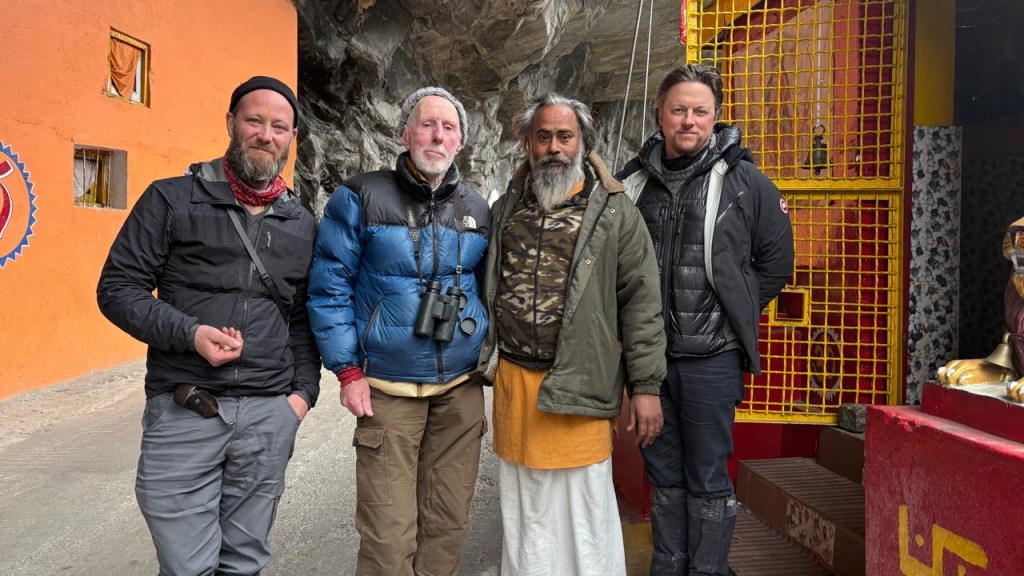
I should spare a word for my companions. I tend to eschew hyperbole because there is too much about us nowadays, but I do not exaggerate when I say that the party of four who formed the core of the trip (Sanjeeva Pandey, Roger Bull, Kieren O’Donovan and Stephen Marchal) made the most entertaining company I could have wished for. Excepting those I made myself, I heard no words of complaint. It was definitely the best 80th birthday I could possibly have wished for. Thanks, guys…
Coda
It turns out that the cough I developed in Spiti is a recognised condition, known colloquially as “Khumbu cough” because it is common among those attempting Everest. It develops as a result of low temperatures and oxygen pressure and very dry air and can persist for up to a couple of months. Judging from other accounts, I had a fairly light dose. It probably helped that we chose to descend from Kibber a day earlier than we had planned.
 Being ourselves