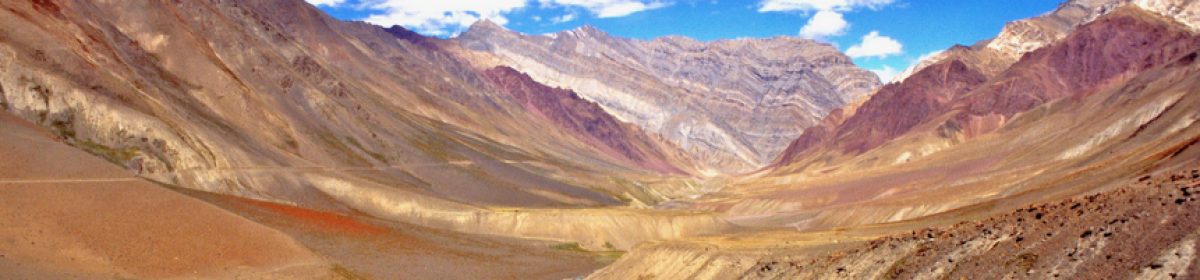
After two successful trips to Mediterranean islands (Sicily [2023] and Crete [2025]) we have decided they are among our favourite places: nice weather, good food, lovely landscapes, rustic atmosphere, tons of history, birds, flowers… Who could ask for anything more? So this year we are sampling Corsica, for a taste of France. This blog will start 1 May, assuming all goes according to plan. I can’t wait.
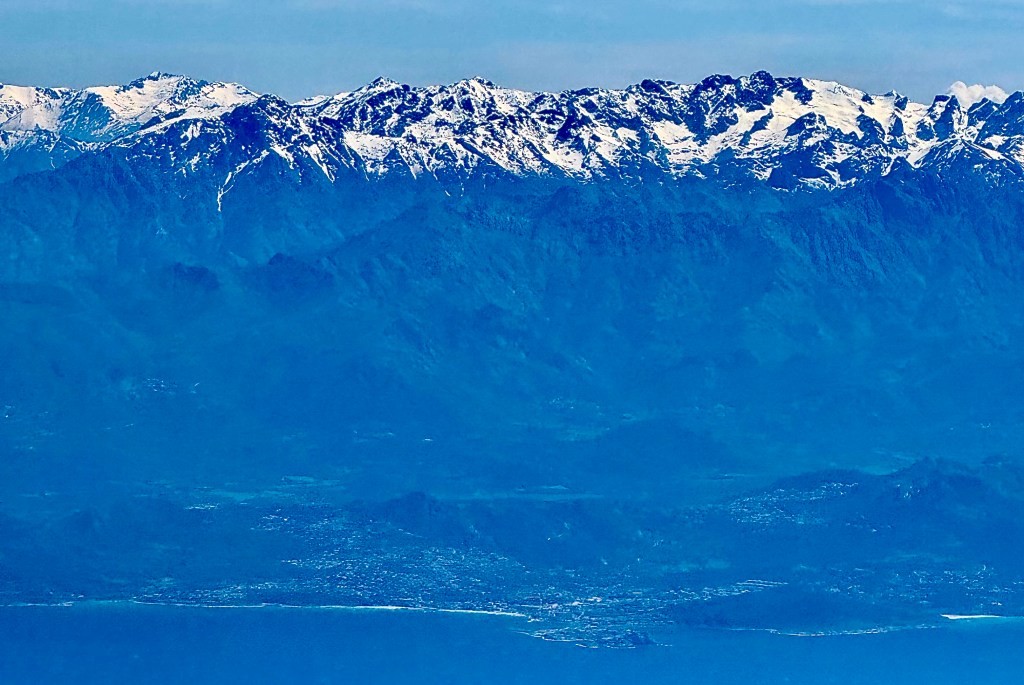
Friday, 1 May, 2026, arrival Bastia, Corsica
Departed from Heathrow at 8.45 am for Nice. We expected hassle there from the newly instituted immigration system, but at least for Canadians the system worked flawlessly and we took less time to enter France than we would have taken to get back into Canada. The Air Corsica flight to Bastia was a TVR turboprop. I will nominate them for “worst airline on the planet” for reasons I will not detail here but the tea they served in flight was outstanding in it’s badness and may have been some sort of revenge for Trafalgar.
Next, I distinguished myself by haranguing the staff of Sixt Car Hire at the Bastia airport loudly in Bad French before realising that my car was booked for two days hence. Merde! Je demand pardon! We took a taxi to our downtown hotel, the Continental, not as grand as the name suggests. In the evening clouds of common swifts swirled above the Place St Nicolas. We had fine Dorade beside the old harbour. My equanimity slowly returned.
Saturday, 2 May, Bastia
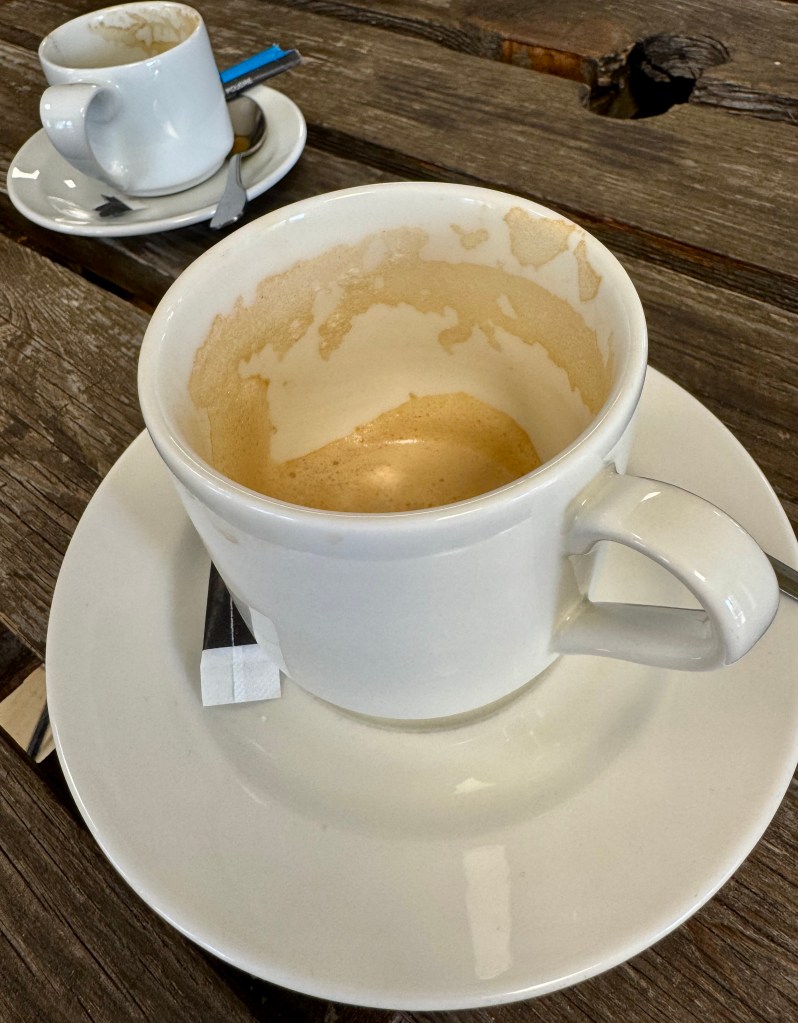
The breakfast was not very inspiring, but they did have Canadian Maple Syrup and the large satsuma was very good once we had wrestled the skin off the contents. The latte was luke-warm and the cup was only half full, which was a blessing because it was not very tasty.
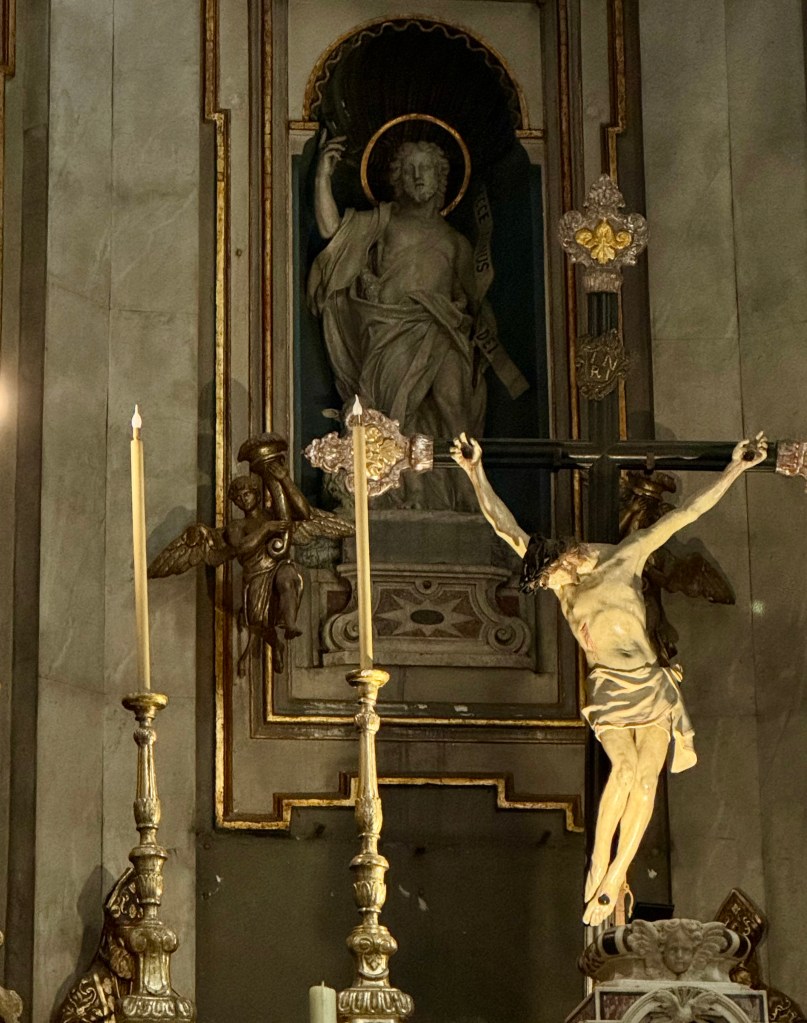
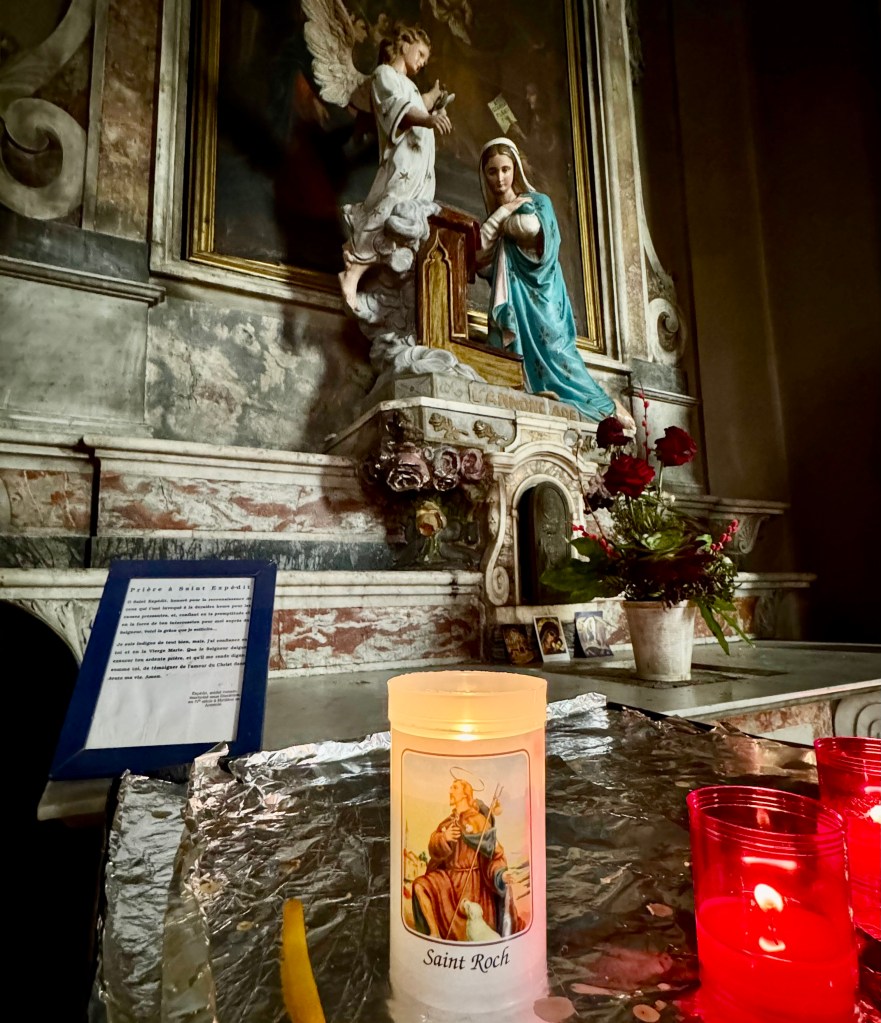
After making what we could out of this dismal fare we rambled up to the Genoese fort above the old harbour where we found the museum very well organised and informative, as well as cheap (E2.50). On the way we stopped at the Chapel of St. Roch, where I lit a candle before the virgin in honor of my beloved and recently departed sister-in-law, Joan Cellik. Immediately after doing so, without any prior warning, I burst into floods of tears which disabled me for several minutes. It is the ‘Why?’ that is so provoking. Why do the people we love have to die? I don’t much care about my own death – maybe I will later – but the loss of our dearest is so hard.
I was reminded, also, that St. Roch was the name of the RCMP cutter that was the first ship to traverse the NW Passage from west to east (1940-42), and did it in both directions, as well as being the first to circumnavigate N America, passing through the Panama Canal to do so. So there was a connection, me being the first person born on a Sunday in Beckenham, Kent to navigate the NW Passage (in a cruise ship) in 2017.
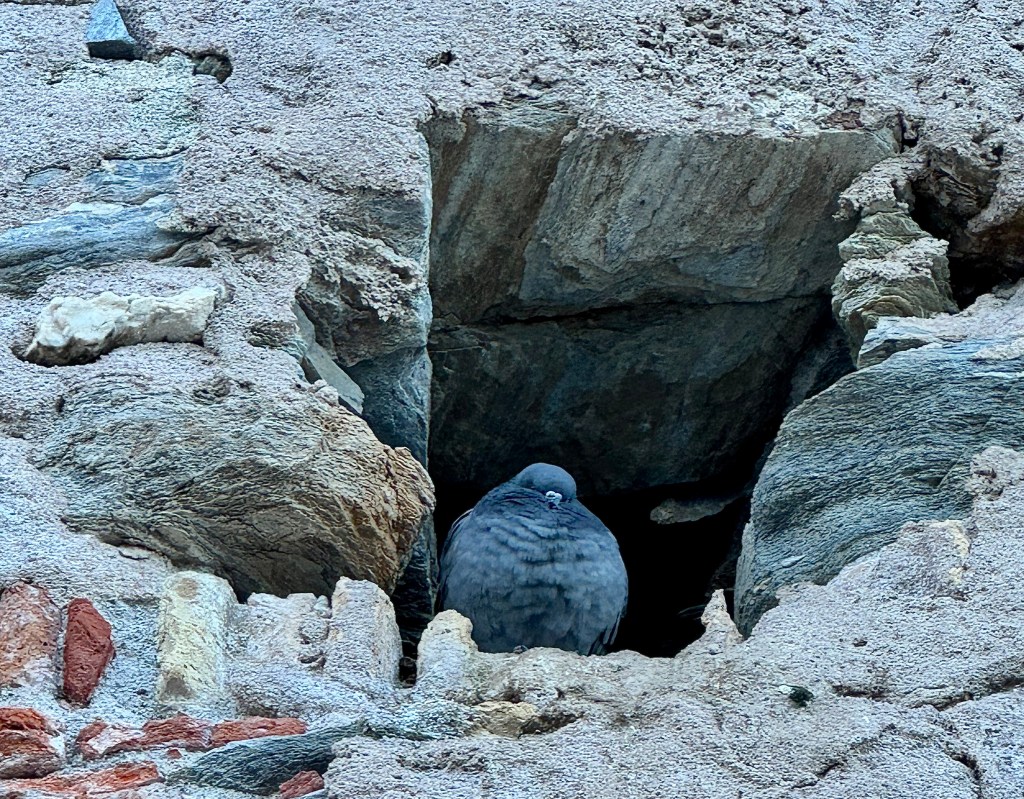
In the evening we walked the coastal path below the old town and our activities were closely observed by the local pigeons and Yellow-legged Gulls. We had an uninspired pizza for dinner, although the salad was excellent.
Sunday, 3 May, Bastia to Palazzu Nicrosi
WE picked up our hired car at the airport and I had another unsatisfactory exchange with the workers at Sixt. I had specifically asked for a gasoline car, not because I have anything against EVs, but because never having driven one, I thought the narrow, winding roads of Corsica, people by mad French drivers, might be a bad place to begin. Of course, they had no ICE cars on hand so we drove off, very slowly and cautiously, in a Peugeot 8002 EV. Fingers crossed…
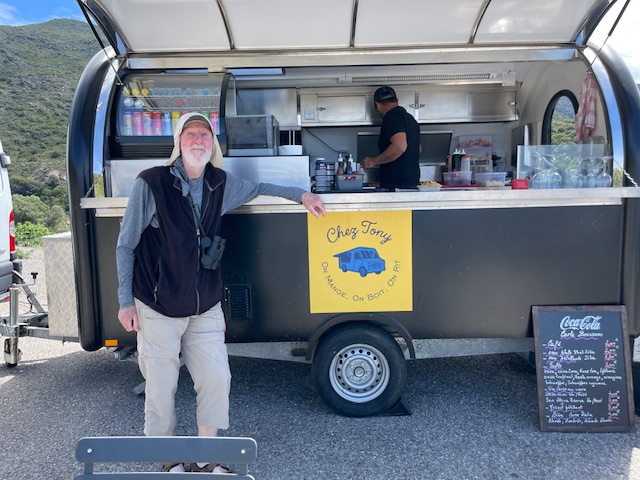
Our first stop was for coffee, where I found they had anticipated my arrival…
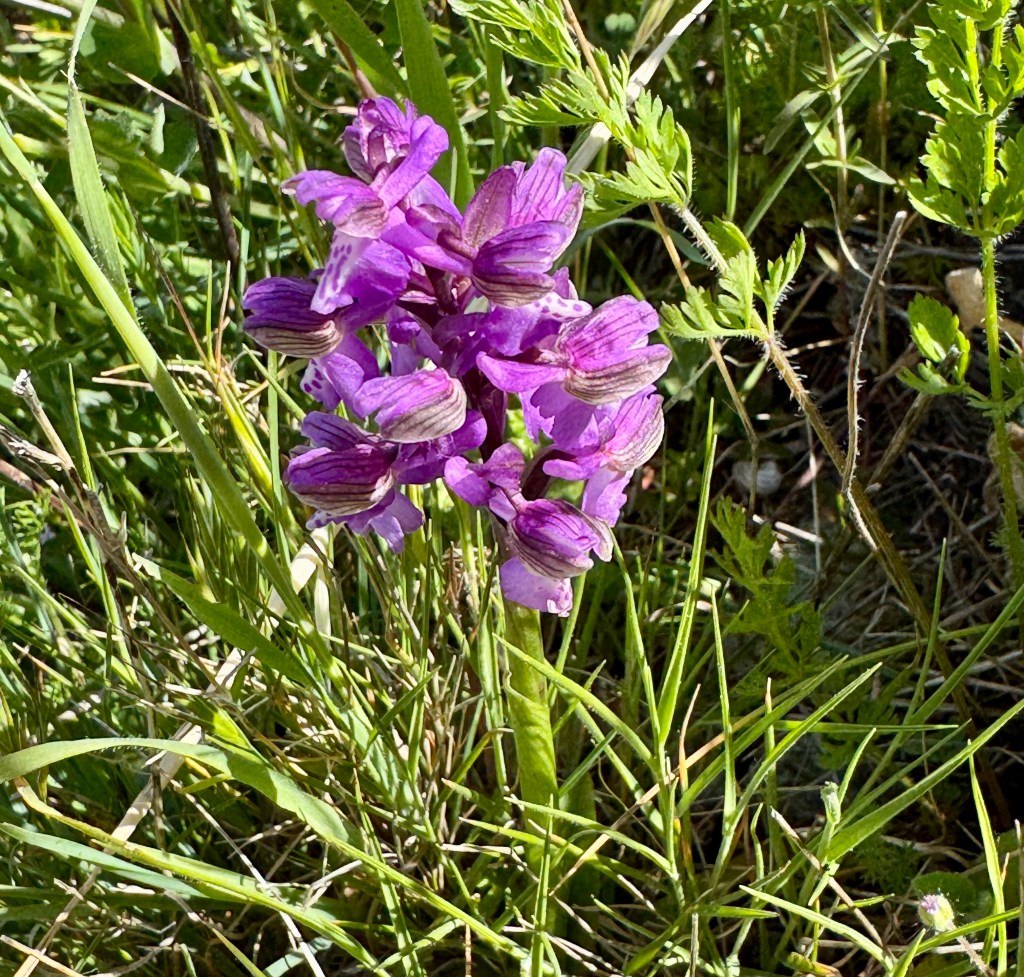
Two hours later we stop to look at roadside flowers and find this green-winged orchid. I feel much better now. Actually the Peugeot, although bulkier and heavier than my current car, drives quite nicely. But why don’t they make steering wheels round any more? And who thought flat-bottomed wash basins were an improvement on the more traditional style? Sometimes I feel civilization is accelerating backwards.
We reached our destination, the Palazzu Nicrosi, perched on a hill high above Cap Corse, about 4 pm, in time for a rest and a walk to the various unsigned ruins that dot the landscape. Star bird of the day was a Whinchat that was trying to peck squashed bugs off the road. Must be 50 years since I last saw one.
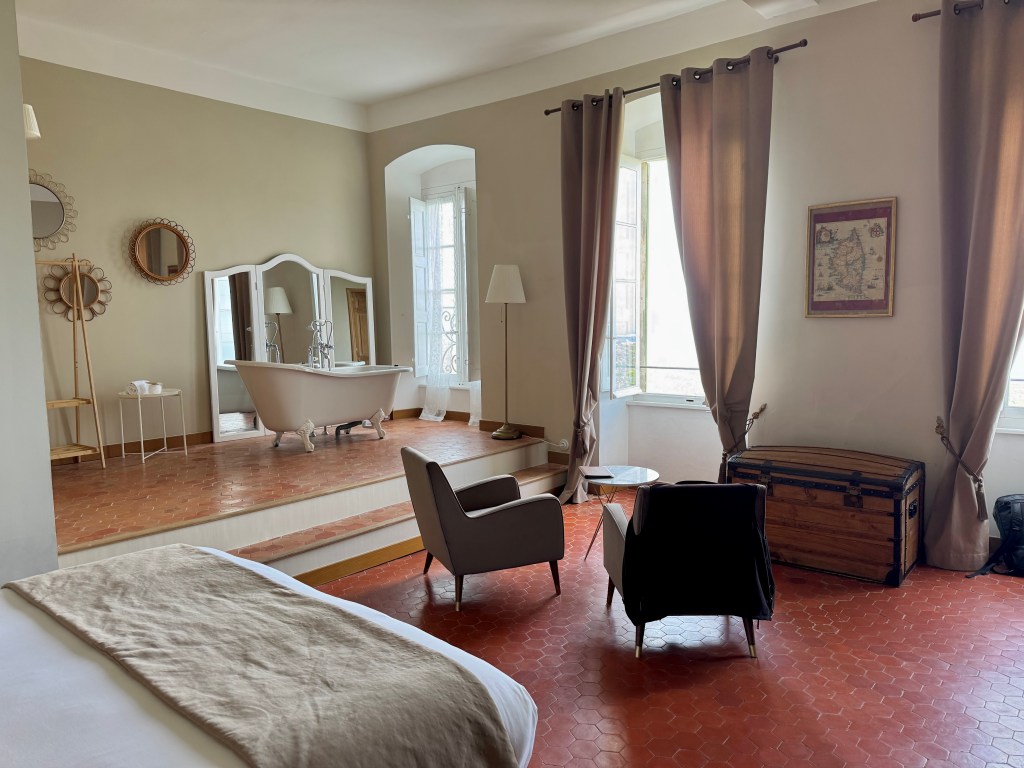
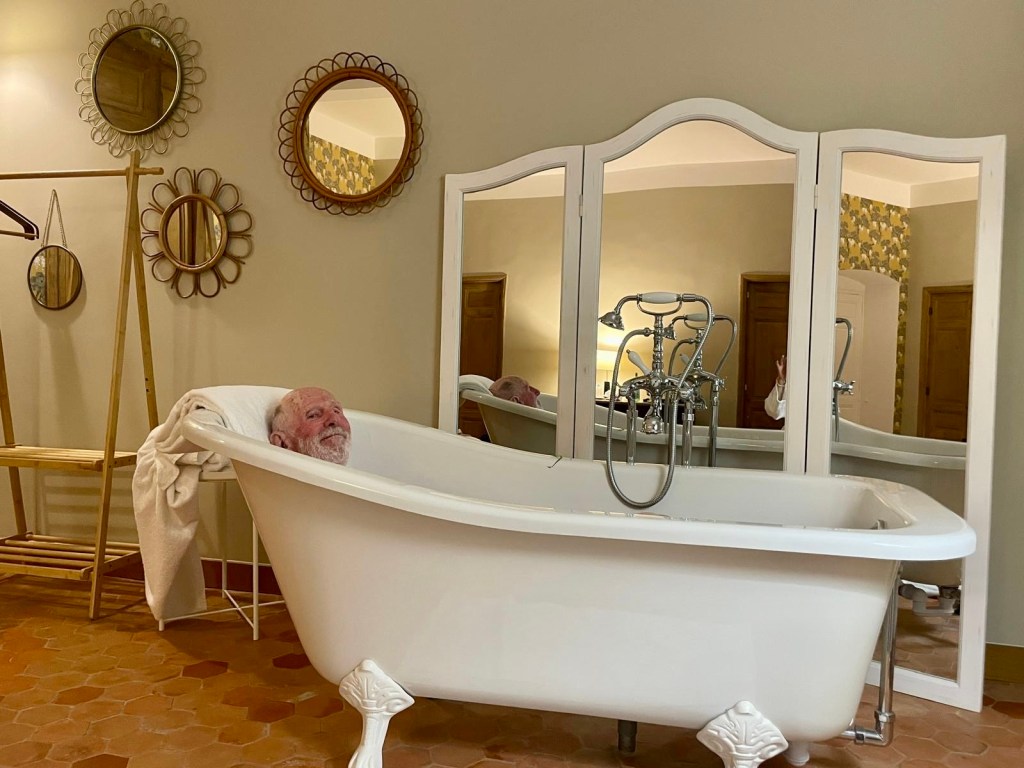
The Palazzu (no, not a typo – the Corsican spelling) is one of a number of 19th century mansions around Cap Corse built by returning Corsicans after they had made fortunes in the US. Nicrosi, who made his money in Alabama, is supposed to have invented the modern supermarket, providing his customers with wicker baskets to hold their groceries. In the grounds, Blue and Great tits sang jauntily; Red Kites floated by…
The descendent family lives on the second floor and we had the third to ourselves. As the pictures show, we had ample space. Apart from anything else, the design of windows and blinds, which all locked together with a simple rod system running up the centre of the window showed outstanding ingenuity. The bath was a plastic replica, but very pleasant, nevertheless. I think every holiday should include at least one day of unadulterated luxury – this was ours. Supper was splendid, in the otherwise empty dining room, observed by the photos of departed magnates. The bed was so large I had to resort to the phone to locate Angela.
Monday, 4 May, Paluzzu Nicrosi – Galerida
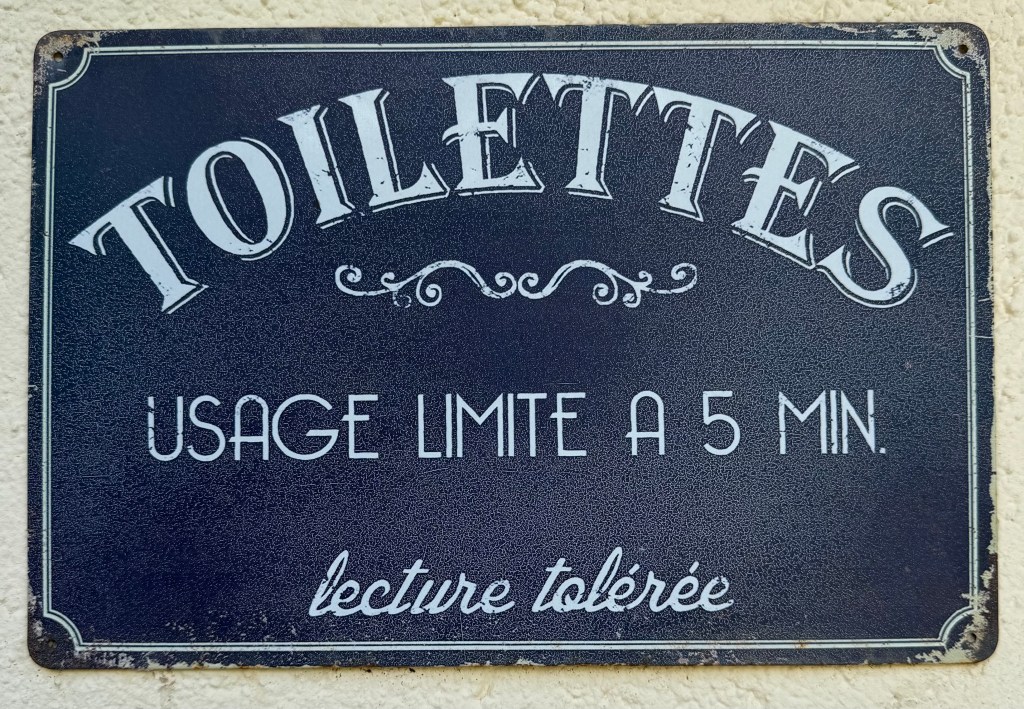
The breakfast was even grander than the dinner, with a dining table that would have seated ten completely spread with cheeses, charcuterie, jams, preserves, croissants, breads, eggs (bantams, so about the size of lapwings). We regretfully quit the Palazzu at 11 because we had a 4 hour drive ahead. The route south lay right along the coast with lovely views but nothing you could not find on a postcard. Being a monday, most restaurants seemed to be closed and we had to make do with a very basic spot with two coach-loads already with eyes down in the trough. However, the omelette was very good. For some reason, use of the toilet was restricted to 5 minutes… But they allow you to read, thank God!
What with one thing and another (detours, arguments, brief halts for snaps) we did not reach Galeria until 5 pm but our landlady was waiting for us and handed over the keys to a large and rather sparsely furnished apartment with a small patio, equipped with loungers. However, it started to rain so we did not make use of the loungers. We ate across the road at the restaurant twinned with our apartments. It rained heavily all night.
Tuesday, 5 May, Galeria
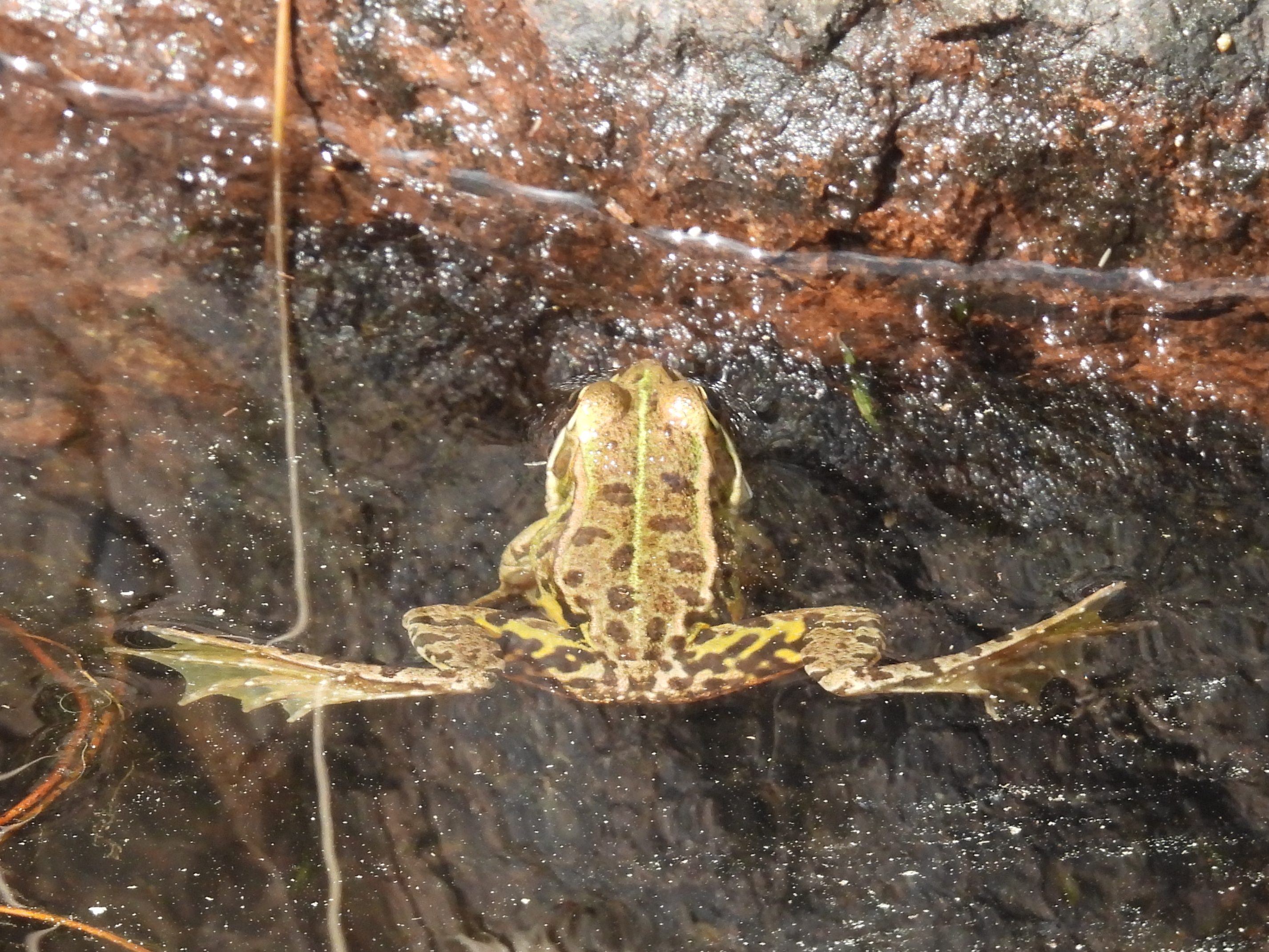
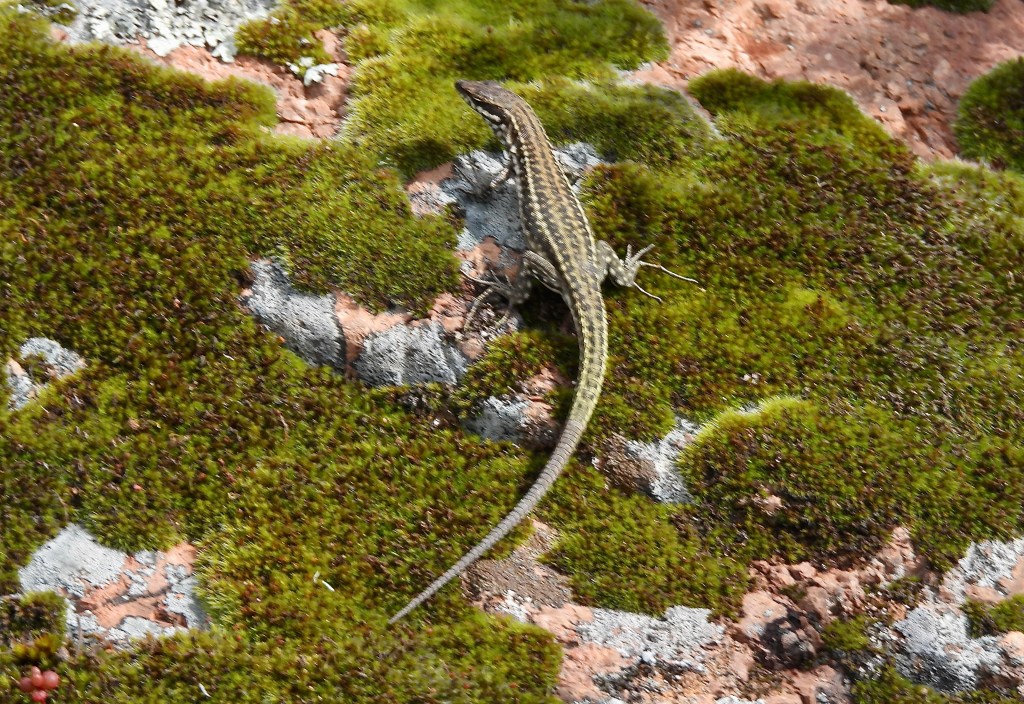
This is to be our first day of hiking and intensive bioblitzing. We targeted the valley of the River Fango, gorgeous clear, fast-flowing stream that rollicks out of the mountains and winds among maquis-covered rocks creating many clear pools interspersed with rapids. As we only got underway at 10, it was already a bit warm, with signs of rain, so very humid. We were walking uphill on a very rough trail, so quickly got very sweaty. However, the bioblitz got off to a fine start with a small rock pool full of croaking Pond Frogs. Then we found a Tyrrhenian wall lizard and spent some time trying to get close enough to photograph it, only to find, a little further along, that they were everywhere and many very tame – hard not to step on them in places.
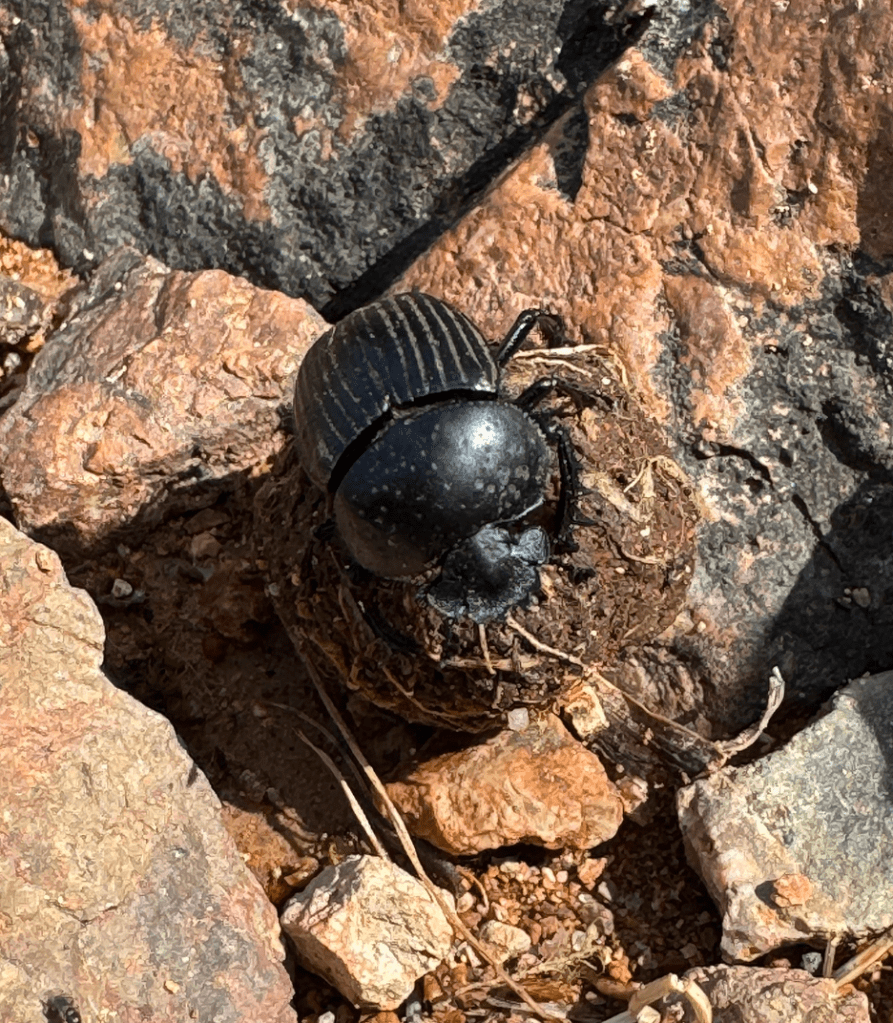
The third star turn was a dung beetle, Scarabaeus laticollis, which had got into difficulties trying to back its dung ball over a rock. Luckily, your hero was on hand to nudge it gently upright so that it could continue the vital, self-imposed task of renewing earth’s nutrients by burying gobs of dung. Saving the planet can be as simple as kicking a scarab!
By 1 pm we were all in, with heat and humidity and repaired to a nearby restaurant where they served “milk-fed lamb”. Thence to our apartment and then to make our first attempt to replenish the charge in our EV. So far, chargers 1, Gaston 0. More on that demain…
Wednesday, 6 May, Galeria
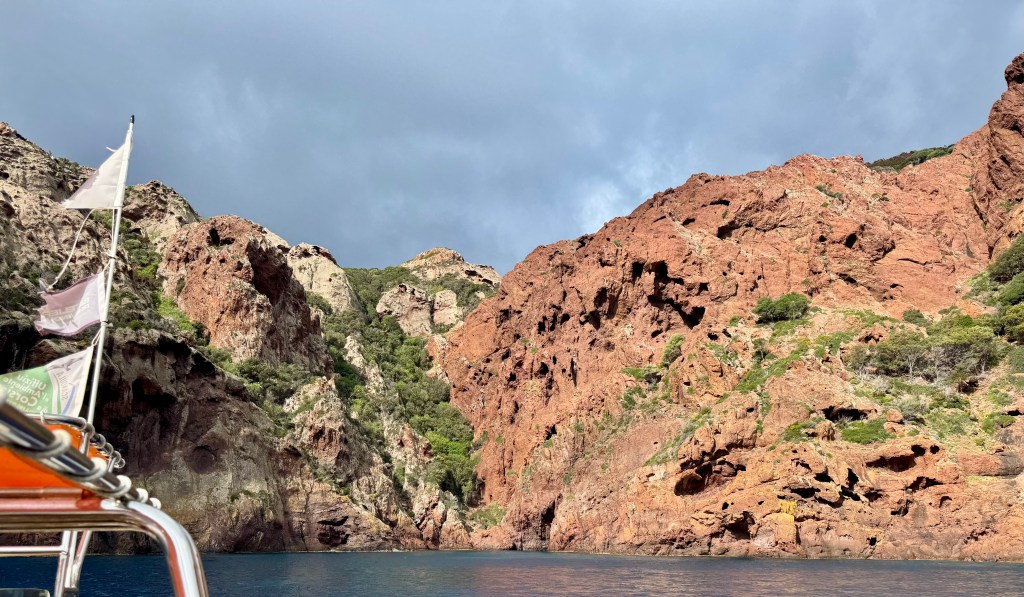
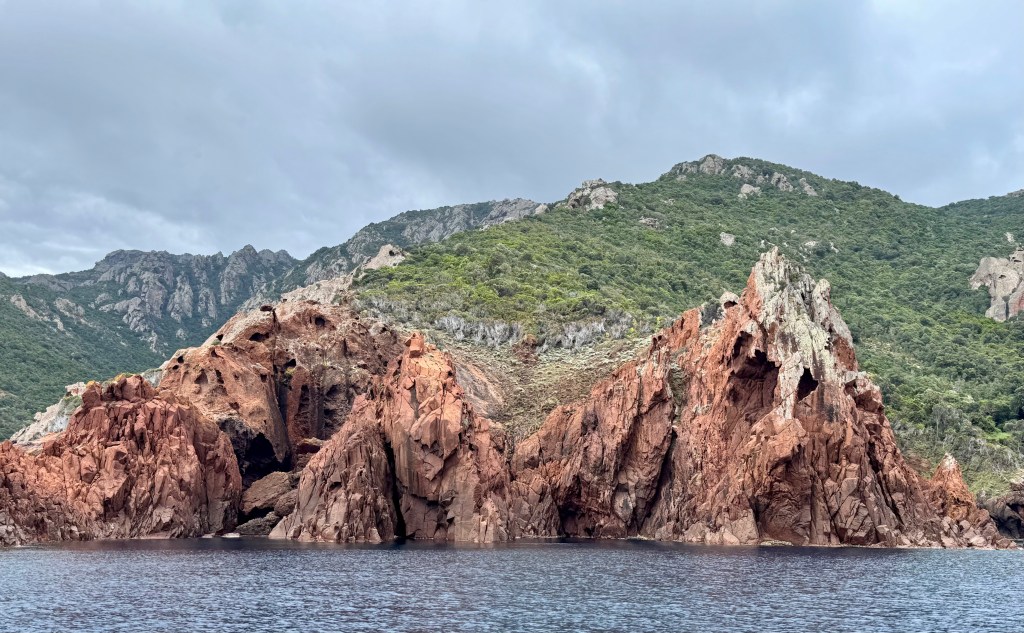
Breakfast bright and early; I won’t describe it except to say it was French… Ca suffit! We were at the harbour for a 9 am departure to the Scandola Nature Reserve just west of here along the coast: a region of rugged volcanic rocks with a reddish tinge, previously ruled by Rupert, or maybe Roger (Roger ruled the rugged, reddish rocks, reportedly). Or perhaps Rogier?
The weather was not promising and our captain told us we would probably not make it alive but all 7 of his guests voted to continue (in a sense – we continued to sit in the boat, like cattle, or perhaps sea-cows). Once out of the harbour a brisk headwind caused the bow of our open boat (twin 150 hp outboards but no windscreen) to crash the waves and soak us all (no rain gear provided).
Before our departure, I inquired about the life jackets and was told they were under the seat. Actually, that meant “in the seat”, which had to be raised, using some exertion. All were neatly folded in a manner suggesting they had never been removed from their stowage since they were brought on board. The skipper claimed that they were only necessary if he exceeded 20 kts. Wanting to see how they went on (no demonstration offered) I took one, figured out how to put it on (I am familiar with various sorts of flotation) and having got geared up I decided to keep it on. As I remarked to the skipper, in Canada we would all have been wearing one, even on a calm day.. and this was anything but! He looked on me pityingly. I am extremely unimpressed by the insouciance of the French in relation to safety afloat.
Best things sighted on the trip were several ospreys with nests on rock pinnacles. Apparently the species was almost extinct in Corsica once, but is now exporting young birds for re-introduction in Italy. Scenery-wise, Scandola is nice but not, in my opinion, world class. The only land fauna seen was a “wild” cow, spotted by Angela. Apparently these bovines, which also roam the streets of Galeria, were released by a farmer after he gave up farming in 1960, so hardly constitute “wild cattle” but they have become a “sight”. Overall, C+.
After returning to our apartment, showering off the salt and hanging up our wet things, we returned for lunch at a fish restaurant beside the harbour. As we emerged from the hotel, I suffered a momentary loss of memory so I did not recognise anything on the street. This was very disconcerting and it was not until later, after I took a long nap, that my memory fully returned. Weird!
Charging the EV, Part II. After yesterday’s failure, despite contacting the EV firm and talking to an agent who spoke good English, I was a little apprehensive. This time we went to a charging point beside the tourist information bureau. It was a different firm and we managed to get almost there when we faced a glitch that we could not resolve.Fortunately, an affable local in a pick-up saw our distress and came to sort us out. It was a huge relief to see the amount of charge creeping up and to know that we were not marooned in Galeria for the rest of time, despite it’s undoubted charms. That make it Gaston 1, EV Chargers 1.
Thursday, 7 May, Galerida to Evisa, via Oporto
An early start from Evisa turned into a late one when Angela discovered she had left her binoculars in the room. The drive to Porto/Portu turned out to be very spectacular. I have visited many mountain area in a lifetime of travel, but I don’t think I have ever been in such vertiginous terrain before. The roads brought back memories of Spiti for Angela and the road she swore never to travel again. Here, the roads were just as windy, the drops just as vertical, but the surface, at least was generally good. That advantage was somewhat eclipsed by the periodic appearance of coaches, enforcing very tight passages. So far, we are still unscathed.
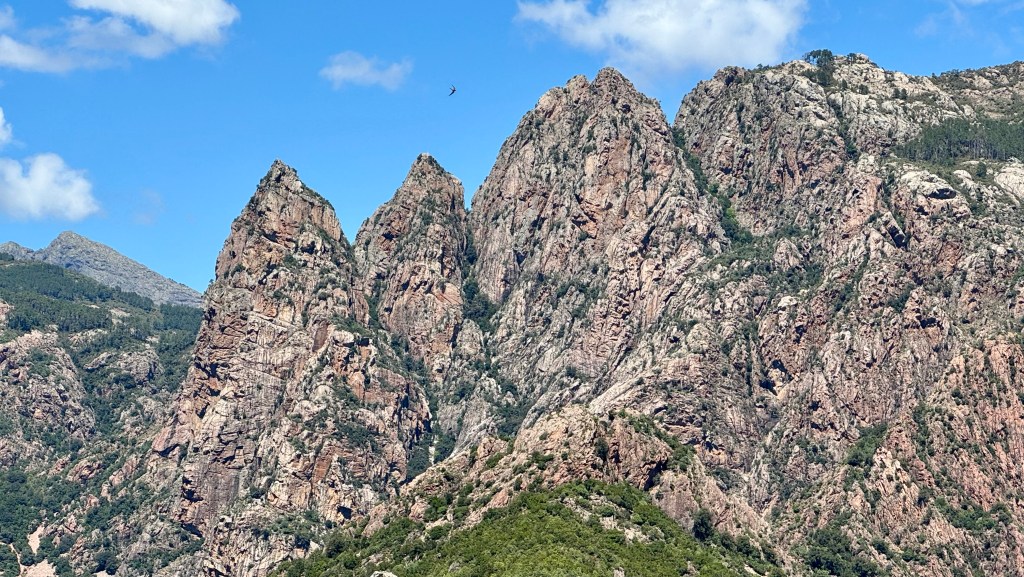
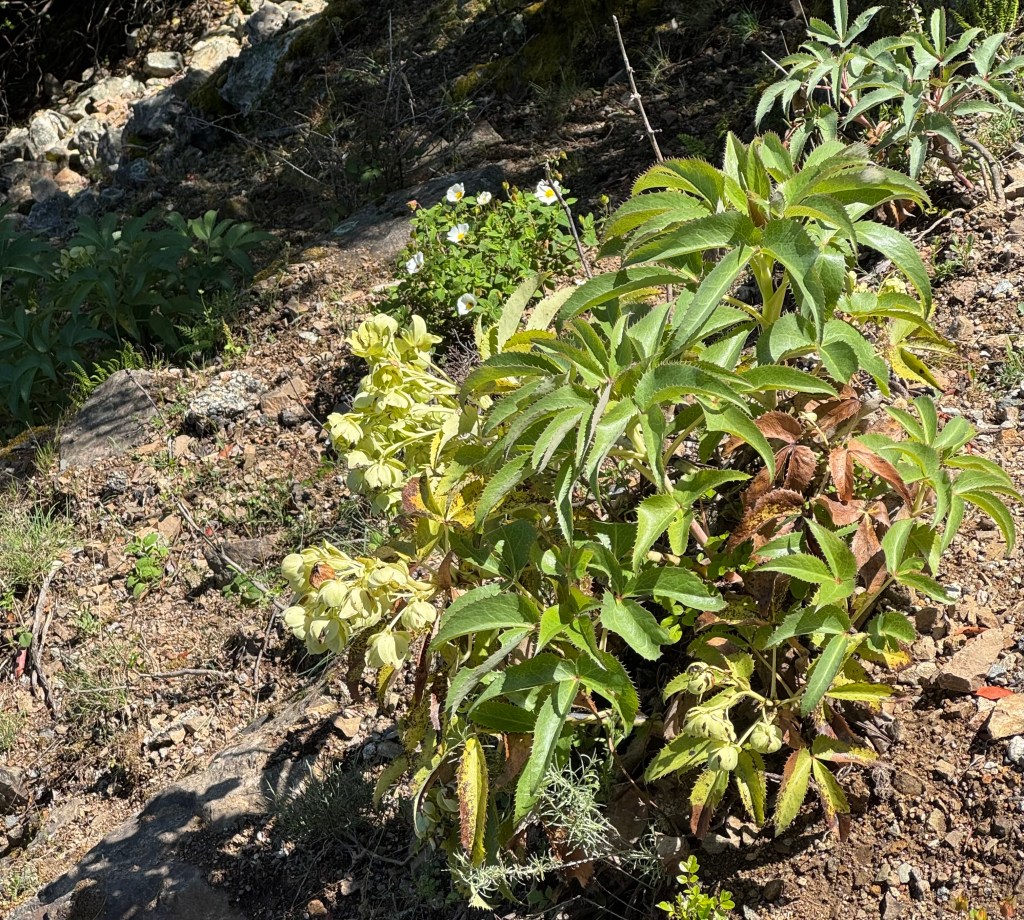
Although Evisa was our target we detoured to Porto, a small harbour from which run many boat trips to Scandola. It supports a large number of restaurants, all serving virtually identical food, which includes American-style pizza. Roll on immigrant Asian chefs! On the way, we stopped for the views and the plants wherever the road widened enough to allow it safely. Pride of place went to the Corsican Hellebore, one of dozens of Corsica endemics. It is larger a pricklier than the 50-year old “Lenten Rose” in my Ottawa garden and occurred beneath broad-leaved trees in several places.
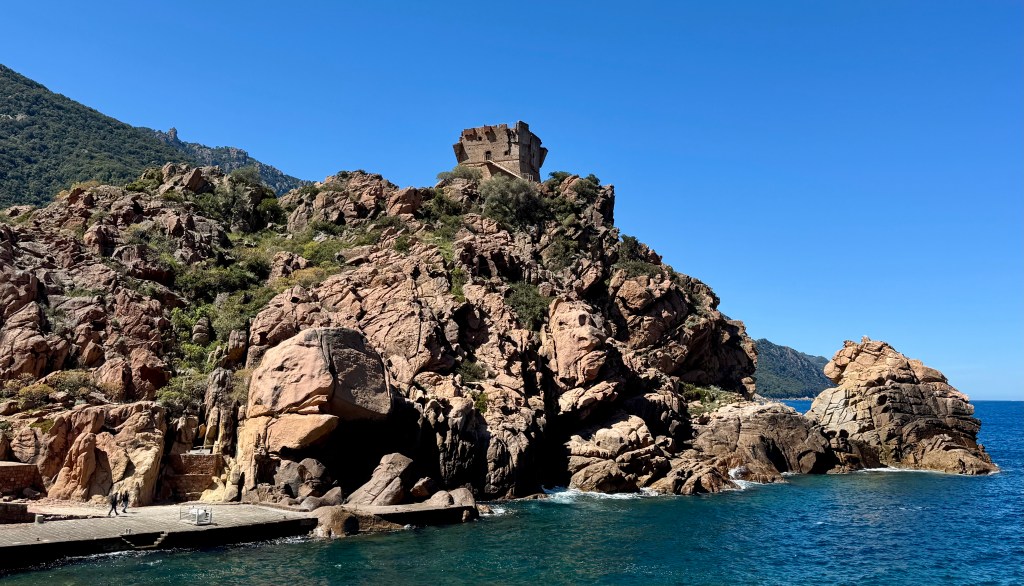
After a rather unsatisfactory lunch in Porto, we drove an hour to Evisa at nearly 900 m in the interior and checked into our “Chambre de charme”. The name seems to be a euphemism for “crouch or you’ll hit your head on the beams”. Evisa is a charming village with lots of stone steps running up and down the steep slope on which the church and houses are situated. Our room is up four flights of very rickety and extremely poorly-lit wooden stairs. The room itself has been modernized as far of the very low ceiling allows but the toilet is separated from the rest of the room just by a canvas screen – intimate, you might say. Like the Palazzu, there is a stand-alone tub, in this case close to the foot of the bed so splashing is not advised.
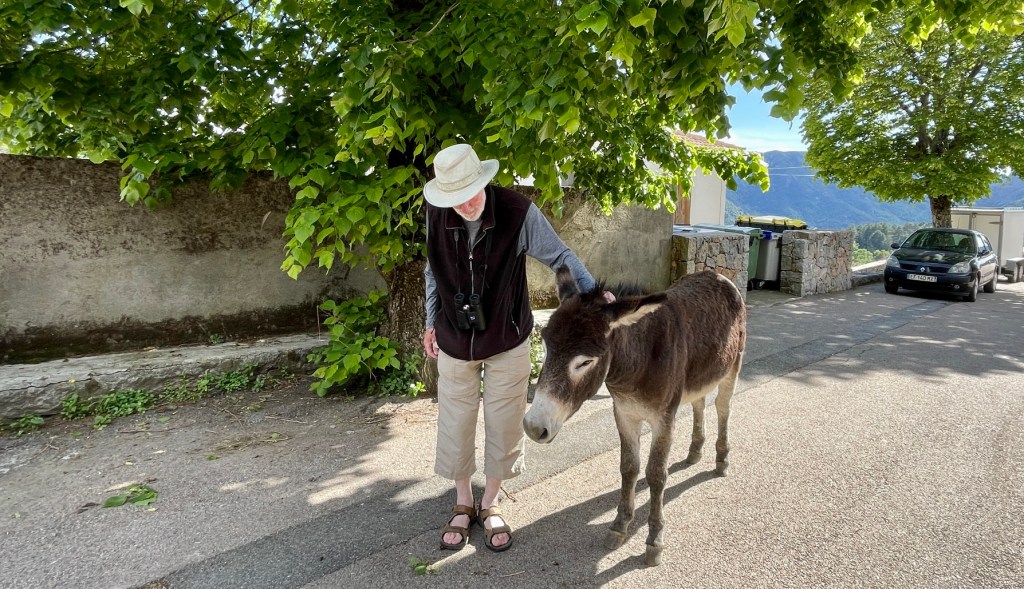
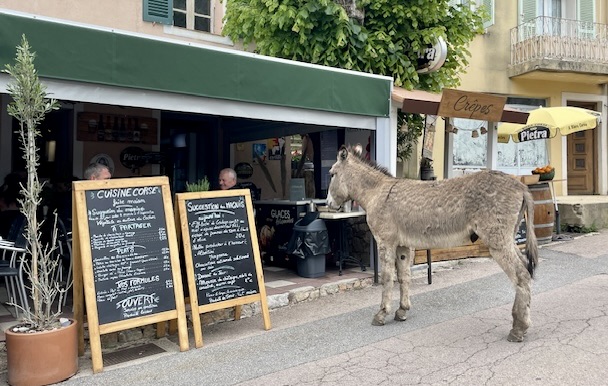
Once settled we sallied out for refreshment and found a place serving chestnut-flour crepes with local honey – excellent! The village is surrounded by chestnut groves including many old trees that have died back and recently begun to put out foliage again, giving the appearance of a forest badly wounded but indomitable. A herd of very tame donkeys roamed the main road looking for handouts…
Friday, 8 May, Evisa
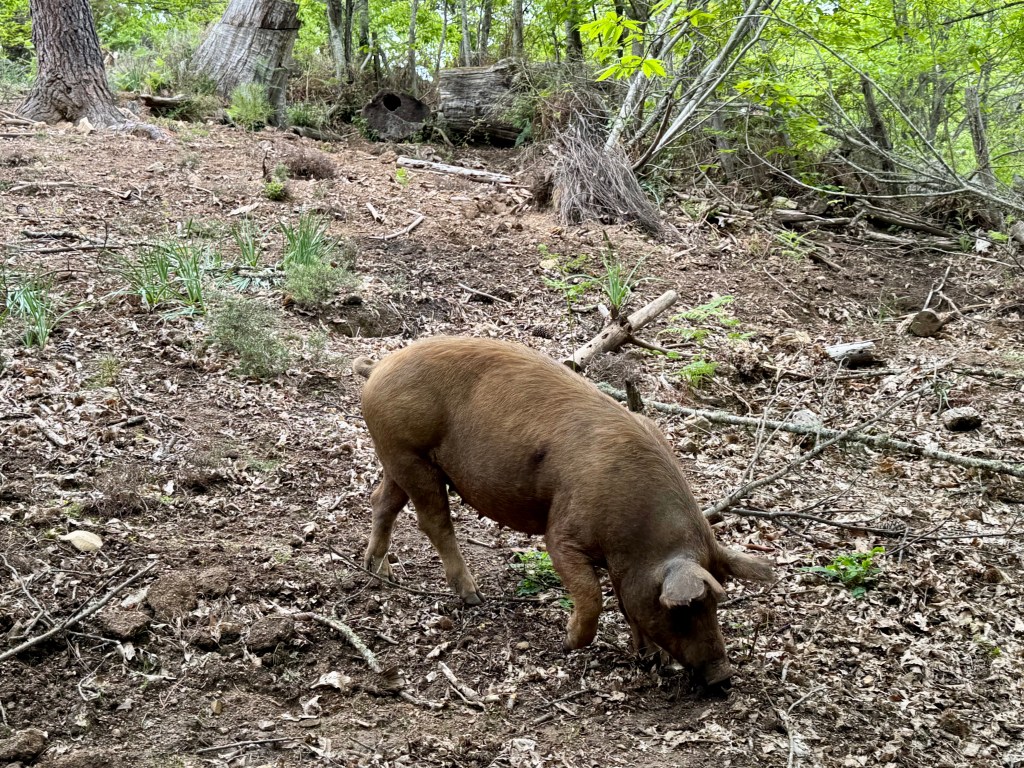
A full day exploring the forests around Evisa. The weather was not promising at the outset but in the end we only had a few drops of rain. In the morning, we took the “Route du Chartaigniers” that winds up a rocky valley among chestnut groves and pine forests. The story of the sweet chestnut in this area is a typical tale of trees in the twentieth century. For millennia the chestnut cultivators of Evisa had harvested the nuts for food and flour and allowed their pigs to root in the forest floor, producing chestnut-fed pork and ham. The trees were heavily pollarded about 3 m above the ground, often grafted with different mediterranean varieties. Then, about 50 years ago, an alien rot fungus arrived and infected the majority of trees: their dead branches still give a slightly haunted appearance to the forest. It may be that the trees, mostly 200-300 years old, were made more susceptible by intensive management. More recently, many of the infected trees have sprouted new branches. We obtained no explanation for this revival.
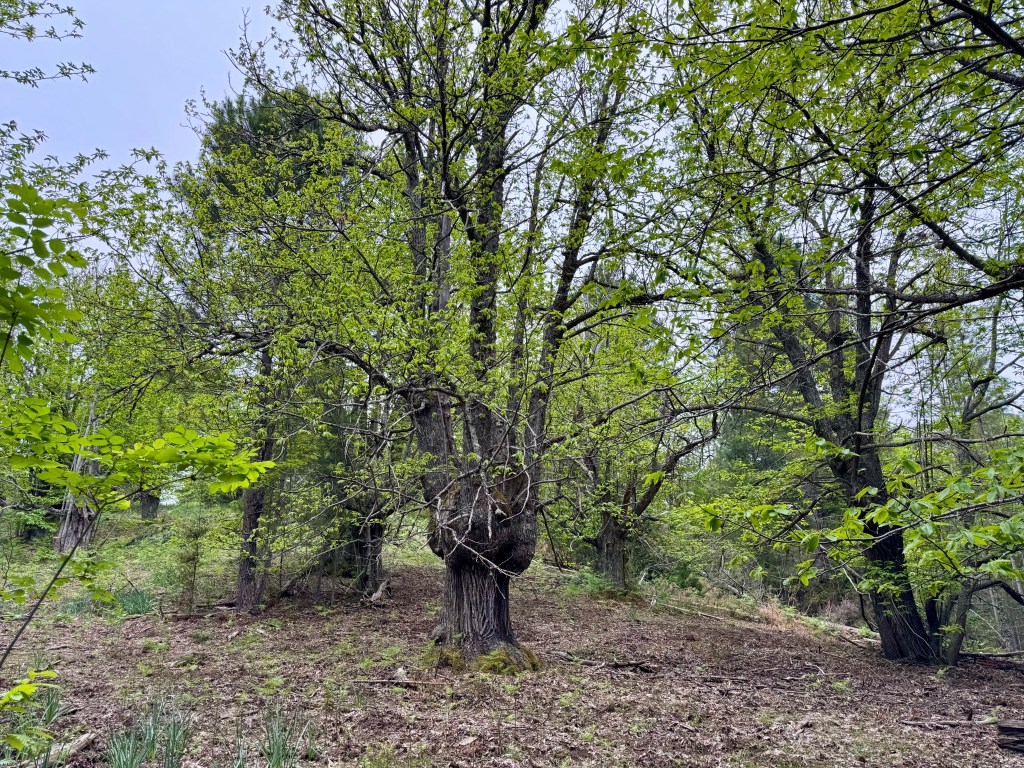
The trail is a popular one and fairly easy. By starting early we saw few other hikers until near mid-day. It runs along an old drovers road and is fenced by ancient, moss-covered, stone walls, in places paved to make steps.
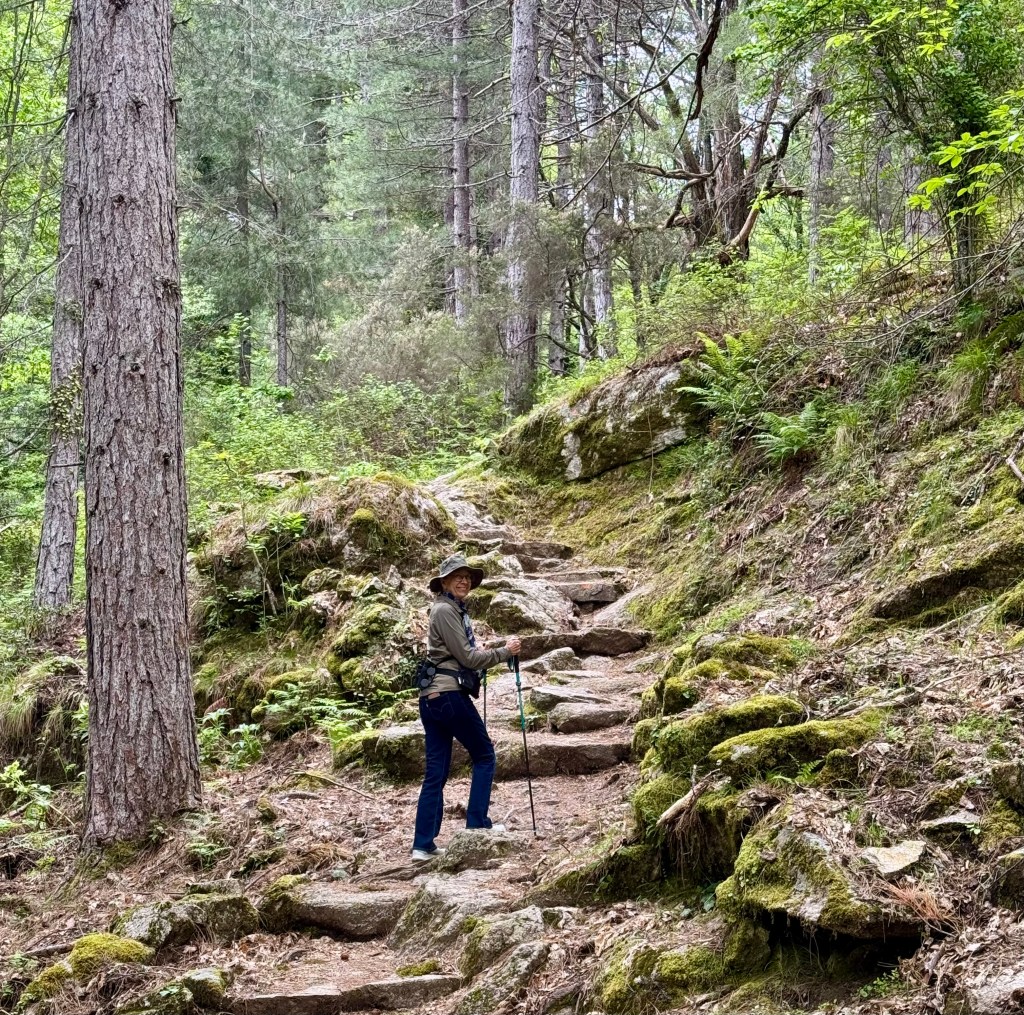
Where the death of chestnuts has opened out the canopy, maritime and black (Corsican) pines have moved in. Their presence alters the ground flora markedly, with grass and bracken replacing the flowers. Corsican or Laricio pines have wonderfully straight trunks and were extensively used for ships’ masts in the days of sail. However, the signage provided by the Park suggested their recent spread is reducing biodiversity. Somehow, nature is never quite the way we want it…
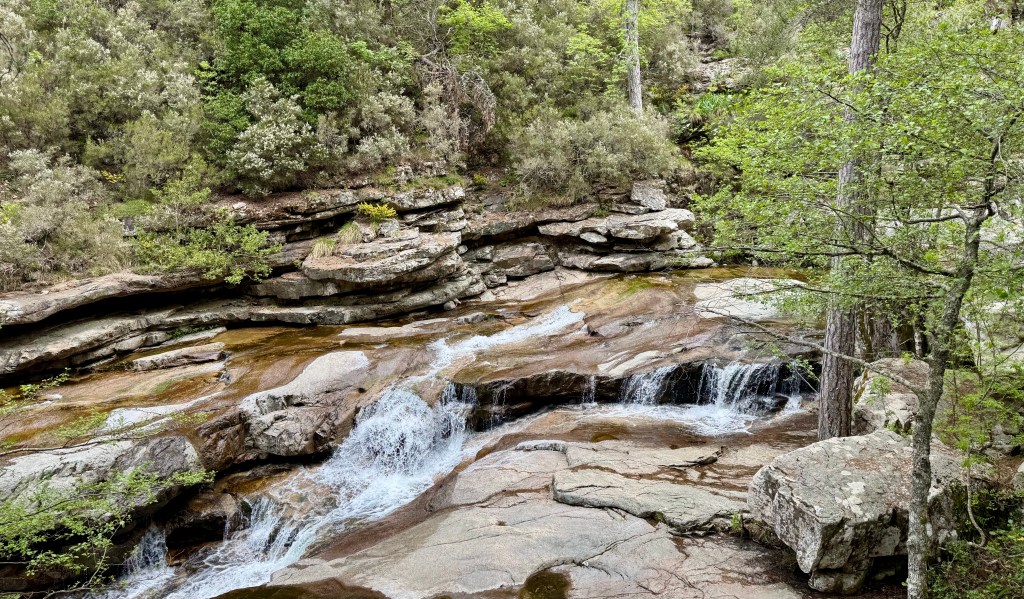
At the furthest point we reached a fine rock pool fed by the River Aitone. By this time there were lots of tourists about, some behaving in such an outrageously risky manner that Angela urged our return lest we witness a serious accident and have to risk ourselves in trying to aid the victim. Not the most noble response to the peril of others, perhaps, but practical in the circumstances.
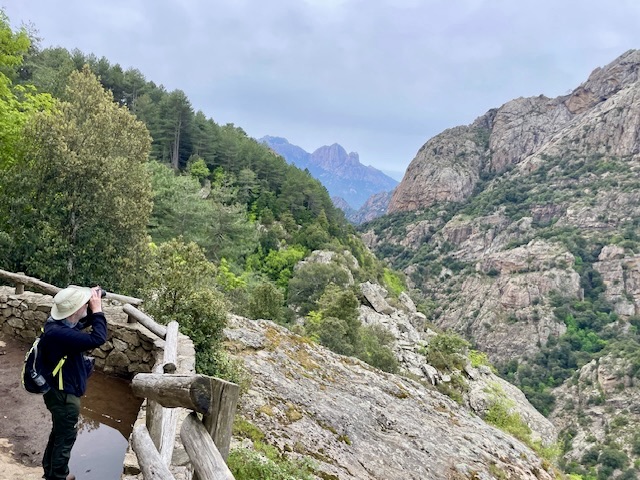
By the time reached Evisa again it was well after one and, having taken lunch, we napped before taking a shorter trail walk after five, by which time there was no one about. We were specifically looking for the Corsican Nuthach, one of two birds endemic to Corsica, but evening was not a good time for bird song and we neither saw now heard them. However, we did find a few more endemic plants. In places, there were carpets of the small cyclamen known as Spring Sowbread – more cyclamens than I ever saw in one place before. Dinner was roast pork with smashed potatoes and salad. I hope that the pig gave itself willingly for our gratification, which was, it must be said, considerable.
Saturday, 9 May, Evisa-Sartene
We had a happy parting from our landlord, a humble and helpful man – or gave a fine facsimile of such – and we managed to get away by nine. Our target for today was Sartene, near the south end of Corsica, but we made a detour to visit the windswept col at the head of the Evisa valley and became embroiled in a cycle race (the Tour de Corsica, perhaps) with dense peletons of riders travelling in the opposite direction to us, accompanied by security cars and motorcyles and ambulances, as well as throngs of well-wishers. This delayed us somewhat. However, I was pleased to see that almost all the electricity we expended on the steep climb to the pass was returned to us on the descent by our brakes: formidable!
Once free of the rally we encountered very little traffic for most of the journey and we found ourselves in some of the emptiest country we had seen in Europe, totally dominated by dense maquis. It was not hard to see how the wartime resistance might have disappeared into this dense, prickly jungle. I can even imagine there may still be maquiards out there somewhere who are unaware the WW2 was won some time ago.
Sadly, the desolate countryside did not yield a restaurant until too late to get lunch (afternoon closure seems to be very strict here), so we made do with take-away roast chicken, being allowed to make use of what appeared to be owners’ living room to consume it. We reached Sartene at 4.30 and checked into the Best Western right beside the convent and the hospital and hence ideally positioned for both spiritual and medical needs. Red Kites soared over our balcony; nightingales sang in the woods below – very formidable!
Sunday, 10 May, Archaeology around Sartene
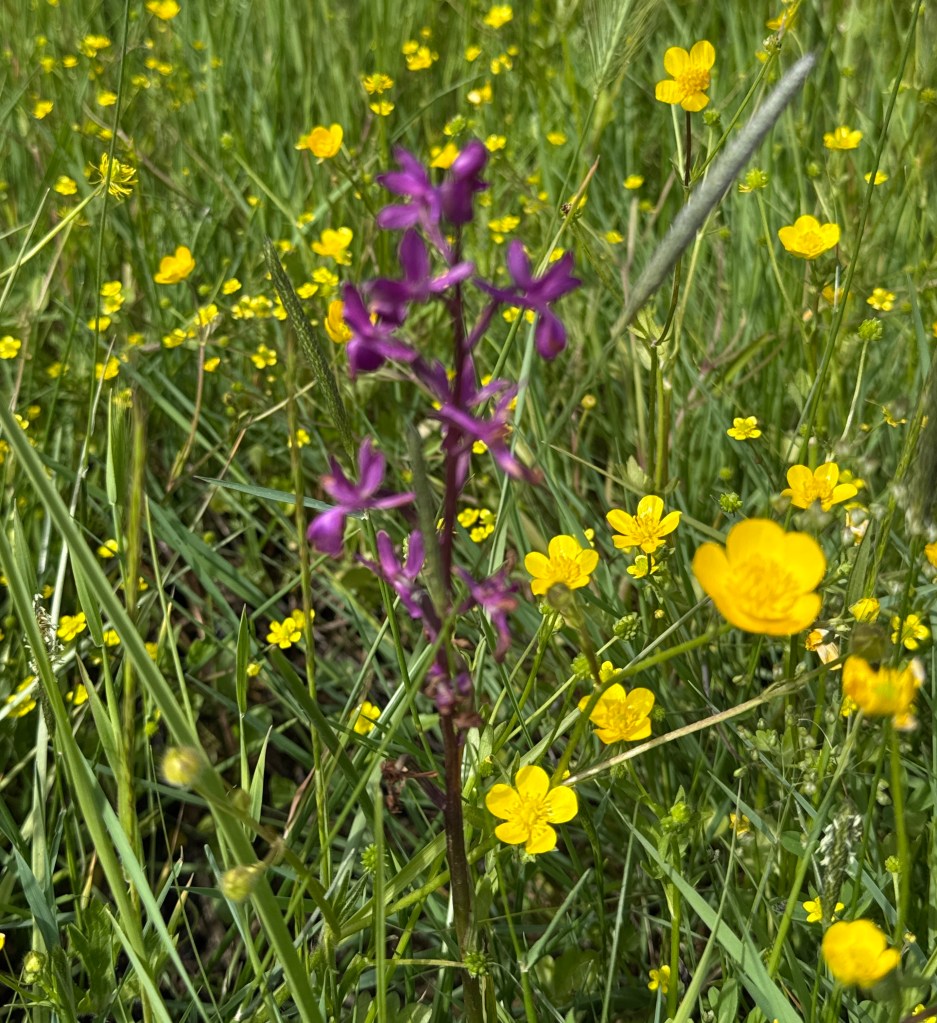
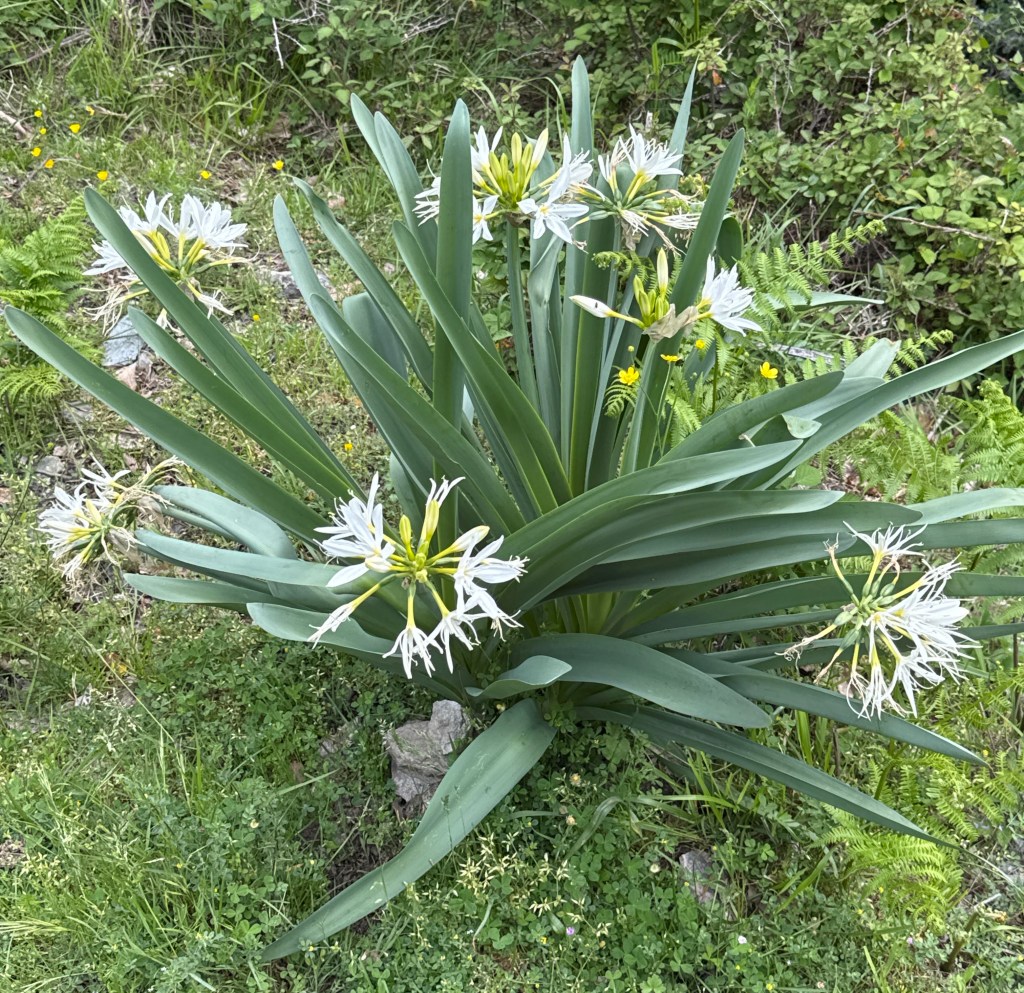
A great day for the bioblitz! The several Stone and Bronze age archaeological sites at Cauria, about 12 km from Sartene, are connected by a nice foot path that runs first down the lane between hedges and then across what I would describe as cork oak Savannah with huge old, spreading cork oaks dotted about the landscape and separated by meadows, which must’ve been incredible in the spring because now they are covered in the seed heads of the Candelabra Asphodel that grows about 3 feet high. We are seeing hectares of Meadow covered in these Asphodels which must be breathtaking when in full flower. On other parts of the meadow, especially where it was a little damp, we found a couple of species of orchids as well as a big variety of herbaceous plants that we had not identified previously. This is definitely the best botanical area we’ve found in Corsica so far. The notice near the entrance to the sites said that the trail took one hour, but what with chasing butterflies and beetles and crawling on our knees to photograph orchids and grasses, it took us about three.
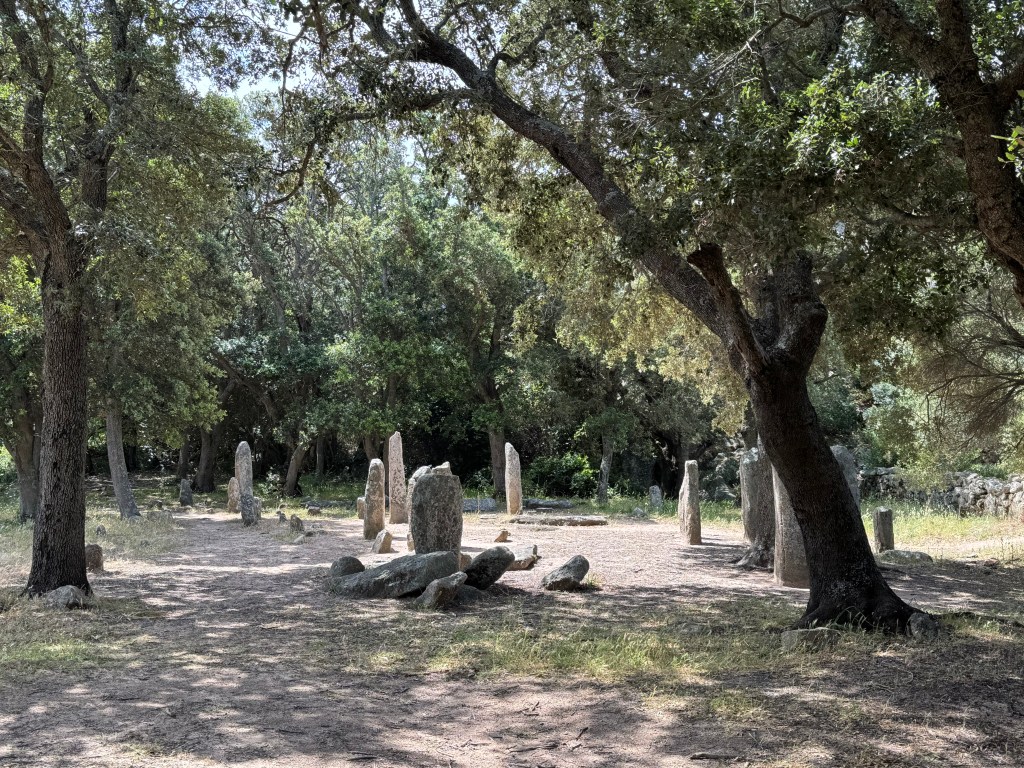
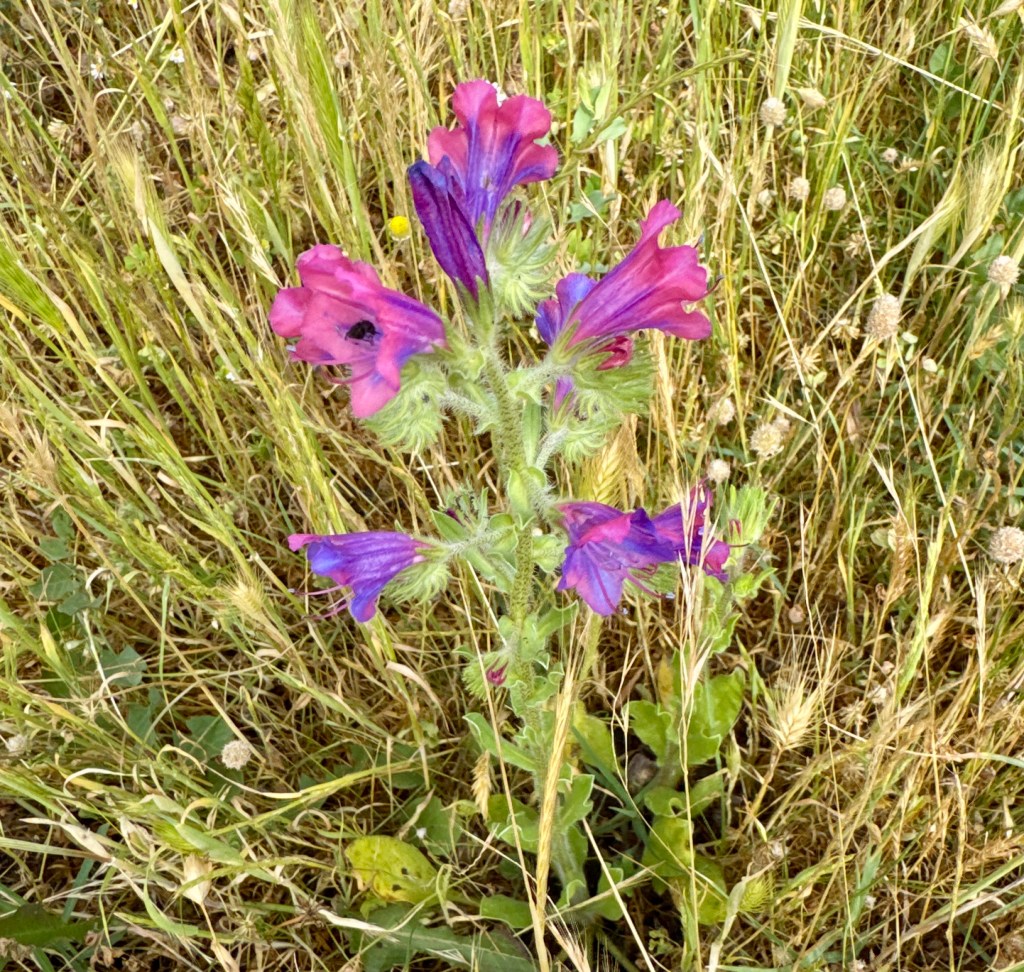
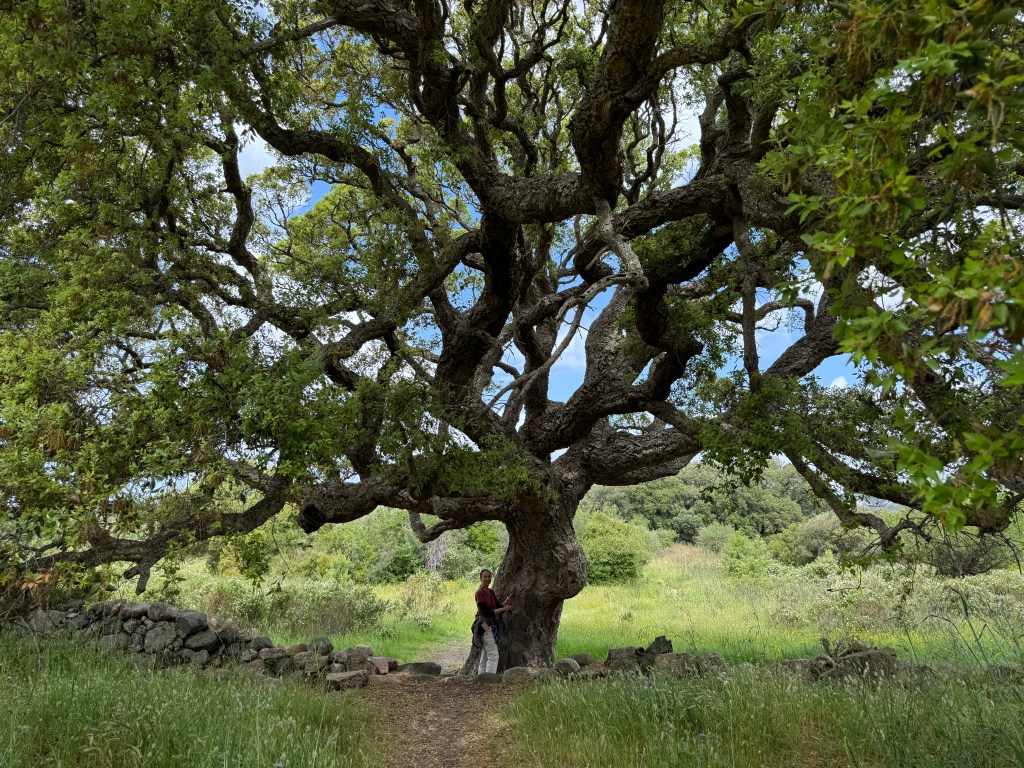
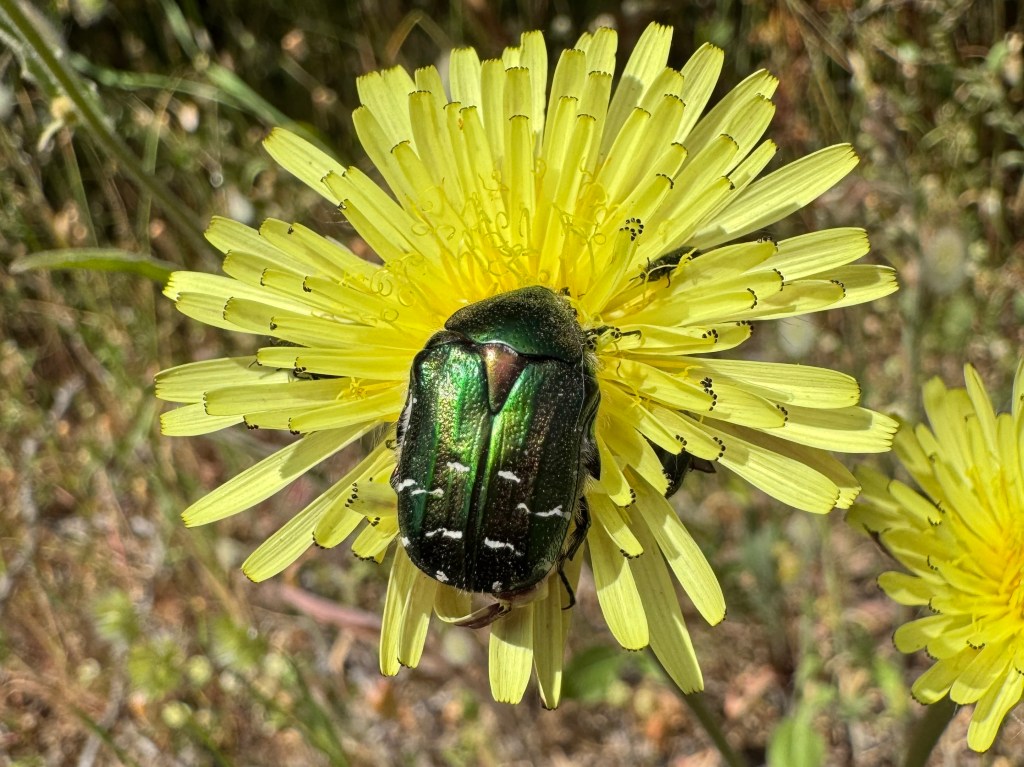
We were very hungry after this strenuous identification session and were lucky to find a good farm restaurant close to Cauria that provided excellent gazpacho and lasagne, sitting in a pleasant garden serenaded by Cirl Buntings. Afterwards, we returned to explore the old town of Sartene which turned out to be a very picturesque jumble of old stone houses intersected by alleyways. The original front doors were on the second floor, accessed by a ladder that was pulled up at night, suggesting that trust in neighbours was fairly minimal when the houses were built. Today the ladders have mainly been replaced by wrought iron stairs.
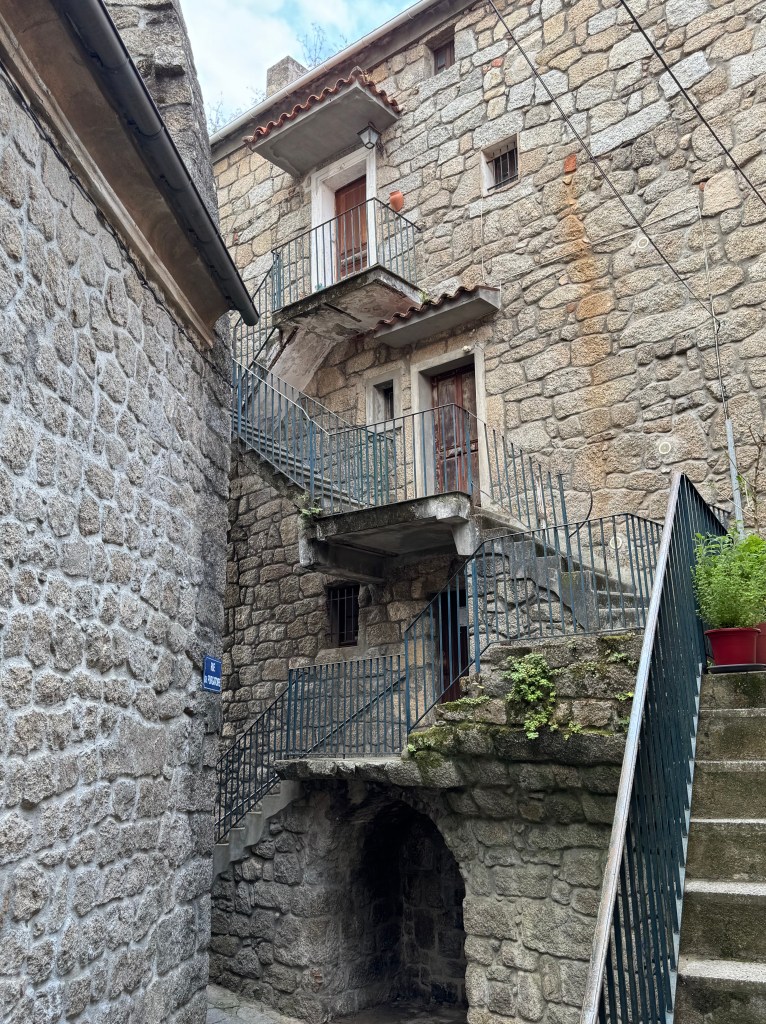
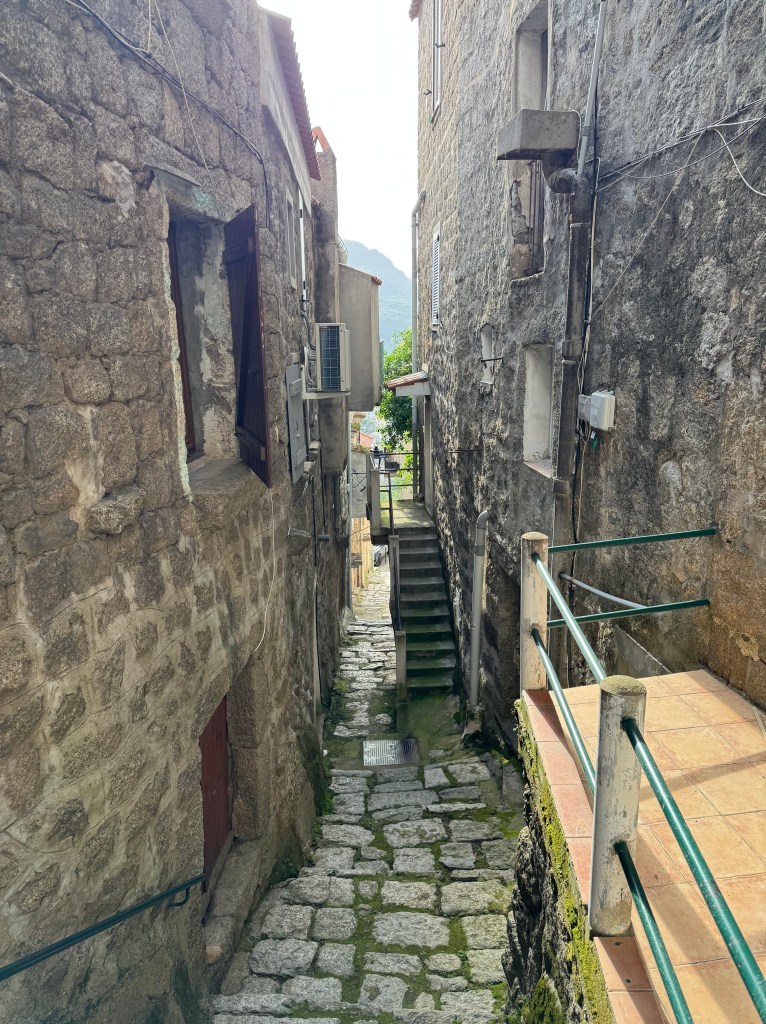
La Vielle Ville, Sartene
Our final venture was to find an EV charging point but the one marked by Google maps turned out to be in the pedestrian square and clearly designed for invalid carriages. Beware this feature of Google Maps! Nice meal in the old town in which “vegetarian” Angela wrestled an enormous pork chop. When in Rome, etc…
Monday, 11 May – Sartene to Corte
Our start today was somewhat delayed by the need to pump up the charge on our EV. Luckily, we found a suitable charger near a restaurant overlooking a fine and little-used sandy beach where we took lunch while are car also got refreshed, after which we took a wonderful windy, narrow road through the mountains to Corte, experiencing some heavy showers on the way. The countryside, like our earlier traverses nearer the west coast, was amazingly empty, with huge vistas devoid of any sign of human agency and very little habitation along the road. For a relatively accessible part of densely-populated Europe, Corsica remains very wild.
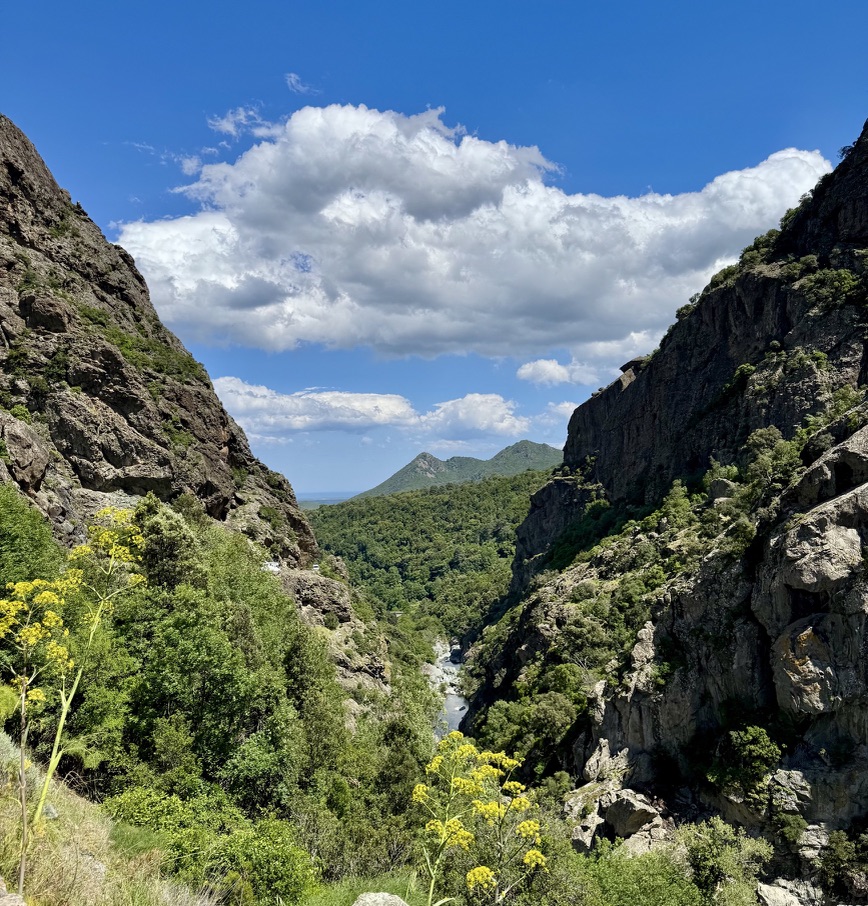
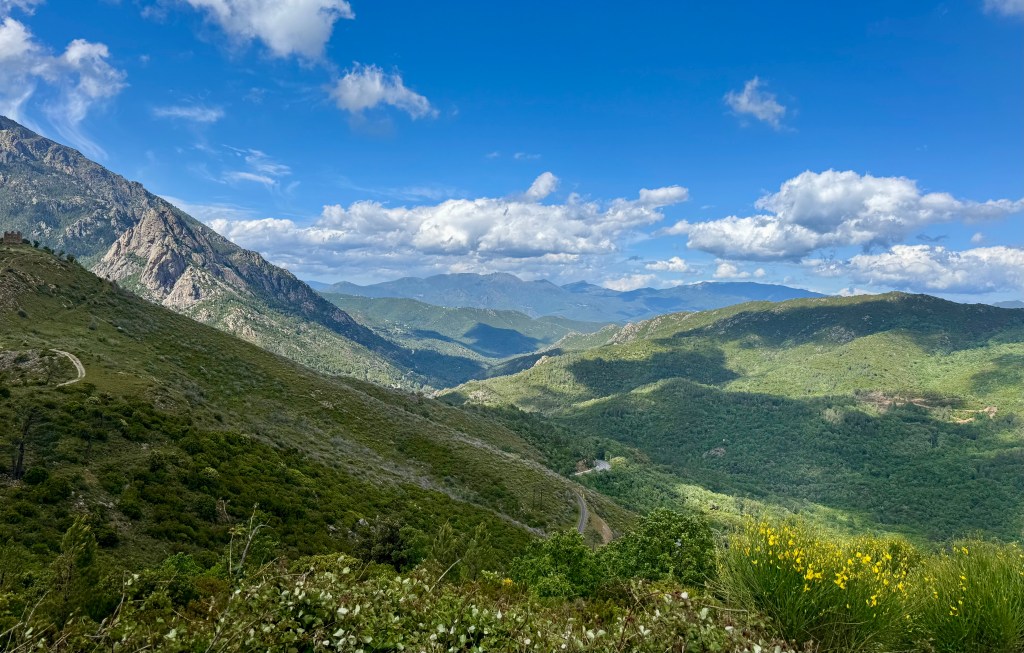
Our guest house at Corte was a 20-minute walk from the old town, which is situated on a steep hill above the deep, rocky valley of the River Tavignani. On the debit side, the hotel was a bit proscriptive, with signs saying “no eating in rooms”, but on the credit side, it had an EV charging point that I was allowed to use overnight and they charged us at their own rate, rather than applying a commercial mark-up. Also, the assistant manager, who came over as rather fussy on first encounter, turned out to be extremely helpful and we warmed up to her.
The main drawback was that we shared the hotel with a gang of a dozen German motorcycle enthusiasts who had come to Corsica, like many others we encountered, to test their riding skills on the winding mountain roads. Motorcycle gangs were a common occurrence in Corsica while we were there and, while in the saddle, did not always behave in ways that Angela deemed to be safe. They comprised mostly middle-aged or older men, well-endowed in the abdominal region, who looked as though they might be small businessmen, plumbers or bartenders. They were polite and friendly when we encountered them but made quite a lot of noise, as males of that type tend to do when away from wives and girlfriends.
Tuesday, 12 May – walk to the Cascades des Anglais and later explore the old town of Corte
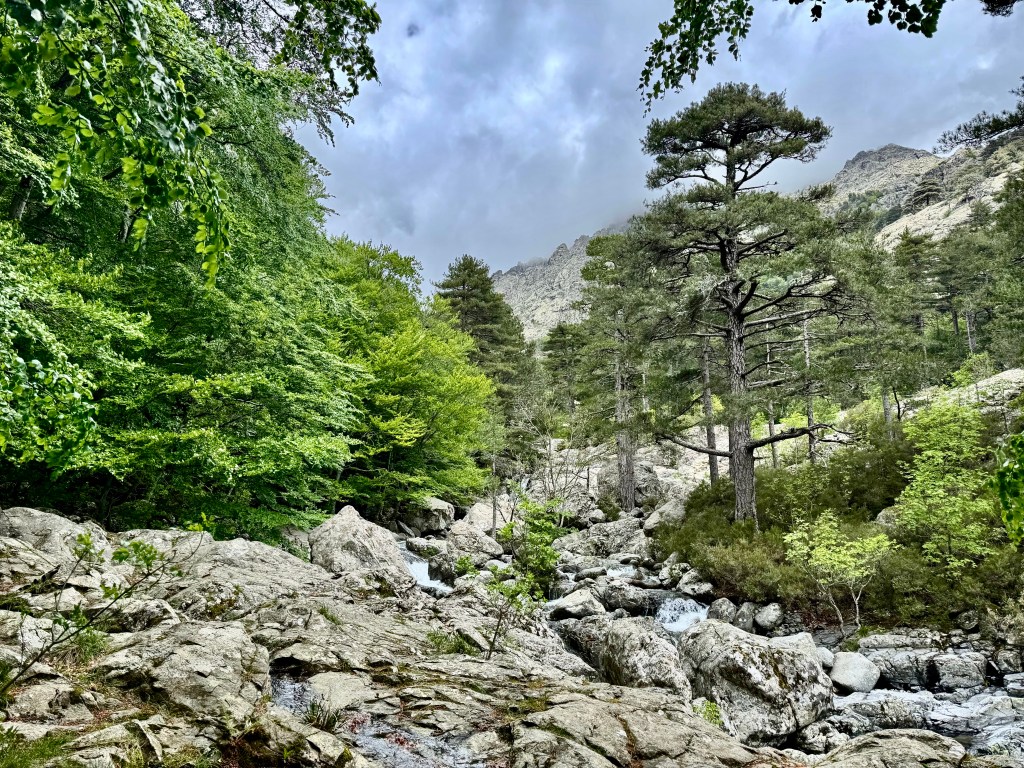
The trail to the Cascades des Anglais is said to be “easy”, which is true most of the way, but the last stretch, where the trail rises up alongside the falls is very bouldery and many boulders were slick from recent rain, so it proved a challenge. The forest here is mainly the European Beech, interspersed with Laricio Pines. Many of the pines are fine, old trees, perhaps 2-3 m dbh (diameter at breast height), whereas most of the beeches are quite young and there are many young saplings coming up. It appears that an elderly pine forest is being replaced by beech and I could see no obvious explanation. However, the combination, along with scattered chestnuts, makes for a very delightful forest.
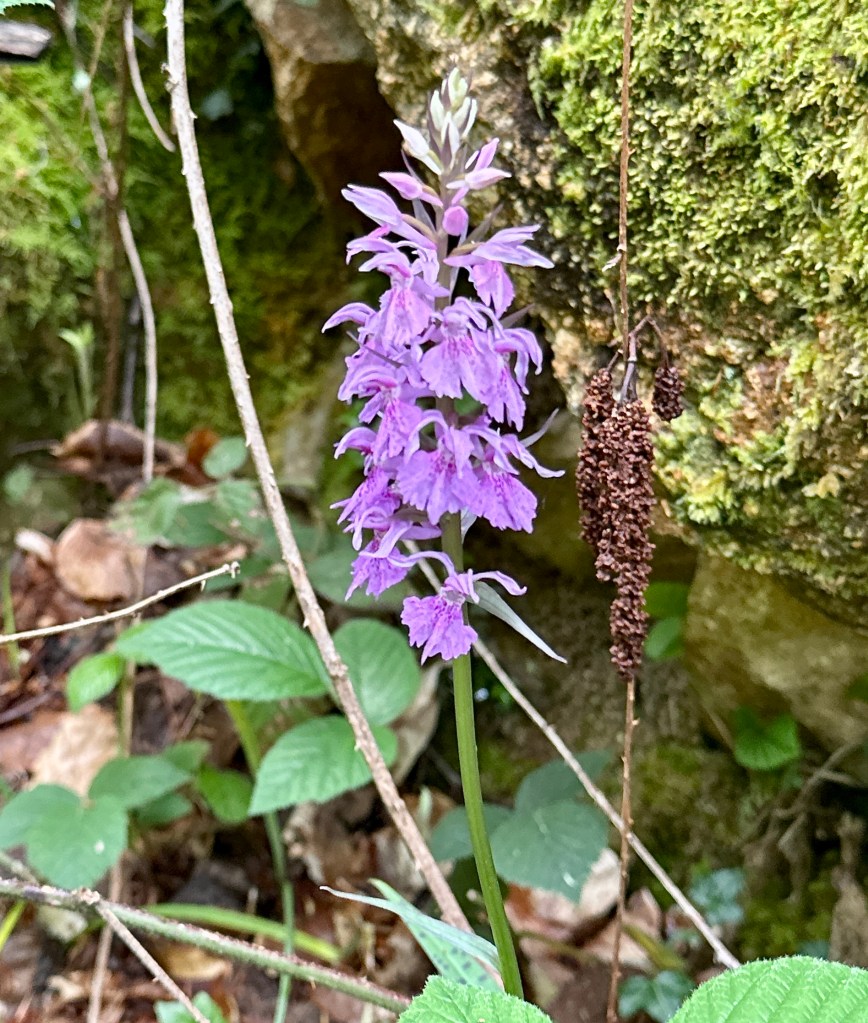
Sadly, the wind blew very hard the whole time we were walking, so seeing or even hearing birds was a problem and we detected nothing new. However, perhaps because of the association with beech, we found many flowers we had not seen, including the wedge-lipped orchid (provisional ID). We finished the hike in the early afternoon and took lunch near Vivario, then returned to Corte and explored the old town before taking our last dinner in Corsica at a very fine restaurant just below the town museum.
Wednesday, 13 May – Corte to Bastia-Poretta Airport, whence we flew via Nice to Heathrow.
We did not need to reach the airport until 1 pm, so we took a small road over a high pass to reach the east coast and stopped in several places to view the flowers. In places there were substantial groves of Cork Oaks and Blackcaps appeared especially prominent there, with a substantial chorus of singing greeting us wherever we stopped.
I had more grief from Sixt when I returned the car but there were no extra charges and I have to admit the price was right, working out to CA$80/day plus a very small cost for the power. Overall, the experience of driving an EV in a rural area with chargers in limited supply was a good one and gave me food for thought on the topic of EVs versus ICEs. Overall, EVs give a great experience and are very easy to drive, but range is certainly a constraint and necessitates greater forethought when travelling away from home, at least as long as petrol is widely available.
The rest of today was a long list of small inconveniences that, added up, came to a very considerable annoyance and we reached our hotel about four hours later than I had anticipated. Given that we had to be up early for our flight back to Canada the next day it was very unfortunate and would have been a lot worse had it not been for a very helpful middle-aged lady who took pity on us after our arrival in Nice and personally escorted us through various security barriers to the light railway that connects the two terminals – an exploit that would have caused us a great deal of hair-tearing had she not offered her services. The rest was too tedious to describe.
Thursday, 14 May – we return to Ottawa
Suffice it to say that today was as good as yesterday was bad. Air Canada even laid on Butter Chicken and Tandoori Roti for lunch! Ottawa was grey, cold and uninviting, reminding us of why we went away in the first place. Finis!
Some final thoughts
As I have mentioned several times, Corsica is very lightly populated compared to most of Europe. In addition, for many centuries two of the main crops were chestnuts and cork, leading to the development of a culture based on forest products and leaving large parts of the landscape that might otherwise have been cleared, covered in trees. This probably led to a more forest-oriented culture than in other parts of the Mediterranean.
Another striking feature of Corsica is the relative paucity of domestic sheep and goats, which form a prominent component of Mediterranean landscapes elsewhere. Their absence may account for the very dense development of the maquis, with virtually impenetrable shrub cover mantling the hillsides. The geology may also help, comprising mostly metamorphic rocks, especially schist, and hence favouring plants of acid soils, which suit many prominent Mediterranean genera such as Cistus and Vaccinium.
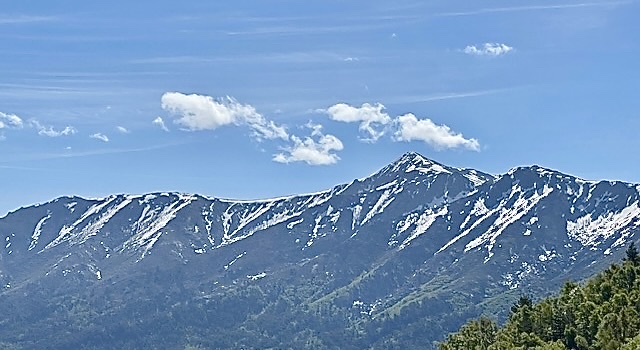
Although the mountains do not reach any great height (max. 2700 m) they are steep and jagged and create scenic awe out of proportion to their altitude. In places there are glacial moraines, presumably left over from the ice ages, but the lower river courses appear to be mainly unglaciated and deeply furrowed into the bedrock, attesting great antiquity.
The towns and villages, although blessed with typical European tiled roofs, are not especially attractive to look at and their main characteristic is a total lack of ornamentation, except for the church towers. The picturesque quality of both towns and villages is definitely reduced by the number of deserted and ruined buildings. On the other hand, for a place subject to a lot of tourism, both towns and countryside are remarkably free of litter. Along the trails where we hiked we hardly saw a piece of plastic or metal: a fine tribute to French ramblers.
In Corte and Sartene, where we wandered the older quarters extensively, self-defence seems to have been a significant consideration. The general state of property in the older parts of both towns suggested that, at present, many buildings are either partially abandoned or are owned by people who cannot afford to spend much on upkeep. Although clean, there was a distinct air of poverty about both towns. In contrast, the old town at Bastia was being extensively renovated.
Certainly, part of the desire to travel is about learning other peoples’ approach to life, but in some cases it is also to revisit practices that our own culture has left behind. At one point I was immensely cheered by the sight of a lone labourer hauling a bucket to the roof of a house by means of a rope and pulley; a system I had not seen since I was quite young but which gave rise in 1958 to a famous Gerard Hoffnung monologue https://www.youtube.com/watch?v=zZUJLO6lMhI that I recommend.
It was clear from posters displayed pretty much everywhere we went that local music traditions are very much alive. In fact, I have a feeling that music is one of the most resilient aspects of any culture, forms persisting for centuries after their invention. I think this may be because the entry investment is so heavy, compared to painting or poetry. After all, everyone speaks, but even the simplest musical instruments take time and effort to learn, and the style studied is inevitably one from the past. Perhaps our most authentic cultural experience in Corsica was a musical one. Passing the open door of a church on our last evening, we heard singing coming from inside. On entering, we found five men, on the young side of middle age, standing in a circle in front of the altar, singing a cappella in polyphonic harmony. All were bass or baritones and their voices were quite rough. It was not the kind of music that I would put on my lifetime playlist, but in that very reverberent space it had a unique feeling, and as we sat listening I felt that I was truly hearing something old and significant. We applauded as we left and they acknowledged with smiles. It was a nice coda for our trip.
Take-aways
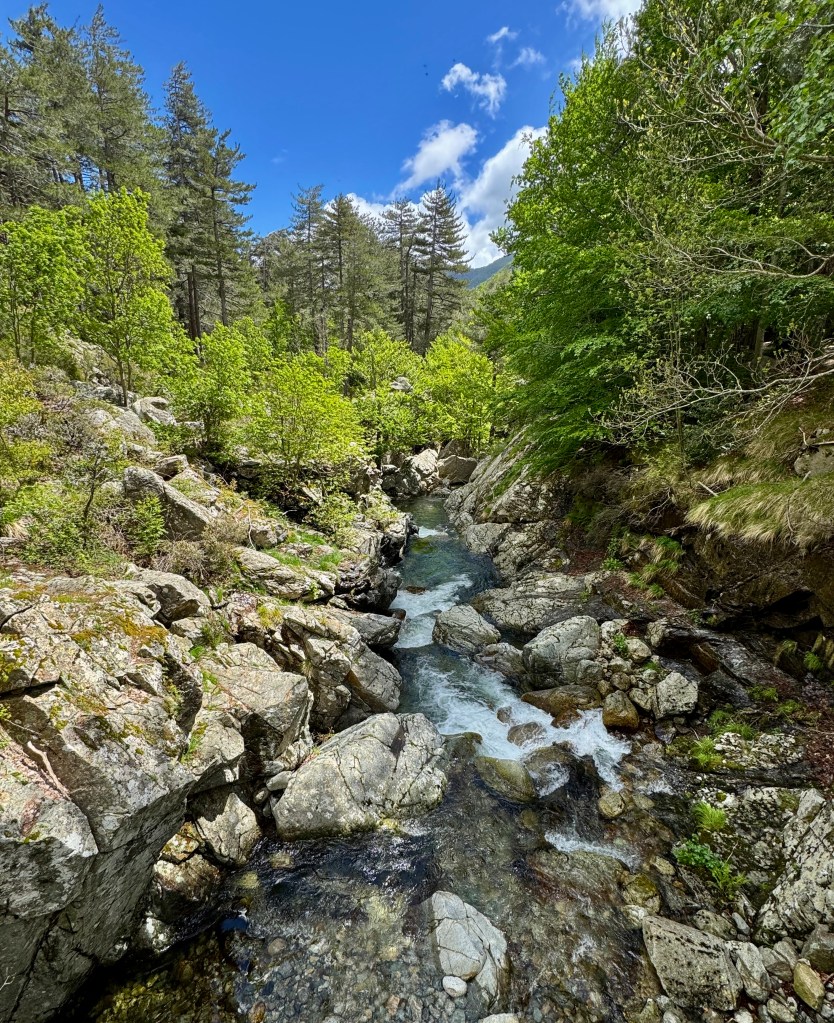
Corsica is amazing for the grandeur of the mountains and the beauty of the rivers and streams. We did not trek, confining ourselves to day-hikes, but it was clear that the many long-distance paths would make awesome multi-day trips for those with the necessary legs. The environment is distinguished for its intactness, rather than its species richness: in the forests and maquis, birds are abundant but not diverse. The land has been occupied by nearly all the great Mediterranean colonists: Phoenicians, Greeks, Romans, Saracens, Genoese, French and even, for a brief time, the English, as well as asserting full independence at periods. However, there are few significant historical monuments (significant for the wider world, that is) and the buildings are less charming than in some parts of Europe. This is definitely a holiday for naturalists and ecologists, rather than those seeking historical sights. For those seeking pristine nature and great trails, Corsica will not disappoint.
 Being ourselves